Bill Hornbuckle’s first purchase for his new life in Las Vegas was a $100 station wagon. It broke down before he could leave Connecticut. For a young person heading toward a city devoted to possibility, this was an awkward review of the business plan. A friend’s father lent him and his two companions a van. They continued west.
He arrived in 1977. The attractions included UNLV’s hotel school, the hospitality business and a climate with considerably less New England in it. He would earn his degree, work in hotels and remain in the city as its ambitions expanded. The vehicle had been temporary. The address proved rather durable.
Today, Hornbuckle is chief executive officer and president of MGM Resorts International. His working geography includes Las Vegas, Macau, digital gaming and a resort under construction in Osaka. Yet the early journey supplies a useful scale for the later one. Before there were international development plans, there was the practical question of how three friends were going to get to Nevada.
The car gave up first
Hospitality had already caught his attention in Connecticut, where he bartended and attended community college. Television helped give the interest an address: a segment about UNLV’s hotel school during a Runnin’ Rebels basketball broadcast. A professor helped arrange a meeting with Dean Jerry Vallen. Hornbuckle and his friends flew out to see him.
The welcome mattered. Vallen was willing to take a chance on them. In Hornbuckle’s recollection, the invitation to attend had a warmth that stayed with him long after he had moved into the business of welcoming other people. The school was sufficiently convincing to turn an interest into a cross-country move.
He came from a military family, had traveled during childhood and grew up in Connecticut. Las Vegas offered another departure. It also offered work. At the Jockey Club, he became a room-service busboy. An industry associated with elaborate evenings began for him with clearing up after somebody else’s.
He graduated from UNLV in 1984 with a bachelor’s degree in hotel administration. By then, the relationship between study and work was firmly established. His education had a campus and a Strip address, with different kinds of instruction available at each.
- 1977Arrives in
Las Vegas - 1984Graduates
from UNLV - 1989Helps open
The Mirage - 2012Becomes
MGM president - 2020Named
permanent CEO
An education in other people’s problems
At the Flamingo Hilton, an assistant hotel manager’s title brought a particularly direct education. Guests arrived with complaints, and he had to work out what to do about them. Hornbuckle later described the assignment as foundational. The job let him see how the business worked through the things that had failed to work for a guest.
That is an exacting place to learn operations. A disappointed visitor rarely wants a tour of the organizational chart. The problem has arrived at the desk, and the person behind it has to connect the visitor’s experience with whatever the hotel can actually deliver.
The assignments grew. He worked with Steve Wynn and was vice president of hotel operations when The Mirage opened in 1989. Later responsibilities included Treasure Island, the Golden Nugget in Laughlin and Caesars Palace. The list charts a career moving through the working machinery of resorts, learning how a property holds together.
He joined MGM in 1998, the same year Jim Murren arrived. Hornbuckle would lead MGM Grand and Mandalay Bay, then take on corporate responsibilities. Marketing brought another perspective: as chief marketing officer, he helped create and launch M life Rewards. The guest was now also a relationship the company hoped to maintain between visits.
“Be patient, first and foremost.”
Bill Hornbuckle, on advice for aspiring leaders
President followed in 2012; chief operating officer in 2019. He became acting CEO in March 2020 and permanent CEO that July. The dates make the ascent look orderly. The number of intervening jobs gives a better sense of its duration. In a 2025 conversation, he joked: “I’m an overnight sensation. 47 years later.”
The city gets a bigger calendar
As his responsibilities widened, Las Vegas acquired more reasons for people to visit. Hornbuckle’s work extended to T-Mobile Arena, the joint venture with AEG, where he serves as president and a board member. He helped bring the NHL’s Vegas Golden Knights to the city. A resort executive’s concerns could now include what happened on the ice.
From 2016 through 2021, he also served on the Clark County Stadium Authority Board, during development of the stadium project that supported the Raiders’ move to Las Vegas. These were collective undertakings, involving public bodies, team owners and commercial partners. They placed him among the people working on the city’s expansion into major professional sports.
For a hotel operator, an arena changes the question that comes before a reservation. A guest needs a reason to make the trip. A game can supply one, and the surrounding stay can involve restaurants, entertainment and rooms. The calendar becomes part of the product.
His industry role now reaches beyond Nevada. In February 2025, the U.S. Travel Association selected him as national chair for a two-year term, succeeding Hilton’s Chris Nassetta. The association’s agenda included making the most of major events such as the 2026 World Cup and 2028 Summer Olympics. Bringing people to a destination had become a national brief.
The next opening is across the Pacific
At MGM, Hornbuckle’s remit covers strategy, operations and development. It also includes choices about what the company owns and how it grows. Major transactions under his leadership included acquiring the remaining interest in CityCenter, taking over The Cosmopolitan’s operations and the MGM Growth Properties transaction with Vici.
The physical resort is only part of the company he runs. Digital gaming gives MGM another way to reach customers, through businesses including BetMGM and LeoVegas. The operating questions change when the guest is holding a phone, but the ambition to keep a customer engaged remains familiar.
Osaka requires a different timetable. MGM’s Japanese integrated resort is targeting a 2030 opening. The company’s July 2026 presentation reported that approximately 60 percent of its foundation piles had been completed, with concrete slab and structural steel work progressing. A future destination was acquiring the less glamorous prerequisites of an actual building.
Hornbuckle’s own timetable is connected to that project. In May 2025, MGM extended his employment agreement through the end of 2028 and agreed to offer a subsequent advisory arrangement supporting Osaka until opening. The agreement makes room for a handover while keeping his experience attached to the development.
The current business still demands attention. In the second quarter of 2026, MGM reported about $4.5 billion in consolidated revenue, up 1 percent, while consolidated adjusted EBITDA fell to $610 million from $648 million. Growth arrives with complications; a larger revenue figure does not settle every operating question.
Another appointment widened his professional circle in 2026. Vail Resorts added him to its board, effective August 3. The setting changes from the Strip to ski destinations, while the underlying experience of running resorts, understanding guests and coordinating complicated operations travels reasonably well.
An electricity bill with a desert address
The scale of a resort business also appears somewhere less theatrical: its demand for power. In 2021, MGM launched a 100-megawatt solar array north of Las Vegas. Its 323,000 panels were intended to supply up to 90 percent of the company’s Las Vegas daytime electricity needs under the conditions described at launch.
In January 2026, the company said the addition of the Escape Solar and Storage Project, combined with that array, could supply up to 100 percent of daytime electricity needs at its Strip resorts. Daytime is a meaningful qualification in a city with such enthusiastic evenings.
For Hornbuckle, these projects sit alongside the more visible business of openings and entertainment. The same portfolio that puts on a show has to power its buildings. Expansion brings the less photogenic obligations along with the ceremonial scissors.
The debt he was asked to pass along
A smaller story explains another use of his position. Hornbuckle learned, years after attending Catholic school, that his family had been unable to afford the tuition. The school had kept him enrolled. When he tried to repay the help, an administrator encouraged him to establish a fund for other students.
In 2004, he and his wife, Wendy, created an endowed scholarship fund for Nevada students pursuing hospitality degrees at UNLV. The support returned to the institution that had helped bring him west, with the next opportunity going to somebody else.
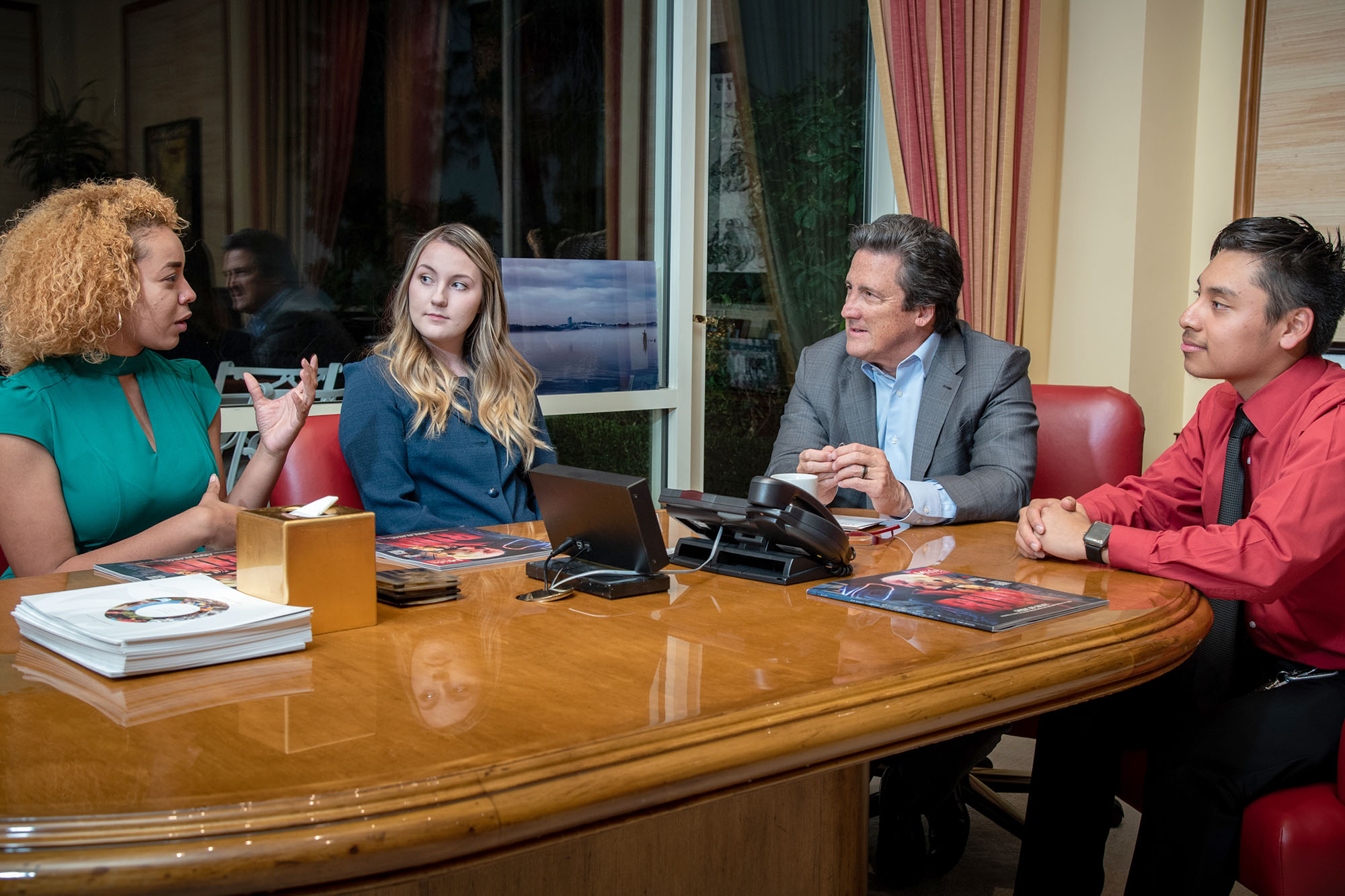
His community commitments include Three Square Food Bank and the Fulfillment Fund. There is a banking connection, too: he helped found the institution now called GBank and serves on its holding-company board. The hotel career has produced relationships well beyond the hotel.
Sometimes those connections are personal and hard to measure. Alex Dixon, later chief executive of Resorts World Las Vegas, recalled meeting Hornbuckle when he was running Mandalay Bay. The conversation did not produce a job. Dixon nevertheless remembered it as a consequential moment in imagining his own future in hospitality.
That is a fitting detail in a career whose early turns depended on people willing to help: a professor who could arrange a meeting, a dean who made an invitation, a friend’s father with a van. Las Vegas supplied the setting. Other people helped make the journey possible. The station wagon’s contribution was brief, but it did leave Hornbuckle with an opening story that no limousine could improve.