Mark Wang went to Hawaii with little money. He stayed for 27 years. In a business devoted to persuading people to take a break, his own consequential journey became a very long working visit. The islands gave him somewhere to build companies, learn the vacation ownership business and, eventually, begin a career at Hilton. Long before Orlando became his base, Hawaii was where the work took root.
“I actually took a big risk when I went to Hawaii,” he recalled in 2024. He had been working for a small company and decided to try his chances elsewhere. The sentence has the plainness of someone describing a decision before it acquired the flattering label of a career move. At the time, it was a move. The career followed.
The entrepreneurial years matter. Before Hilton recruited him, Wang co-founded PAHIO Resorts and founded Aloha Resorts International. His experience was in creating and running resort businesses. There is a useful distinction between selling someone a holiday and operating the place where they will spend it. Wang’s early companies put those activities in the same working life.
Japan entered that life early, too. In 1987, he introduced the U.S. timeshare product to the Japanese market. That date places his involvement well before the current round of Japanese resort openings. For Wang, the relationship between Hawaii and Japan has been a career-long commercial connection, one that would keep returning as his responsibilities grew.
A comfortable office, then a telephone call
He joined Hilton in 1999 as managing director in Hawaii, subsequently taking on responsibility across Asia Pacific. In March 2008 he became president of Hilton Grand Vacations. The promotion brought a geographical adjustment: he moved from Hawaii to Orlando. After nearly three decades on the islands, his work now required a different view from the office.
Wang later made a small comedy out of the change. Speaking to investors in December 2016, he remembered Chris Nassetta calling him to Beverly Hills for a conversation. Wang had enjoyed a “really cushy office in Hawaii.” A summons to discuss the future apparently came without a full advance explanation. Even a senior executive can discover that the next meeting is about his next address.
At the same gathering, he teased the audience about whether people who had stayed for his presentation deserved a prize. It is a modest glimpse of his public manner: a little teasing before the numbers. He also opened his account of the business with a video of members, giving the customers a speaking part before the executive presentation began.
The responsibilities kept widening. Alongside leading HGV, Wang served as Hilton’s president of global sales from 2013 to 2014. That dual assignment connected the vacation ownership operation with the wider hotel business. It also helps explain why the Hilton relationship runs so consistently through his later decisions, even after HGV became an independent company.
“really cushy office in Hawaii”
Mark Wang, recalling the office he left behind
The bell and the business behind it
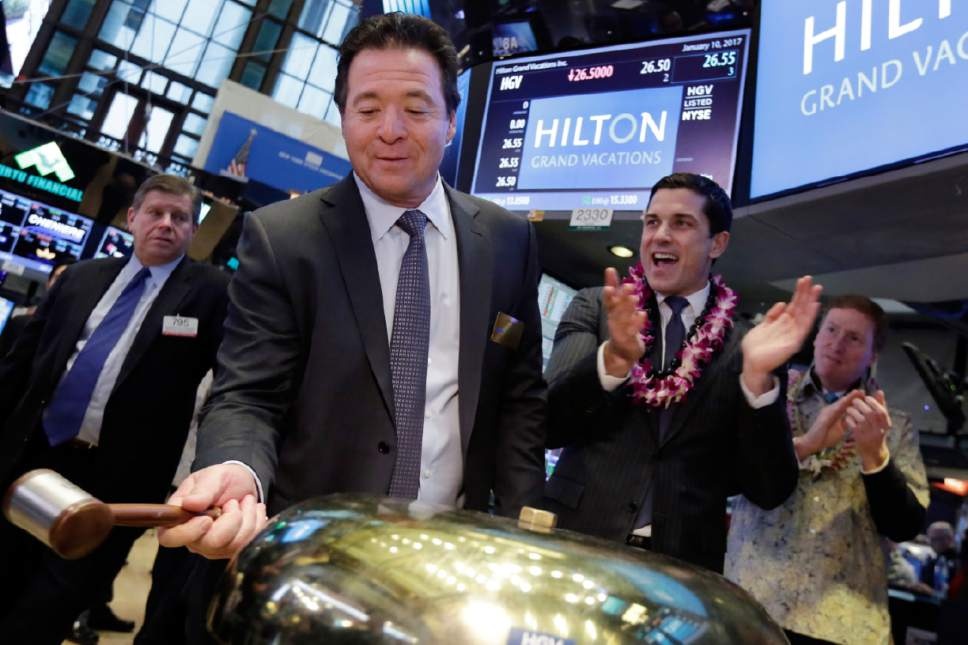
On January 4, 2017, Hilton Grand Vacations began trading independently following its separation from Hilton. Six days later, Wang and chief financial officer James Mikolaichik joined colleagues and board members at the New York Stock Exchange to ring the opening bell. Vacation ownership had acquired its own public-company stage, complete with a timetable that left little room for island time.
HGV then had 47 resorts and more than 260,000 club members. Those figures establish the scale of the responsibility Wang took into the public markets. He had already been running the division for years; becoming CEO of the independent business added a separate shareholder audience to the owners, guests and employees already depending on its performance.
The Hilton name stayed central. HGV operates through an exclusive licensing relationship with Hilton, combining a separate corporate identity with a familiar hospitality brand. Wang’s job involves making that arrangement useful in practice: through developments, marketing and places members actually want to visit. Corporate independence still leaves considerable value in a well-known name above the door.
The destinations were changing as well. In September 2018, Wang cut the ribbon at The Residences by Hilton Club atop the New York Hilton Midtown. Its 47 units drew design inspiration from penthouses where Conrad Hilton had lived. This was an urban version of vacation ownership, with Central Park nearby rather than a beach outside. Wang was expanding the menu of reasons to return.
Two deals, many more front doors
The acquisition of Diamond Resorts closed on August 2, 2021. The stock-based transaction had an equity value of approximately $1.4 billion and brought more than 380,000 additional owners into HGV. An acquisition of that size changes a company’s daily work as much as its presentation slides. More owners mean more relationships to maintain across a larger collection of destinations.
Bluegreen Vacations followed on January 17, 2024. This time, total consideration was approximately $1.5 billion, including net debt. The distinction matters: the two headline prices describe different measures. Bluegreen added about 200,000 members, extended the portfolio to nearly 200 properties and brought destinations in eight additional states and 14 new geographies.
It also brought relationships with Bass Pro Shops and NASCAR. Those connections broadened where HGV could meet prospective customers and the interests around which it could build trips. For a resort operator, a new address is one kind of expansion. A new route to the person who might book that address is another.
The management structure changed alongside the portfolio. In March 2024, Dan Mathewes became president while retaining his chief financial officer role, and Dusty Tonkin was appointed chief sales and marketing officer. Wang remained CEO. Mathewes took a closer role with sales and local marketing as Bluegreen integration proceeded. The division of responsibilities reflected the work the enlarged business needed to get done.
- 2017A separate companyHGV begins independent trading.
- 2021Diamond ResortsAcquisition closes August 2.
- 2024Bluegreen VacationsAcquisition closes January 17.
A fan with a business to run
Wang’s enthusiasm for Formula 1 gives the vacation business a more personal register. His first race was the Long Beach Grand Prix in 1980; he also attended the Las Vegas race in 1982. By the 2024 Las Vegas Grand Prix, he counted 29 races attended. When the modern circuit came close to HGV’s Elara property, a longstanding interest and a business opportunity found themselves on the same street.
There is a limit to how much any sporting weekend can explain a chief executive. Still, it gives a revealing piece of texture to a career otherwise described in appointments and acquisitions. Here was an executive who could talk about the event as a customer as well as an operator. An itinerary looks different when you have spent decades wanting to be there yourself.
The broader question of how timeshares are presented has also taken Wang into public discussions with competitors. In March 2023, he joined Travel + Leisure Co. CEO Michael D. Brown for a discussion about modern vacation ownership. The subjects included flexibility, changing customer expectations and the experiences available through membership. These are practical questions for an industry whose product asks people to think beyond a single booking.
The work between the openings
The public-company calendar provides less festive occasions than a bell-ringing or a race weekend. In July 2026, HGV reported second-quarter contract sales of $810 million and revenue of $1.358 billion. Net income attributable to stockholders was $12 million. These are different measures of the business, and placing them together gives a fuller picture than choosing whichever figure looks most agreeable in large type.
On the earnings call, Wang discussed execution problems in Orlando and Myrtle Beach. He described leadership changes and additional recruiting and training investments. His explanation placed responsibility on how the business was operating, rather than treating every disappointing result as something imposed from outside. Whether those actions deliver is a continuing operational question, not something a new resort opening settles.
“We had some execution misses in a couple of our markets,” he said. It is a useful sentence to set beside the ceremonial photographs. Hospitality leadership includes the repeated, fairly unglamorous task of correcting performance in specific places. An acquisition can be announced on one morning; making the combined organization work takes many more.
Back to Hawaii, with a longer horizon
Wang’s attachment to Hawaii has extended beyond developments. Following the 2023 Maui wildfires, he spoke about the personal significance of the islands and HGV’s involvement in relief and recovery. He had lived and worked there for more than a quarter of a century. In that context, a destination on the company map was also a community with which he had a long relationship.
Japan supplied one of 2026’s new chapters. Tradimo Kyoto Gojo opened in March as HGV’s first Kyoto resort and third property in Japan. Its 63 one-bedroom suites occupy a reworked building whose design draws on local materials and the idea of kintsugi. Nearly four decades after Wang’s early work with Japanese buyers, HGV was adding another place for members to stay within Japan itself.
Then, on October 2, came Ka Haku in Waikiki: HGV’s first Hilton Club property in Hawaii and its 14th resort in the state. It opened with 205 suites. The project also included a $1 million company contribution toward improvements at Kuhio Beach Park. The opening connected a new accommodation business with investment in a public space used by visitors and residents.
Wang’s stated plans emphasize continued growth, operating efficiency and cash generation, alongside more choice for members. Those ambitions now have a much larger organization attached to them than the businesses he began in Hawaii. Yet the geography keeps circling back. The young arrival who stayed for 27 years became an executive whose next opening could still bring him back to Waikiki. For someone in the vacation business, he has made a considerable career out of returning.
Keep following the story
Hilton Grand Vacations ↗Mark Wang on LinkedIn ↗Watch: Wang and Michael D. Brown on vacation ownership ↗Listen: the Chief Travel Leader conversation ↗Read: the Formula 1 interview ↗Ka Haku’s October 2026 opening ↗Second-quarter 2026 results ↗From HGV