A factory is an argument between repetition and surprise. The machines repeat. Materials arrive with tiny differences. Temperatures wander. Tools wear. Operators make judgments. Somewhere inside that commotion, a perfect-looking routine begins producing imperfect parts. The line can record the symptom in a thousand columns of data. The expensive part is explaining why it happened.
Bernhard Kratzwald has built a career around that stubborn word. As co-founder and chief technology officer of EthonAI, he works on software meant to connect the scattered evidence of production - sensor readings, process histories, quality images, orders and machine events - and turn it into a cause an engineer can inspect. His subject is artificial intelligence. His setting is the factory floor, where a persuasive answer without evidence is merely a faster route to more scrap.
The route here began far from a production line. Kratzwald, an Austrian citizen born in 1991, studied computer science at TU Wien, briefly studied law at the University of Vienna, then moved to Zurich in 2015 for a master's in computer science at ETH. He later wrote that he had expected to leave the city as quickly as possible. Instead, Zurich kept him for roughly a decade and gave his work its durable shape.
“I came to Zürich for my master’s, fully expecting to leave as quickly as possible.”Bernhard Kratzwald, reflecting on a decade in the city
The useful problem hiding inside a thesis
Kratzwald's doctoral thesis examined domain adaptation in neural question answering. In ordinary language, it asked what happens when an AI trained on one kind of question is confronted by another. Models tend to flourish in the tidy country of their training data. Reality has border crossings. Vocabulary changes, examples grow scarce and old assumptions lose their passports.
His research proposed systems that could transfer with limited labeled data, learn from user feedback after deployment and remain useful as a domain shifted beneath them. During the doctorate he spent four months at Huan Sun's lab at The Ohio State University, worked with Stefan Feuerriegel at ETH, and published research on document retrieval, answer re-ranking, continuous learning and verifiable knowledge-base completion. The papers were about language, but the underlying preoccupation was practical: how does a system produce a reliable answer when conditions refuse to stay familiar?
One question, two domains
A factory is domain shift with a roof. One production line differs from the next. A new product arrives. A supplier changes. The night shift and the morning shift inherit different conditions. A model that recognized yesterday's defect may never have seen today's. The translation from Kratzwald's doctorate to manufacturing was not literal, but it was remarkably direct.
Research meets the line
At ETH, Kratzwald began collaborating with Julian Senoner, a doctoral researcher studying manufacturing applications of AI, and Torbjørn Netland, professor of production and operations management. Work with Siemens gave the researchers access to the untidy reality of production. They could test not just whether an algorithm performed, but whether it helped the people who had to make a decision while the line was running.
The early idea joined visual inspection with root-cause analysis. A manufacturer could show the system examples of acceptable products, then use it to detect unusual surface defects, including patterns not cataloged in advance. In parallel, process data could help engineers investigate which upstream variables were associated with a quality problem. The ambition was to shorten the distance between seeing a defect and understanding what had produced it.
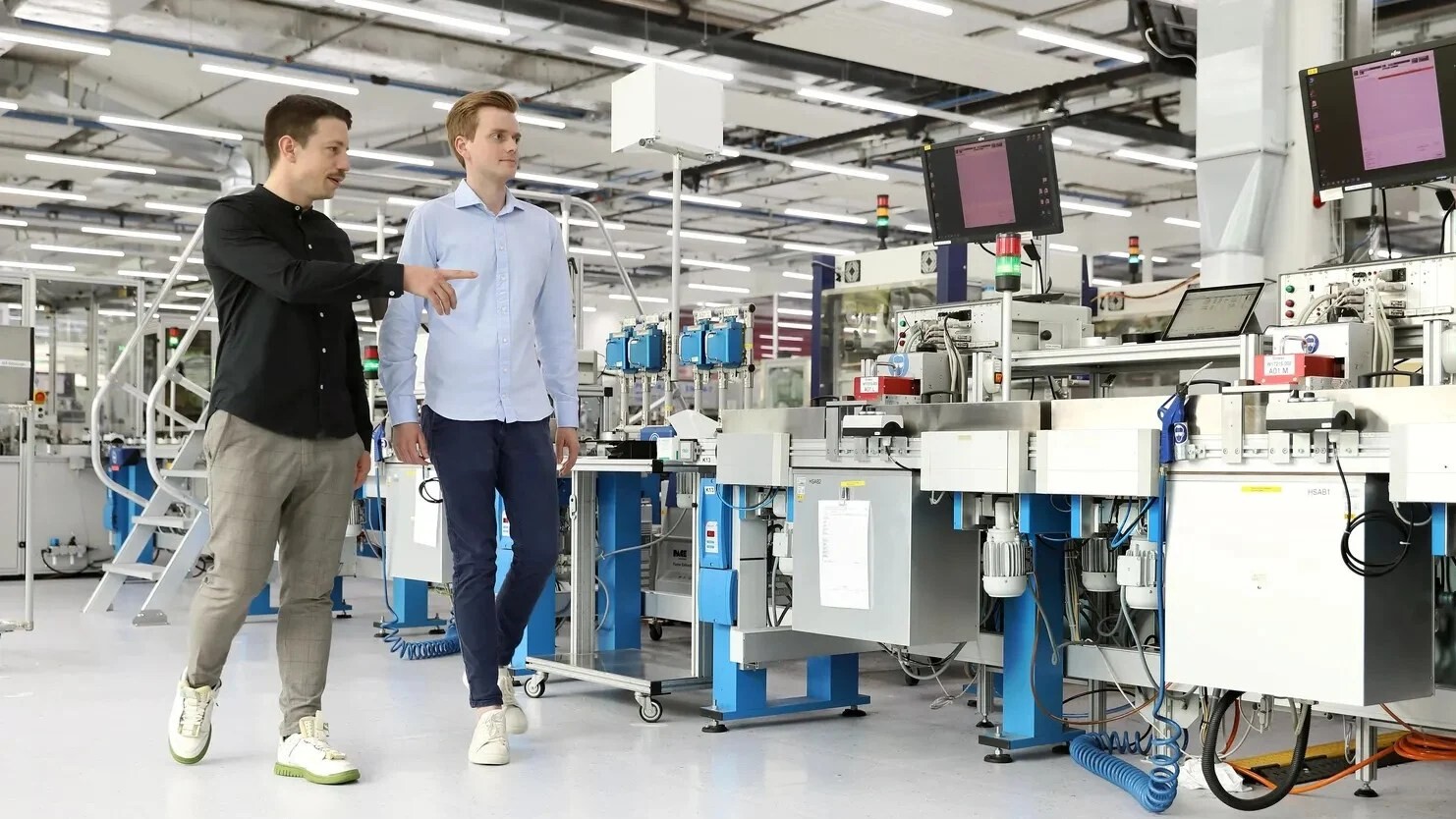
Kratzwald and Senoner founded EthonAI in 2021. The company became an ETH spin-off and Kratzwald an ETH Pioneer Fellow. Their first product language centered on quality management, but the scope widened as customer problems refused to fit inside one box. Visual defects mattered. So did throughput, process stability, material use, downtime and the strange differences between factories that were supposed to be identical.
That widening produced what the company calls an Industrial AI Platform. It layers several methods: computer vision for visual defects, anomaly detection for deviations, process mining for the path work actually takes, and causal AI for reasoning about cause and effect. The unglamorous foundation is context. A temperature reading means little until the system knows which machine, product, batch, recipe and moment it belongs to.
This is where Kratzwald's academic instincts remain visible. An industrial recommendation should connect back to evidence that a process expert can examine. Language models may help people navigate the analysis, but the factual work sits in the production data and domain-specific models beneath them. In an office demo, a fluent mistake can be embarrassing. On a line, it can become material, time and money.
The economics of an unanswered why
Manufacturing's data problem is a peculiar one. Modern factories are dense with cameras, sensors and control systems, yet much of the resulting information remains unused. The usual tools report what happened: yield fell, a machine stopped, a batch needed rework. Human experts then spend hours joining tables, comparing shifts and arguing with dashboards. They are doing detective work while production keeps moving.
EthonAI's public case studies give the abstraction edges. At Siemens, the platform expanded from a research collaboration in visual inspection to use across more than 20 factories, with Siemens reporting more than $10 million in savings. A chocolate producer used data-driven setpoint recommendations to stabilize production. A semiconductor manufacturer analyzed more than 3,000 process parameters and reduced scrap by 51 percent. These are company and customer results, not laws of nature, but they show why root-cause analysis attracts attention: a recurring defect is a small bill with excellent attendance.
The company's 2024 financing arrived as that argument was gaining force. Index Ventures led a CHF 15 million Series A, joined by General Catalyst, Earlybird and Founderful. The round funded a broader push beyond isolated quality tools toward a system that could sit above existing factory data sources. EthonAI did not need manufacturers to replace the machinery below. It needed to make the signals between those systems legible.
Can an engineer follow the recommendation back through the relevant process variables, compare conditions and decide whether the suggested cause makes physical sense? In industrial AI, usefulness begins where inspection remains possible.
Trust is part of the machinery
In 2025, Siemens named Kratzwald and Senoner Inventors of the Year in the Open Innovation category. The award recognized a relationship that had traveled an unusual distance: Siemens was a research partner, then an early customer, then a commercial partner deploying the platform across its own sites. Kratzwald accepted the honor onstage and returned to a recurring theme in his work: useful technology depends on people being willing to trust it.
Trust, in this context, is not applause for an algorithm. It is the decision by an operator or process engineer to use a result in the real sequence of production. That trust is earned through a less cinematic list: integration, context, traceability, repeated performance and a useful interface. Kratzwald has said new products can be integrated into the visual inspection system within minutes. Speed matters because a model that takes a data science project to configure will remain a special occasion. Factory work is mostly Tuesday.
His public tone tends toward the practical. He talks about causal models, knowledge graphs and autonomous workflows, then returns to the same operational nouns: scrap, yield, throughput, setpoints. Even the company's larger mission - eliminating manufacturing's trillion-dollar waste problem - is divided into stubborn, local questions. Why did this line drift? Which setting changed? Why does one plant outperform another? What should the operator adjust now?
“With our algorithms, new products can be integrated within a few minutes.”Bernhard Kratzwald
New York, with Zurich packed inside
In 2026, Kratzwald moved to the United States to lead Ethon's next phase of growth from New York. The geography is more than a founder's change of address. Zurich remains the company's technical home and, in Kratzwald's words, home in the personal sense too. New York places him closer to a broad North American manufacturing market and turns a research-born Swiss company into a two-city operation.
There is a pleasing symmetry in the move. He once arrived in Zurich expecting not to stay. He left only after the city had supplied the education, collaborators and industrial relationships that shaped his company. Now the task is to carry that patient, evidence-heavy culture into a market that rewards speed. The interesting question is whether EthonAI can scale without sanding away the very thing that made it useful: a willingness to dwell on why.
Kratzwald's career so far offers a quiet counterpoint to the usual AI spectacle. The important output is not a sentence, image or humanoid flourish. It is a better decision made beside a machine. The model notices a pattern. The system connects it to context. An engineer inspects the chain and changes a parameter before another batch becomes waste.
Factories will continue to generate surprises. That is almost their defining talent. Kratzwald is betting they can become better at remembering those surprises, explaining them and acting before repetition turns an anomaly into routine. In other words, the machines may keep making mistakes. The useful advance is teaching the factory to ask a sharper next question.