The useful thing about growing up in a bakery is that failure keeps hours. A roll that misses the morning rush cannot be patched at noon with a presentation. Dough, heat, hands, shelves and customers have to arrive in the right order. In Forstern, an Upper Bavarian town east of Munich, Bastian Nominacher watched that choreography inside a business his family had run for five generations. He would not become its sixth baker. He did, however, inherit an eye for flow.
His father, Erwin, helped make the detour possible. The elder Nominacher was interested in technology and programmed at home with his son. Bastian remembers a ten-megabyte hard drive, a capacity now small enough to sound like a joke and once large enough to feel like the future. While still at school he worked in a computer shop. After middle school, he took an apprenticeship as an IT systems sales specialist rather than the more ceremonial route expected of a future software executive.
The sequence matters. He learned technology first as something sold, installed and expected to work. Then came the academic layers: information systems and management in Munich, international business in Wales, and a master’s in finance and information management at the Technical University of Munich. By the time theory arrived, practice already had fingerprints on it.
Three students meet a process nobody can quite explain
At Academy Consult Munich, a student consultancy, Nominacher met Alexander Rinke and Martin Klenk. Their backgrounds fitted together with suspicious neatness: Rinke brought mathematics, Klenk computer science, and Nominacher the overlap of information technology, business and finance. In 2010, they took on an assignment for Bayerischer Rundfunk, the Bavarian public broadcaster. The brief was ordinary enough: improve the broadcaster’s IT service management.
The conventional method was to interview people, run workshops and draw the process they described. Yet the trio kept encountering the same problem. A description of work is not the work. Memory tidies. Departments see their own corridor. The system, meanwhile, records every reset password, failed printer and service request without concern for anyone’s preferred version of events.
They found the process-mining research of Dutch computer scientist Wil van der Aalst and recognized the bridge. Event logs could reconstruct how the work actually moved. They wrote software, applied discovery algorithms to the broadcaster’s data, and prepared a workshop with glorious impracticality: more than 300 process models, printed on A3 sheets and mounted around a conference room.
How an academic idea escaped into the world
Before process mining became a category, it was a room full of paper. That scene contains the company in miniature. The cleverness was computational; the test was human. Could the people responsible for the process see themselves in the evidence? Could they spot the detour? Would they want to fix it?
“It was clear to us that we had to analyze it, that there was an immense value behind it.”Bastian Nominacher
The apartment years
The three founded Celonis in 2011, shortly after completing their studies. The first office was Nominacher’s apartment. For roughly three months, he recalled, they virtually locked themselves inside. Every day supplied a fresh reason to despair; every day, one of them found the idea that kept the work moving. It is a less photogenic founding ritual than the garage, but apartments come with better heating.
Their division of labor became durable. Klenk drove technical development. Rinke pushed the product vision and later the American expansion. Nominacher concentrated on the operating machine, customers and the European business. Mentors at TUM helped when the founders met setbacks, and an EXIST grant gave the young company room. Large customers, including Siemens, came early. For the first five years, Celonis grew without external investment.
That restraint reveals Nominacher’s temperament better than a valuation does. He has described himself as a fan of working hard, persisting and proving the business model. Revenue is a form of evidence. So is a customer who returns. The bakery analogy is not decorative here: demand arrives, the operation either serves it or does not, and yesterday’s reputation cannot be invoiced twice.
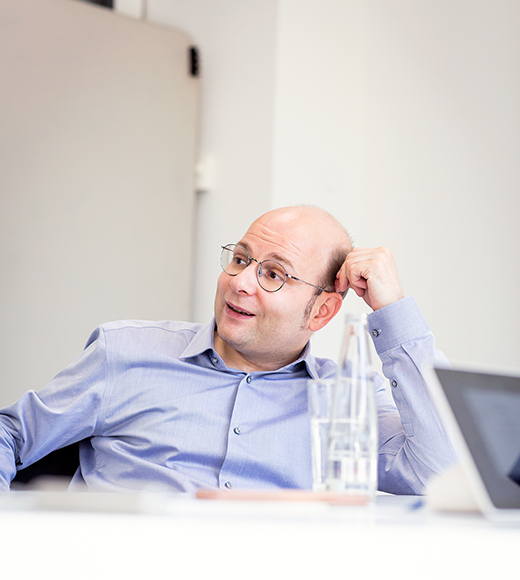
Making the invisible legible
Process mining is often explained as an X-ray for a company. The metaphor is Nominacher’s and it works because an X-ray does not ask the bone where it hurts; it reveals the structure beneath the account. Enterprise systems leave event logs when an order is raised, an invoice is paid, a shipment stalls or a customer request changes hands. Celonis reconstructs those paths, compares them with the intended route and identifies bottlenecks or deviations.
The notion sounds obvious after it has been explained, which is the fate of many strong inventions. Its business consequence was not obvious in 2011. The founders had to persuade organizations that the unlovely residue of their software systems was valuable, and that process improvement could begin with observation instead of another round of opinion.
By 2018, Celonis had reached a reported billion-dollar valuation. A year later, Nominacher, Rinke and Klenk received the German Future Prize from President Frank-Walter Steinmeier. The award recognized more than a company’s growth. It honored their work in translating an academic discipline into software that organizations could use. Nominacher has called it a particular source of pride, important enough to merit its own display case at the office.
The translation involved more than making an algorithm fast. Research supplied process discovery and conformance checking: one reconstructs the route taken, while the other compares that route with the route intended. A product had to make both understandable to people who were not process-mining specialists. Nominacher repeatedly returned to lowering those barriers. The company offered learning resources and academic access, inviting students and smaller organizations to use tools once aimed at large enterprises. Category creation, in his telling, required evangelism as much as engineering.
That may explain his attachment to the ecosystem around Celonis. The original company depended on unusually generous connections: a broadcaster willing to let students investigate a real operation, university mentors who advised them through setbacks, government support that bought time, researchers whose published work supplied the intellectual base, and early customers prepared to trust young founders. Nominacher did not describe the breakthrough as a solitary flash. He described a connection, the recognition that one body of research could unlock one stubborn set of data.
Even the prize belonged to a network. He treated it as recognition for the employees who had converted a prototype into a dependable product, and for the broader argument that German research could become globally useful technology. The three founders remained the visible triangle, but the operating story had already expanded far beyond them. A map of Celonis itself would show professors, mentors, clients, engineers, platform partners and thousands of colleagues entering at different points.
Begins an apprenticeship in IT systems sales.
Tests process mining on a broadcaster’s service data.
Founds Celonis with Alexander Rinke and Martin Klenk.
The founders win the German Future Prize.
Celonis marks fifteen years as the founders turn their attention to context for enterprise AI.
A straight line would be suspicious
Today Nominacher is co-CEO, responsible for Europe and Asia as well as operations, HR, security and overall business strategy. The portfolio is broad but internally consistent. Each function asks whether a system can preserve clarity while the organization around it grows more complicated.
He has said that perseverance and consistency define entrepreneurs, because a happy customer on Tuesday does not prevent the technology from changing on Wednesday. “If you have a vision and want to drive it forward, you can never go in a straight line.” It is an appealing line from someone whose product turns organizational wandering into a map.
His smaller habits suggest how he handles scale. In a 2018 questionnaire, he said he began the day with tea in the office kitchen and a chat with colleagues. The point was contact: as the company expanded, conversation became a way to keep the human system observable. His Bavarian dialect has reportedly tested interpreters at international events. Software may standardize a process; vowels retain local management.
“My biggest passion in life is building things.”Bastian Nominacher
The current frontier is artificial intelligence. Nominacher argues that enterprises do not merely need stronger models. They need context: the processes, exceptions and unwritten rules that explain how the business actually operates. Without that grounding, pilots remain pilots. Celonis now presents its process intelligence and Context Model as a bridge from impressive demonstrations to useful action.
The language has changed from process maps to AI context, but the method remains recognizable. Begin with the trace. Prefer the awkward truth of observed behavior to the polished diagram of intention. Make the hidden route visible. Then decide what to change.
Nominacher’s family bakery ended its 125-year run under family ownership in 2017. Its would-be heir had already built a different kind of operating system. Bread and enterprise software share few ingredients, but both are unforgiving about sequence. The morning rush is merely one form of real time.