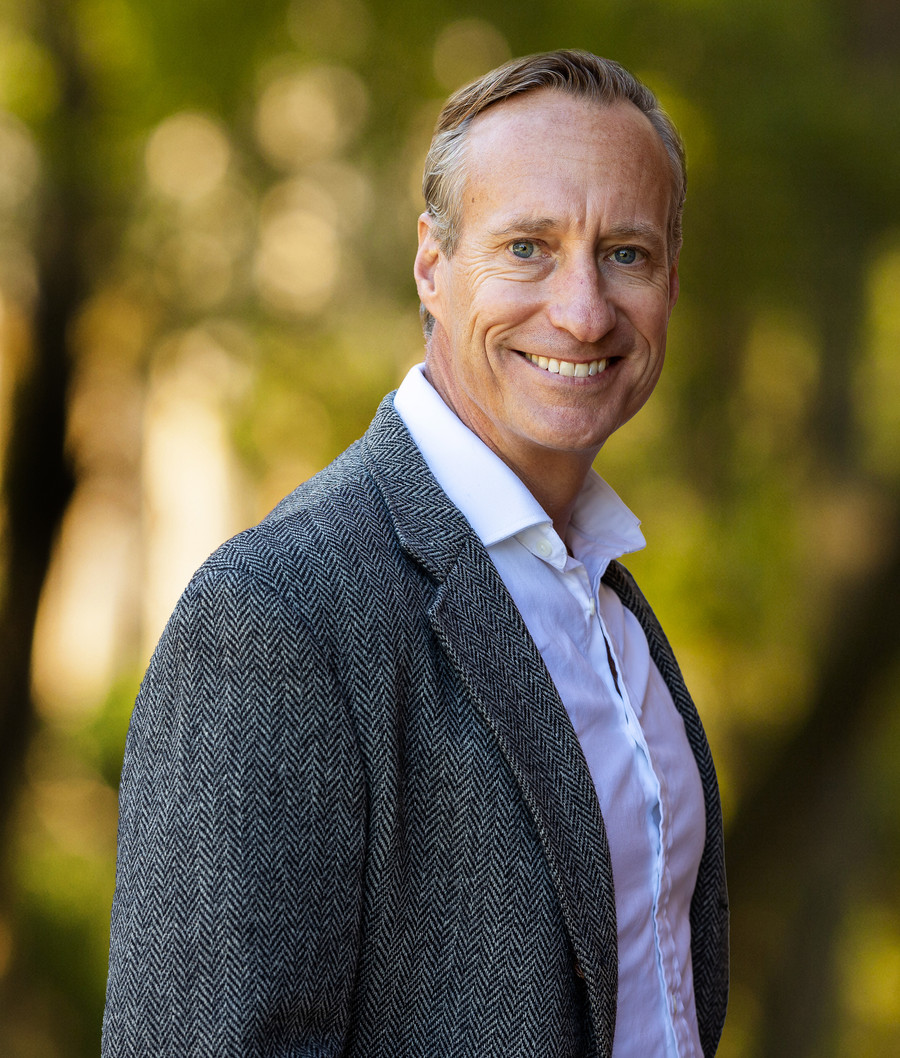
An engineer who buries carbon for a thousand years
Most carbon removal companies want to build machines that suck CO2 out of the sky. Barclay Rogers looked at that and asked a quieter question: photosynthesis already pulls billions of tons of carbon from the air for free every year, so why not just stop that carbon from rotting back into the atmosphere? That single redirection is the company he runs now.
Rogers is the co-founder and CEO of Graphyte, a carbon removal company built around a process it calls Carbon Casting. The recipe is almost rude in its simplicity. Take leftover plant matter - sawdust, timber scraps, agricultural waste. Dry it out so microbes can't feast on it. Press it into dense blocks. Wrap them and tuck them safely underground, monitored, where the carbon stays put for more than a millennium. No giant fans. No exotic chemistry. Plants do the capturing; Graphyte does the keeping.
The pitch lands because of the number attached to it: durable removal at under $100 a ton. Direct air capture, the headline-grabbing alternative, has long cost several times that. Rogers' wager is that the climate doesn't need the cleverest technology. It needs the cheapest one that actually works at scale - and works now, not in a decade.
"Carbon casting is a nature-based solution that leverages engineering techniques to store CO2 safely and affordably."
How Carbon Casting works
Strip away the branding and it's four steps, each one deliberately unglamorous.
Capture
Plants pull CO2 from the air through photosynthesis - the free, planetary-scale part.
Dry
Waste biomass is dehydrated so it can't decompose and release its carbon back.
Cast
The dried material is compressed into dense, stable carbon blocks.
Store
Blocks are buried and monitored, locking carbon away for 1,000+ years.
That last figure is the one that keeps people in this field awake. The world currently removes a rounding error's worth of the carbon that climate targets demand. Rogers frames Graphyte not as a moonshot but as a way to make the math less hopeless - a method cheap and replicable enough to multiply.
Four degrees, two careers, one problem
Rogers arrived at carbon removal by an unusually winding road. He holds a B.S. in mechanical engineering from the University of Arkansas, a law degree from Lewis & Clark College, an LL.M. focused on agriculture back at Arkansas, and an MBA from the University of Cambridge. Engineer, environmental lawyer, business operator - he is, in effect, three professionals wearing one badge.
That blend isn't decorative. Carbon removal is a field where the technology, the legal framework for permanent storage, and the unit economics all have to work at once. An engineer who can also argue the regulatory case for his own product, and then model whether it pencils out, is a rare animal. Rogers built the company at exactly that intersection.
Before Graphyte, he spent years in agricultural technology and climate - the connective tissue being data, land, and carbon. He co-founded Good Earth Irrigation, applying big data to farming. He was Chief Revenue Officer at TerrAvion, which flew aerial imagery for growers, and a vice president at Ceres Imaging. At Indigo Agriculture he led business development around soil carbon removals, and at C12 Energy he ran development for geologic carbon sequestration. Each stop circled closer to the same target: getting carbon out of the air and keeping it out.
"We're seeing serious economic costs of climate change."
The Bill Gates factor
Graphyte emerged backed by Breakthrough Energy Ventures, the climate fund founded by Bill Gates. When Gates publicly drew attention to the company, the moment was big enough that regional outlets like the Memphis Business Journal flagged it for their readers. The first commercial Carbon Casting facility opened in Pine Bluff, Arkansas - not Silicon Valley, not a coastal lab, but a working plant in a part of the country with biomass to spare.
The geography is a tell. Rogers' whole thesis is that durable carbon removal should be industrial and ordinary, the kind of thing you build near the feedstock and run like a mill. Glamour is optional. Tonnage is not.
The professor in the room
For all the frontier-tech framing, Rogers keeps one foot in the classroom. He is an adjunct professor of law at Tulane University in New Orleans, where he teaches a course on climate change solutions. It's a fitting double life: by day he buries the planet's carbon by the ton, and on the side he hands the next generation of lawyers and policymakers the tools to argue about how, and how fast, the rest of us should be doing the same.
There's a through-line in all of it. Rogers doesn't seem interested in being the smartest person solving the climate problem in the most sophisticated way. He's interested in the version that scales - the cheap, repeatable, slightly boring solution that a thousand other plants could copy. In a field crowded with elegant prototypes, that pragmatism may turn out to be the most radical move of all.
▶ Watch: Barclay Rogers on the costs of climate change