Bala Kuchibhotla was helping his daughter with geometry when a word interrupted the lesson. The problem involved four regular hexagons and a rhombus. The word was tessellation: shapes covering a surface without gaps or overlaps. He had spent years working on enterprise databases. Here, in a schoolbook, was a picture of how he wanted them to behave.
The kitchen table is an unlikely place to reorganize corporate computing. It does, however, offer a useful advantage over a conference room: someone has asked a question with an actual answer. Kuchibhotla saw an organizing principle in those shapes. Different pieces could retain their identities and still fit into a coherent whole. Enterprise data, spread across systems and clouds, rarely offered that satisfaction.
He turned the idea into Tessell, which he co-founded in 2021 with Kamal Khanuja and Bakul Banthia. His account of the homework episode ends with a pleasingly domestic detail: his daughter still asks for help with mathematics, and he still agrees. A company may emerge from a lesson. The homework remains due.
Separate pieces. A shared set of rules. No gaps.
A visual metaphor for the idea behind Tessell.A career below the surface
Long before the name, there was the machinery. Kuchibhotla’s master’s thesis concerned an object database kernel. He began working at Versant in 1997, moved to Oracle in 2004, and joined Nutanix in 2017. Across those employers, his subject remained remarkably consistent: the systems that store information and the work required to keep them useful.
At Oracle, he became a vice president and architect working on private and hybrid cloud database development. That territory sits between the application people recognize and the infrastructure they would prefer never to think about. Provisioning, copies, updates and recovery all belong there. Each sounds modest until it must happen reliably across a large organization.
In 2017, he was considering whether to start a company or develop his idea inside an established one. Dheeraj Pandey, a former colleague and Nutanix co-founder, invited him to build at Nutanix. Kuchibhotla became the founder of Nutanix Era and eventually its senior vice president and general manager. The entrepreneurial impulse first found a home within someone else’s company.
That route matters to his story. He had worked on database internals and then on the operational systems surrounding them. The recurring question was how much specialist effort a customer should have to supply before a database could do its everyday job.
- 1997Versant
Database engineering - 2004Oracle
Database cloud development - 2017Nutanix
Building Era - 2021Tessell
Co-founder & CEO
The copy-and-paste problem
One of his conference examples made the difficulty wonderfully concrete. Start with a 20-terabyte Postgres production database. Add demands for business continuity, compliance and a staging environment for an application team. Six copies would imply another 120 terabytes of space. A familiar computer action had acquired the appetite of an industrial machine.
This was the subject of his October 2018 Postgres Conference presentation in Silicon Valley. The example placed the administrator, rather than a product diagram, at the center of the problem. Someone needed to give a development team realistic data while keeping the production system running and satisfying everyone else’s requirements.
His explanation of database virtualization followed the same practical line. Virtualizing the computing resource alone leaves the copying and management of data unresolved. Making servers easier to create can even multiply the work waiting around them. Convenience at one layer may become a queue at another.
“Databases should be simple,” he said during his Nutanix years. It is a small sentence with a substantial engineering bill attached. The ambition makes sense precisely because he has spent so much of his working life among the complications.
“Databases should be simple.”Bala Kuchibhotla
The customer keeps the keys
Tessell carries that operational concern into a business of its own. Its architecture separates the control plane, which coordinates database operations and holds metadata, from the data plane, where databases and their associated data live. In its customer-cloud deployment, that data plane runs inside the customer’s own cloud account.
For a reader outside enterprise software, the distinction can sound like an argument about plumbing. For a company with strict governance requirements, it addresses a basic question: where is our information, and who controls its surroundings? Tessell also offers a deployment with the entire platform inside the customer’s tenant.
The founding team’s premise is that an organization should be able to modernize its databases while retaining choices about engines, clouds and governance. Oracle, SQL Server, PostgreSQL and MySQL belong in that discussion because large organizations already run them. The company’s proposition begins with accommodating an existing estate.
That is a revealing ambition for Kuchibhotla. The elegance he took from geometry has to survive contact with accumulated corporate decisions. A clean pattern must include pieces chosen years before his company arrived. Anyone can draw a tidy arrangement after discarding the awkward shapes.
Customer-cloud deployment, simplified.
A million-dollar conversation, a $600 designer
The same interest in fitting pieces together escaped into the company’s visual identity. Kuchibhotla says he spent three days reaching the agency behind Tesla’s logo, only to learn that its engagements generally began at $1 million. A founder seeking a logo had found a rather expensive way to acquire perspective.
He and Banthia instead hired an online freelancer who quoted about $600. Kuchibhotla wanted pentagon-based forms, multiple elements suggesting clouds and database engines, and a T. Iteration followed. The solution placed the letter in the space between the shapes, rather than drawing it as a solid object.
The anecdote has the pleasing disproportion of startup life: a person responsible for database infrastructure studying the gaps in a small graphic. In his telling, he had begun stopping at street signs to examine what their logos communicated. Product design had expanded to include the sign above the door.
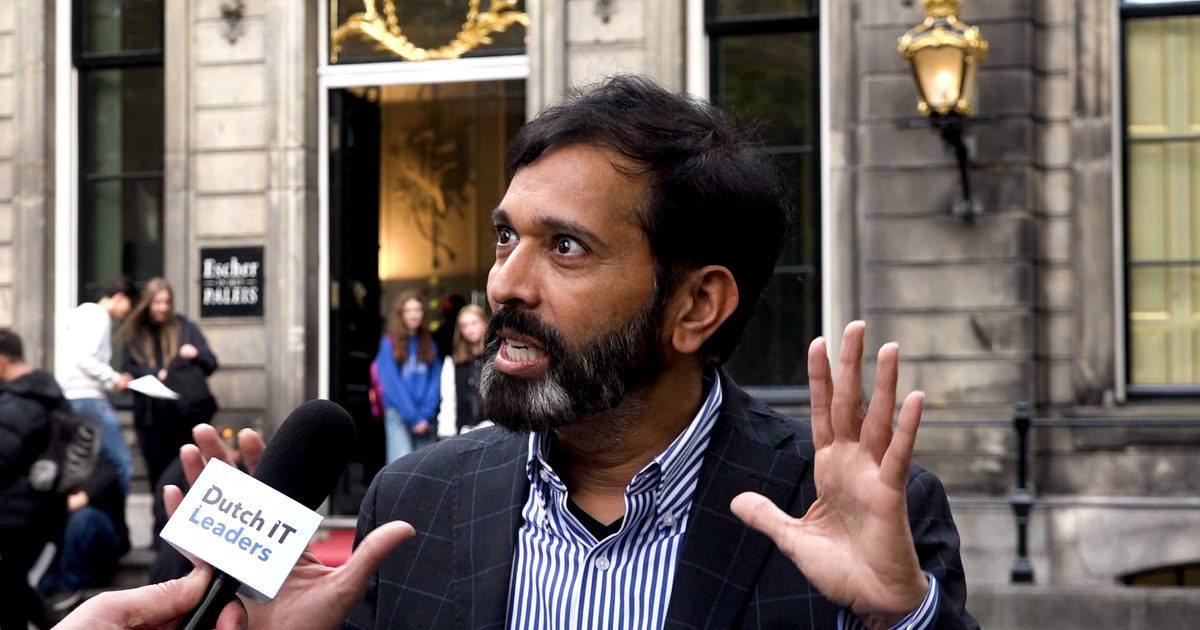
It also explains the appeal of Escher. By September 2025, Kuchibhotla was discussing Tessell outside the Escher museum in The Hague. The setting joined a personal fascination with a business explanation: repeated forms, held together by rules, producing something that looks effortless only after the hard work is done.
The four months after the signature
An enterprise customer story offers a less picturesque test. At Microsoft Ignite in November 2023, a visitor approached Tessell’s booth. He represented a Fortune 100 energy company. A follow-up in February 2024 led to demonstrations, diligence and a proposal built around a $200,000 commitment and consumption-based drawdown.
For the first four months, Kuchibhotla says, consumption amounted to only about $2,000 a month. The signature had arrived before substantial usage. His recollection includes his concern, alongside the long list of requirements still to satisfy.
The customer needed databases moved to Azure, governance and identity integrations, recovery arrangements, monitoring and operational changes. Kuchibhotla credits sales, solutions engineering, engineering and operations colleagues with the work. In his February 2026 account, the relationship had progressed to a $200,000 monthly commitment for the following three years.
Commitment and consumption are different measures; this account does not turn the final commitment into realized revenue. Its more useful detail is the period of slow adoption. Four quiet months after a promising agreement make a better test of a founder’s patience than the announcement of a deal.
“Enterprise trust isn’t won with a signed contract,” he wrote. The work he describes happens after that moment, as teams connect a product to the systems a customer actually uses.
Consumption during the first four months
Commitment reported in February 2026
Growth, and an untidy record
In April 2025, Tessell announced a $60 million Series B led by WestBridge Capital, with Lightspeed, B37 Ventures and Rocketship.vc participating. Kuchibhotla said the company was working with more than 40 large enterprises, six quarters into its go-to-market journey. The funding gave his operational thesis a larger commercial test.
His career also includes a regulatory settlement. In May 2022, the Securities and Exchange Commission entered an order concerning his trading in Nutanix securities before its February 2019 earnings announcement. Kuchibhotla settled without admitting or denying the findings and agreed to a $585,960 civil penalty and a cease-and-desist order.
In March 2024, Nutanix sued Tessell, alleging intellectual property infringement and misuse of company resources by its former employees. Those are allegations. A February 2026 federal appeals court order described the district court proceedings as stayed pending arbitration. Tessell and its founders also filed a separate action against Nutanix and two executives in March 2026; that case was subsequently stayed pending arbitration.
These proceedings sit alongside the product and customer story. They deserve their own factual boundaries: a settled regulatory action, contested company allegations and procedural decisions. A geometric metaphor cannot make a business history as tidy as a tiled plane.
A database service you could talk to
Kuchibhotla’s next ambition returns to the interface between difficult systems and ordinary requests. He wants enterprise data management to become conversational, affordable and prescriptive. The last word matters: different organizations have different security and operating requirements. A friendly interface still has to respect them.
In May 2026, Tessell appointed Matt McDonough as president of go-to-market and Jeff Carter as chief strategy officer. Kuchibhotla said the additions would let him spend more time with customers and on rethinking data and cloud operations for AI. In September, Tessell announced managed Oracle support on Google Cloud’s M4N infrastructure, another concrete extension of its cloud work.
His language often returns to familiar experiences: homework, copying a file, a conversation. That is an effective way to explain infrastructure because customers already know what ease feels like. The engineering challenge lies in delivering the same feeling without concealing the controls an enterprise needs.
The homework story therefore offers more than a charming company name. It identifies the standard Kuchibhotla keeps returning to: a collection of difficult parts that can be made to work together. He has pursued that standard through database kernels, corporate product teams and a company of his own. The shapes on the schoolbook page fit immediately. The enterprise version is taking rather longer.