Buying a dealership is the relatively tidy part. The papers can be signed, the ownership transferred and the figures entered in a spreadsheet. Then somebody still has to persuade a customer to buy a car on Saturday. B. B. Hollingsworth Jr., known as Ben, built Group 1 Automotive around that awkward distance between a financial transaction and a local business. A national company could supply capital and corporate discipline. The people closest to the customer would keep running the stores.
The arrangement suited an unusual founder. Hollingsworth had been an accountant and a corporate acquisition executive before entering automotive retailing. He brought experience from Service Corporation International, where he had helped assemble a large business from separate operators. A dealership had different products and customers, but the organizational question was familiar: what could a larger company improve without smothering the people who knew the business?
His career invites a closer look at the less theatrical parts of entrepreneurship. There is no new automobile bearing his name. His work concerned ownership, financing, managers and the boundaries of authority. The customer could carry on looking at the car. Hollingsworth was interested in how the enterprise behind it was put together.
Before the showroom, the ledger
He graduated from Rice University in 1964 with a bachelor’s degree in economics and began his professional career as a certified public accountant at Arthur Young & Company. In 1967, he joined SCI as a vice president. His responsibilities included corporate development; he subsequently became chief financial officer. He started and directed the acquisition program, moving from the examination of businesses to the business of combining them.
By 1975 he was SCI’s president. He stayed until March 1986, when he retired to pursue other interests. The sequence matters. This was a long apprenticeship in acquisition and management before Group 1 existed, with responsibilities that extended beyond making a purchase. An accountant’s familiarity with the figures had become experience running a public company.
The intervening years included consulting and private investing. One of his interests was the Kingwood Automotive Group, which Group 1 acquired before its public offering. Automotive retailing therefore entered his career through an actual investment. The eventual company joined his public-company experience to the knowledge of established dealership operators. Neither side supplied the whole arrangement on its own.
Let the dealers remain dealers
In October 1996, Hollingsworth joined with three dealership groups to form Group 1. Its stock-market debut followed in late 1997. The founding proposition depended on dealers choosing to join a larger organization and continuing to take part in it. The founders received most of their consideration in stock and agreed to hold their shares for at least two years.
That detail gives the story more substance than a general promise about teamwork. Their continuing stake linked the dealerships to the fortunes of the public company. Hollingsworth also assembled colleagues whose expertise covered acquisitions, finance and the automobile industry: John Turner led the acquisition effort, while Scott Thompson served as chief financial officer.
The growth plan used two kinds of purchase. A larger dealership group could establish a presence in a new market. Smaller additions could expand the brands and operations within that market. The vocabulary was corporate - platforms and tuck-ins - but the intended division of labor was straightforward. Experienced dealers would handle their markets; the central team would handle the public company. Headquarters had plenty to do without choosing every move in every showroom.
Public-company oversight
Day-to-day operations
A brisk first lap
By October 1998, Hollingsworth could point to 32 franchises acquired in five states since the company became public. Group 1 had nearly doubled the revenues of its 1997 businesses. The speed attracted attention, but he described the mechanism in terms of selected purchases and integration. More stores alone were an incomplete explanation.
The company was also adding operating experience. John Bishop, an automobile-industry veteran with experience at Toyota, Ford and Chrysler, was named senior vice president for operations. His job included overseeing operations and coordinating with dealerships. Even during a period of rapid acquisition, the company needed someone attending to what happened after the transaction.
The distinction is easy to lose when the numbers grow quickly. A purchase contributes revenue immediately; the resulting organization still has to work. Hollingsworth’s early account of Group 1 put those two tasks together. Buying and operating belonged in the same conversation. The company had 57 franchises representing 22 brands at the time, a collection already too varied for a single manufacturer’s fortunes to tell the whole story.
“Select acquisitions executed under a disciplined strategy can produce earnings growth and enhance shareholder value.”Ben Hollingsworth · October 1998
The internet arrived. The keys stayed real.
At the turn of the century, another question arrived: would internet retailers make the traditional dealer obsolete? In his account of 2000, Hollingsworth addressed the supposed threat of the virtual dealership alongside interest rates and acquisition activity. Group 1 was using the internet itself. Roughly 6,000 new-vehicle sales that year began through online activity, about 7 percent of its new-vehicle sales.
The buyers started online and completed the process with specially trained salespeople. That is a wonderfully practical answer to a grand technological prediction. The screen became another entrance to the business. A shopper could do some work before arriving; a dealership still had work to do afterward.
The company’s explanation also kept authority divided. Regional leaders knew their products and markets. The corporate team arranged financing, allocated capital, monitored operations and supplied administrative support. You can read this as an organizational preference rather than a prediction about every future technology. Hollingsworth was describing how his company was responding at that moment: adopting a useful channel while keeping the people and facilities required to complete the transaction.
Growth has an awkward second column
By 2004, Group 1 reported $5.435 billion in revenue. The figure looked substantial; the earnings beside it were less comfortable. Net income fell to $27.8 million from $76.1 million in 2003. Competition, pressure on margins and asset impairment charges complicated the picture. Hollingsworth’s annual letter acknowledged that performance had fallen short of expectations.
This is where a founder’s story benefits from keeping the second column visible. Higher sales do not automatically produce higher earnings. A company can acquire businesses and still face difficult operating results. The same year that supplied a revenue record supplied a reminder of the limits of acquisition as an answer.
Hollingsworth’s executive tenure ended in April 2005, and he resigned from the board in May. The transition included a consulting arrangement running through March 2006. A founder’s exit has a practical side as well as a ceremonial one: knowledge needs to pass to the people taking over. Group 1’s future would be managed by successors. His role belongs to the company’s founding chapter, rather than every subsequent chapter written under its name.
Group 1, 2003 → 2004
Rice kept a place on the calendar
Long before the corporate titles, there had been football. Hollingsworth lettered for Rice in 1963, playing defensive back on a team that finished 6-4. The economics graduate of 1964 remained involved with the university after his playing days. In 1998, he received its Distinguished “R” Award.
He and his wife, Starlett, endowed four Rice athletic scholarships. He also chaired the Rice Fund Council and the Annual Fund, and served on the business school’s Council of Overseers. Those are different forms of participation, from supporting individual students to helping an institution organize its resources. A university offers no shortage of committees to anyone who has survived a corporate boardroom.
His involvement extended into university governance. Rice named him among its Distinguished Alumni honorees in 2016, recognizing both his business career and his contribution to the school, including the business school’s building fund. Today, Rice lists him as a trustee emeritus and identifies him with BBH Capital in Houston. Its business school’s advisory board lists his title as chairman of BBH Capital. The relationship with Rice has outlasted his operating tenure at Group 1.
Another kind of succession
In January 2017, the Boone and Crockett Club announced Hollingsworth as its 33rd president. Conservation had an earlier, domestic beginning for him. Growing up in Arlington, Texas, he went fishing with his father. He remembered family trips to Red River, New Mexico, and the trout his mother cooked. The recollection puts dinner ahead of doctrine, which is a pleasant order in which to discover a lifelong interest.
His later account emphasized mentorship. He credited F. R. Daily and Gary Dietrich among those who had taught him. He also described annual Texas ranch hunting trips with his son-in-law and three grandchildren. Teaching safety and wildlife management was part of those outings. Succession here meant passing on judgment and habits through time spent together.
He spoke about mentoring future club members and wildlife professionals as older generations approached retirement. The concern was specific: organizations need people prepared to carry their work forward. His corporate career supplied experience in finance and governance, but his description of family trips supplied a smaller and more personal setting for the same question.
The people who carry it forward
In 2018, under his presidency, the club announced support for The Wildlife Society’s programs certifying future wildlife professionals. Hollingsworth emphasized cooperation among science, education and policy. Professional preparation was a tangible way to support the next generation, beyond merely hoping it would arrive ready.
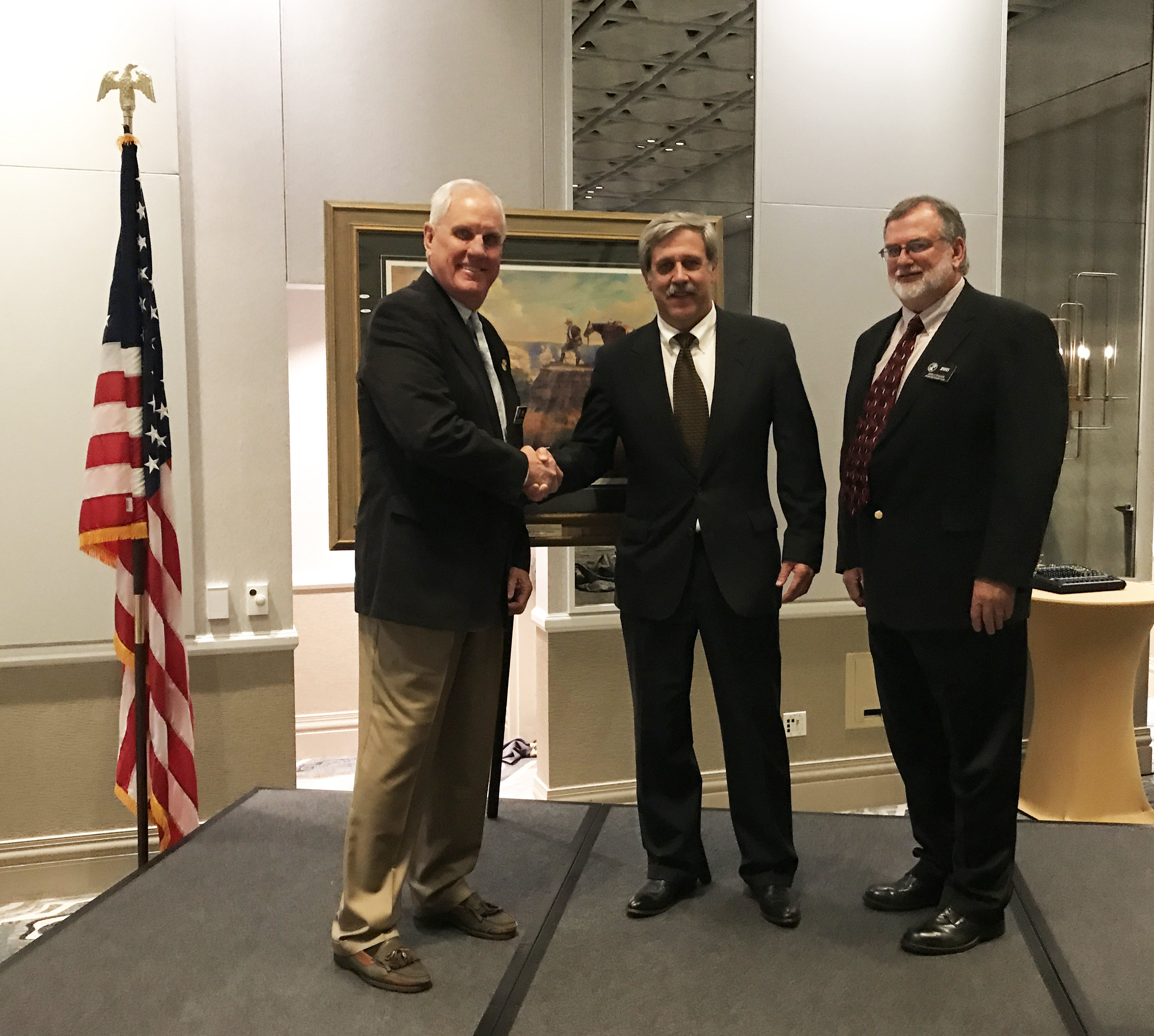
That spring, he also helped present the club’s Conservation and Stewardship Award to the Wildlife Management Institute. In the photograph, Hollingsworth stands on the left; Steve Williams receives the award, with Jimmy Bullock on the right. The occasion honored an institution devoted to wildlife management. It is a useful scene in a career often described through corporate positions: here, the recognition is being handed to somebody else.
Hollingsworth’s story runs through enterprises that depend on people knowing their own ground. A dealer understands a market. A university prepares students. A conservation organization needs trained successors. His work in these settings had different purposes, and they should keep their differences. Still, the repeated attention to who would do the work is hard to miss. The national business could gather resources; the local knowledge had to retain a place. Keeping those two things in useful company was the work.
Follow the story further
Career records, early company letters and conservation work.