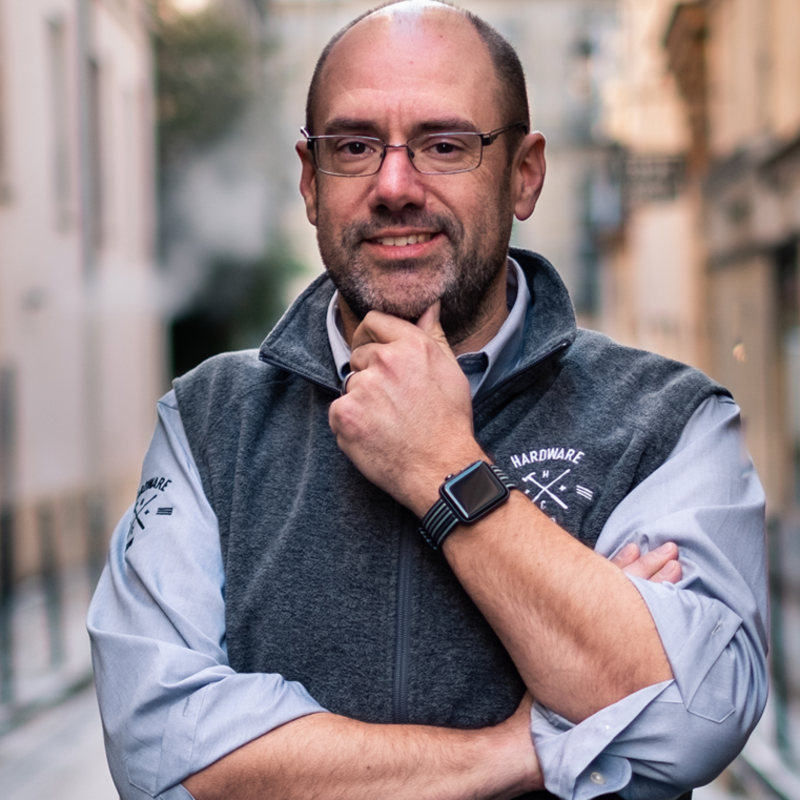
Aymerik Renard's calendar tells you what he believes. A Monday at the HCVC office on Rue Beaubourg in Paris. A Tuesday in a clean-room outside Munich. A red-eye to a robotics demo in the East Bay. A Thursday at a Shenzhen contract manufacturer, the kind that decides whether a startup's heroic prototype becomes a shipping product or a beautifully soldered footnote. Then a board call about a fusion reactor. Then a flight back. Most venture firms decorate their decks with the word global. Renard built his entire career inside it.
He has been a General Partner at HCVC since October 2017, when he left a corporate-venture seat at Western Digital to join the firm Alexis Houssou and Jerry Yang were turning from a community of hardware founders into an investment vehicle. HCVC - the rebrand of what used to be called Hardware Club - calls itself the first community-based venture firm for hardtech. The pitch is straightforward: a network of more than 550 hardtech founders across 60 countries, an annual application funnel north of 3,000 companies, and an acceptance rate kept stubbornly below 7%. Renard is the partner who has done this longest. He is the one whose Rolodex pre-dates the brand.
What he funds is anything that requires a soldering iron, a clean room, a launch pad, or all three. The HCVC portfolio reads like a hardware engineer's dream sequence. Caper, the smart shopping cart that Instacart bought for around $350 million. Cowboy, the Brussels e-bike brand. Augmenta, the AI-powered farm robotics company. Alcatraz AI, the facial-authentication access platform. Amberbox, the indoor gunshot detector. Bellwether Coffee, the electric, ventless commercial roaster that pulled coffee roasting out of the back of warehouses and put it inside cafes. The portfolio's spine: digitize the physical world, then automate it.
He is, by background, a Carnegie Mellon graduate in Information & Decision Systems. He taught software engineering as a student and worked as an Apple Campus Representative, which is the sort of detail that locates a man in a specific moment of computing culture - the early-to-mid 1990s, when consumer software still felt like a quasi-radical idea on a college campus. He started his investing career at Innovacom, a Paris-headquartered firm spun out of France Telecom, where he became a partner. That is the through-line of his life: French roots, an American technical education, and a four-decade obsession with the part of technology that you can pick up and weigh.
After Innovacom, he spent twelve years heading North American investments for Orange, the French telecom giant. The portfolio that came out of those years is a tour of late-90s and 2000s technology - companies that exited via IPOs on the Nasdaq and the NYSE or were absorbed by Microsoft, IBM, Cisco, SAP, Yahoo, Sun Microsystems, Cox Automotive, Keynote, Ericsson, Oracle, Assa Abloy and Cable & Wireless. It is the kind of list that, in a different industry, would have launched a memoir. Renard, characteristically, just kept moving.
In 2011 he joined PCH International as Vice President responsible for startup business development. PCH was, and remains, one of the more unusual companies in tech - Liam Casey's Cork-via-Shenzhen logistics and manufacturing operation, the firm that quietly built the supply chain behind a generation of consumer hardware. Renard's job was to help founders navigate the part of building that no software-trained investor could help with: how to source components in Shenzhen, how to design a product for a real factory line, how to fulfill and distribute it. In 2013 he co-founded Highway1, PCH's accelerator for hardware startups - one of the earliest dedicated programs of its kind, and an experiment that helped legitimize hardware accelerators as a category.
He left PCH in 2014 for SanDisk Ventures, where he led US venture activity and pushed the firm into frontier-tech and IoT. The Global Corporate Venturing Rising Star Award followed in 2016. SanDisk was acquired by Western Digital. Renard stayed and got named a Rising Star again in 2017, this time for Western Digital Capital. Two awards in two years from the same outlet for two formally different employers is the kind of thing that quietly tells you who is doing the actual work.
Then he jumped. When Renard joined Hardware Club in late 2017, HCVC posted a single line from him that has become the cleanest summary of why the firm hangs together: "Representing 6 nationalities and speaking 7 languages, the international nature of Hardware Club's cultural DNA is a significant advantage." Most venture firms treat international as a sales line. HCVC treats it as a hiring requirement.
The thesis Renard underwrites is essentially this: software has eaten what it can eat. The places where the next durable companies will get built are the places where the laws of physics still apply - robotics, space, biotech infrastructure, defense, climate, advanced manufacturing, semiconductors. Hardtech is harder to fund because R&D cycles are long, capital intensity is real, and Series A milestones look nothing like the SaaS playbook. That is the inefficiency he likes. HCVC writes pre-seed to Series A checks in Europe and North America, then holds founders' hands through the part of company-building where Twitter threads stop working - clean-room buildouts, FDA filings, ITAR clearances, factory walk-downs, custom-silicon tape-outs.
His public footprint is unflashy. A LinkedIn page that simply reads HCVC. A Twitter handle (@aymerik) that is mostly retweets of portfolio milestones. An about.me page that lists him as based in Silicon Valley, with Carnegie Mellon under his name. He sits in the ecosystem rather than on top of it. He shows up on SVOD speaker rosters, at SEMICON West, on industry panels about hardware investment in deeptech. He answers his email. Founders who have worked with him describe the texture of his help less as glamorous capital and more as the unglamorous mechanics - the right manufacturing partner, the right buyer at a Tier-1 OEM, the introduction that compresses six months of business development into one call.
What is unusual about Renard is the combination. There are operators who became investors and there are investors who acquired operator instincts; he has been doing both simultaneously since the 1990s, on three continents, in two languages of work and a personal collection of more. He has watched the same hardware cycle pass through several technological eras - telecom, mobile, IoT, drones, robotics, climate, defense - and kept his thesis steady. He bets on people who like the part of building that takes years.
The work, to hear him tell it through what he chooses to write, is community. HCVC's structural innovation is that its LPs include founders, and its founders include LPs. Diligence is partly outsourced to the network. A new prospective investment goes in front of a few hundred operators who have shipped the relevant atoms, and they tell you the truth. It is a clever workaround to the fundamental information asymmetry of hardtech investing - that most generalist VCs cannot tell a great PCB from a bad one - and Renard has been one of the chief architects of how it actually runs day to day.
What comes next is the obvious thing for a partner with his trajectory: more of the same, but bigger. HCVC has been steadily growing its fund size and its geography. The mood inside the firm is the mood of the broader hardtech moment - everyone has finally noticed that the physical world still exists and still needs to be rebuilt. Renard, who never stopped paying attention, has the calmest possible posture about it.