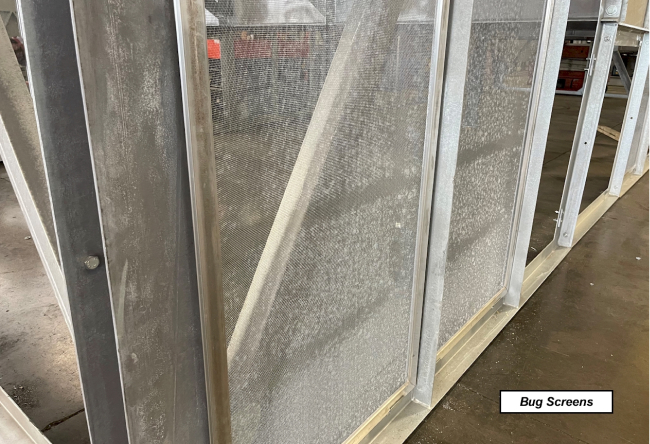
The bugs get their own screen. On AXH air-coolers’ industrial equipment, a removable mesh barrier is one of the small accommodations that stand between an elegant engineering calculation and a messy day outdoors. Fans must move air. Tubes must shed heat. Somebody will eventually need to inspect a bearing. A cooler earns its keep by handling all three without making the operator’s life unnecessarily difficult.
That practical streak is a useful way into AXH, an Oklahoma manufacturer whose work connects natural-gas machinery with the emerging demands of data centers. Its products transfer unwanted heat from fluids to surrounding air. The machinery may sit far from the equipment attracting attention, but the heat still has to go somewhere. AXH builds part of the physical infrastructure that makes that possible.
A factory business discovers another kind of hot customer
AXH’s established territory includes gas compression, processing and transmission, along with power generation and industrial processes. Its customer is typically an engineering or operating organization buying equipment for a specific duty. This is a business of temperatures, dimensions and quotations: standard configurations where they fit, custom engineering where they do not.
The company now markets X-Suite, a dry-cooling platform for data centers. Its three advertised deployment ranges run from X-Pod at 4-15 megawatts, through X-Cluster at 10-75 megawatts, to X-Campus at 50 megawatts to more than a gigawatt. Those are product-family application ranges, not evidence of a named gigawatt installation or the output of one fan.
The attraction is understandable. Dry heat rejection can reduce dependence on water-consuming cooling methods. AXH also sees an opening as higher allowable coolant temperatures make ambient-air cooling useful for more operating hours. Its equipment can serve the facility side of a liquid-cooling installation; liquid at the rack and dry heat rejection outside can coexist.
Climate still gets a vote. AXH says free-cooling capability depends on ambient conditions, design temperatures and the overall system. It offers optional adiabatic assistance for extreme conditions. Buyers therefore need to distinguish a dry operating mode from an assurance that an entire site will never consume cooling water.
FLUID→FINNED
TUBES→OUTDOOR
AIR
Heat leaves. The process fluid returns to work.
Conceptual diagram, not a piping or installation design.The first bottleneck was on a spreadsheet
AXH began making its own equipment in 2005, after operating as a sales and engineering business. An early implementation account published in 2006 describes a company that had reached 275 employees in less than a year. Plant manager Jim Lynch said the first unit was built in 2005 and that the following year’s plan exceeded 2,500 units. A production target is not a shipment count, but it explains the urgency.
The administrative tools were already feeling small. “We started with QuickBooks and spreadsheets,” Lynch said. AXH adopted Encompix software for its engineer-to-order business, with the account reporting an initial implementation in 60 days and involvement from users across the company.
Here is a lesson another manufacturer can actually borrow: when each order brings engineering decisions into production, accounting software alone stops being the whole operating system. AXH’s response was to connect the business around that order complexity. The documented shortcoming was insufficient business control as manufacturing grew; it should not be dressed up as a dramatic factory collapse.
“We started with QuickBooks and spreadsheets”
Jim Lynch, then plant manager, in a 2006 implementation account
More steel, more floor space, more people
By August 2014, AXH was adding three buildings totaling 172,000 square feet. Claremore’s economic development authority described an expansion that would take the complex beyond 500,000 square feet. It followed the acquisition and renovation of a dormant neighboring building. Growth involved putting existing industrial space back to work as well as pouring new foundations.
The current company description reports more than 1,100 employees and over one million square feet of manufacturing space across 150 acres. Its facilities directory makes that scale concrete: header welding and structural fabrication in one plant, tube finning in another, and final assembly, pressure testing and paint in another.
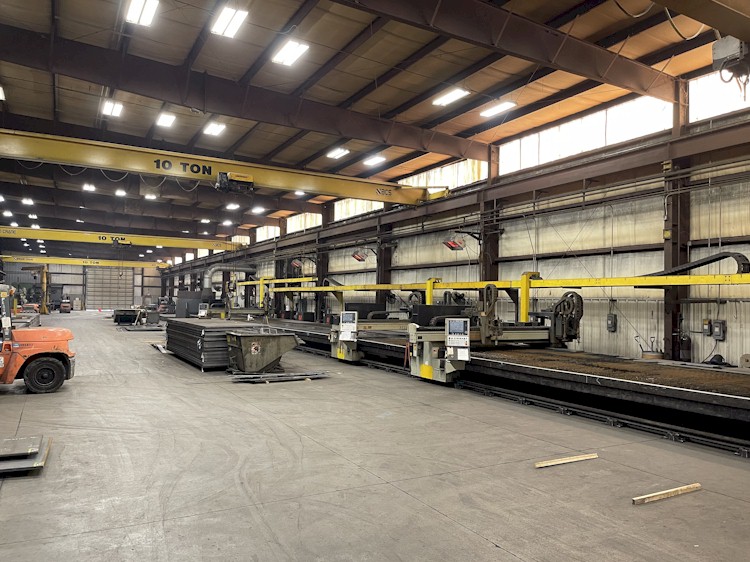
Plant 2 lists 13 finning machines. Plant 7 houses aftermarket and field service work and a cooler noise-test area. These are useful details because they describe capabilities a customer can inspect, rather than an adjective a sales department can print.
Claremore announced a $5.4 million state Business Expansion Incentive Program award in February 2025. The associated plan called for more than 200 jobs at a new Sapulpa campus and another 50 in Claremore. The award is expansion support, not the total construction bill, and the announced jobs are commitments rather than a verified hiring tally.
The local workforce was part of the equation. Reporting in the Claremore Daily Progress identified access to additional workers as a reason for choosing Sapulpa. AXH’s own careers page lists welders, fitters, CNC operators, tube rollers and hydrostatic-test technicians. Its expansion depends on people who can turn drawings into equipment that passes inspection.
The cooler has to fit the truck, too
AXH’s model letters look cryptic until the installation problem becomes visible. Its EF design uses forced draft with vertical discharge. AXH emphasizes the sloping sections, compact footprint and access to moving components. Keeping fans in cooler incoming air is part of the design argument. So is allowing a technician to see what needs attention.
The FF family addresses a different inconvenience: an application too large for a practical single-fan cooler. A narrower, lower configuration can simplify transport and, in suitable installations, share a skid with other equipment. AXH describes arrangements that reduce piping and avoid some disassembly and reassembly in the field. The bill can change long before the unit starts consuming electricity.
VI uses induced draft and vertical discharge, combining engine, compressor and multiple gas-cooling services in one structure. Optional adjustable shutters allow control over airflow for separate services. VVI and VVF offer horizontal airflow where recirculation of warm discharge air is not critical. That qualification matters: the cheaper-looking arrangement is only useful if the site can accommodate its behavior.
ZF and ZI configurations address remote, off-skid installation. The product family offers forced or induced draft and electric drives. Across the range, AXH’s proposition is choice within an engineering discipline. Buyers can match orientation, access, structure and drive arrangement to a real installation instead of forcing the installation around one standard box.
That range makes the comparison less tidy than a ranking of fan sizes. A customer choosing horizontal discharge must think about where the warmed air goes. A customer combining several services needs to think about whether those services require different temperature control. The sensible unit is the one whose arrangement survives those questions, not simply the one with the most imposing dimensions.
The next sale may be a repair
A heat exchanger is an assembly of parts with different maintenance needs. AXH offers replacement sections and tube bundles, retubing and tube re-rolling. Its header designs include individual access plugs for tube work. Specialized machined slab headers reduce welding. That is a more revealing expression of expertise than simply promising that equipment will last.
Replacement sections create a decision point for the owner. A worn bundle does not automatically mean every part of the cooler must be discarded. AXH’s published options let the buyer investigate work on the heat-transfer section itself. The useful question is whether a repair or replacement section meets the required duty within the condition and geometry of the existing equipment. It is an engineering assessment, and a reason to bring the service team into the conversation before treating a whole new cooler as the default purchase.
The commercial logic extends beyond selling new machines. AXH can sell the original cooler, then parts, repairs, performance work and field support over its operating life. Its service division also works on other manufacturers’ equipment, opening a route into facilities that did not originally buy AXH.
In July 2024, AXH acquired Arkansas-based KT MAC. The acquired business describes service coverage reaching major U.S. gas-producing regions and access to aftermarket parts through AXH. Today, AXH’s service page reports an aftermarket team exceeding 130 people, alongside mobile washing equipment, trucks and engineering support. Maintenance requires travel as well as technical knowledge.
Westland Engineering’s website supplies another clue to the widening business. It now identifies Westland as AXH and says existing customer teams remain in place, with relationships involving API Heat Transfer and Thermon Heating carried into the expanded organization. Familiar people and access to a broader operation are the offer.
Factory scale is an argument, not a monopoly
Windjammer Capital Investors acquired AXH in 2023; the investor’s portfolio dates its involvement to November. Lincoln International records the transaction. The ownership change places the later service acquisition and factory expansion in the context of a business backed by private-equity capital.
AXH also faces established alternatives. Chart Industries markets engineered air-cooled heat exchangers through Hudson Products, Air-X-Changers and Smithco, serving many of the same industrial applications and data centers. Buyers can compare engineering, delivery, footprint and lifecycle service across credible suppliers. Cooling by moving air over tubes is not exclusive to AXH.
What distinguishes AXH’s pitch is the combination of a substantial manufacturing operation, multiple familiar cooler configurations and an expanding service business. Its stated commitment joins product quality with delivery and responsive support. Those promises are most usefully judged together: a thermally suitable machine still has to arrive, fit, and remain accessible to the people maintaining it.
For an operator, the practical next step is a properly scoped quotation. Bring the operating duty and installation constraints into the same conversation. Compare the equipment price with shipping, piping, electricity and maintenance implications. For data-center teams, include the hours when ambient air alone will not meet the requirement. AXH’s story rewards that kind of specificity. Even the bug screen has a job.
Inside the machinery
Explore AXH’s website, its industrial models, X-Suite and product video, and service network. Follow AXH on LinkedIn or read the 2025 expansion announcement.