For eight months, one of the larger independent communications firms in America had a name that sounded like an arithmetic problem: Subject Matter+Kivvit. The plus sign was honest. Two companies had combined in May 2023, bringing together more than 200 people, five offices and a business approaching $100 million in annual revenue. But the name also advertised the unfinished work. Everyone could see the seam.
In January 2024, the seam disappeared. Both inherited names were retired and Avōq - pronounced “uh-VOKE” - arrived. Fourteen longtime employees became partners on the same day. The move was more revealing than the vowel with the macron. This was not a roll-up that planned to leave its acquisitions in separate rooms. Avōq wanted one operating system.
May 2023: combine the capabilities. January 2024: make the integration visible.
The product is the handoff that never happens
Avōq sits in an awkward and valuable patch of the market. A lobbying firm can explain a committee. A creative agency can make people look up from a screen. A public-relations firm can shape a news cycle. A research shop can find the audience. Clients with a narrow problem can hire any one of them. Clients whose problem crosses reputation, regulation and public opinion get the expensive puzzle: how to make all four behave as if they received the same brief.
That coordination is what Avōq sells. Its government-relations team tracks Congress, the White House and federal agencies. Its strategic-communications practice handles reputation, crisis response, executives, coalitions and media. Its advertising operation develops creative, content and paid campaigns. Research and AI-enabled tools sit beneath the three, trying to keep judgment attached to evidence.
The business model is familiar professional services: retainers and projects for corporations, nonprofits, trade associations, coalitions and public agencies. The client list shown publicly includes Amazon, Bloomberg Philanthropies, eBay, Exelon, JPMorganChase, Williams and the American Cancer Society Cancer Action Network. Avōq competes both upward and sideways - against global public-affairs networks, integrated independents such as APCO and FGS Global, political agencies such as SKDK and Bully Pulpit Interactive, and specialist shops that can be smaller and sharper on a single assignment.
“Effective advocacy requires constant evolution.”Steve Elmendorf, co-founder and managing partner
A campaign can be tiny and still move a big number
The clearest proof is not a grand brand film. During Chicago's mpox emergency, the city's health department needed to reach people most likely to be affected. Avōq interviewed community partners, placed geotargeted ads on Grindr and showed up at LGBTQ+ bars and events. The ads produced a 10 percent click-through rate - twice the app's benchmark. The creative worked because distribution was part of the idea, not a box checked after approval.
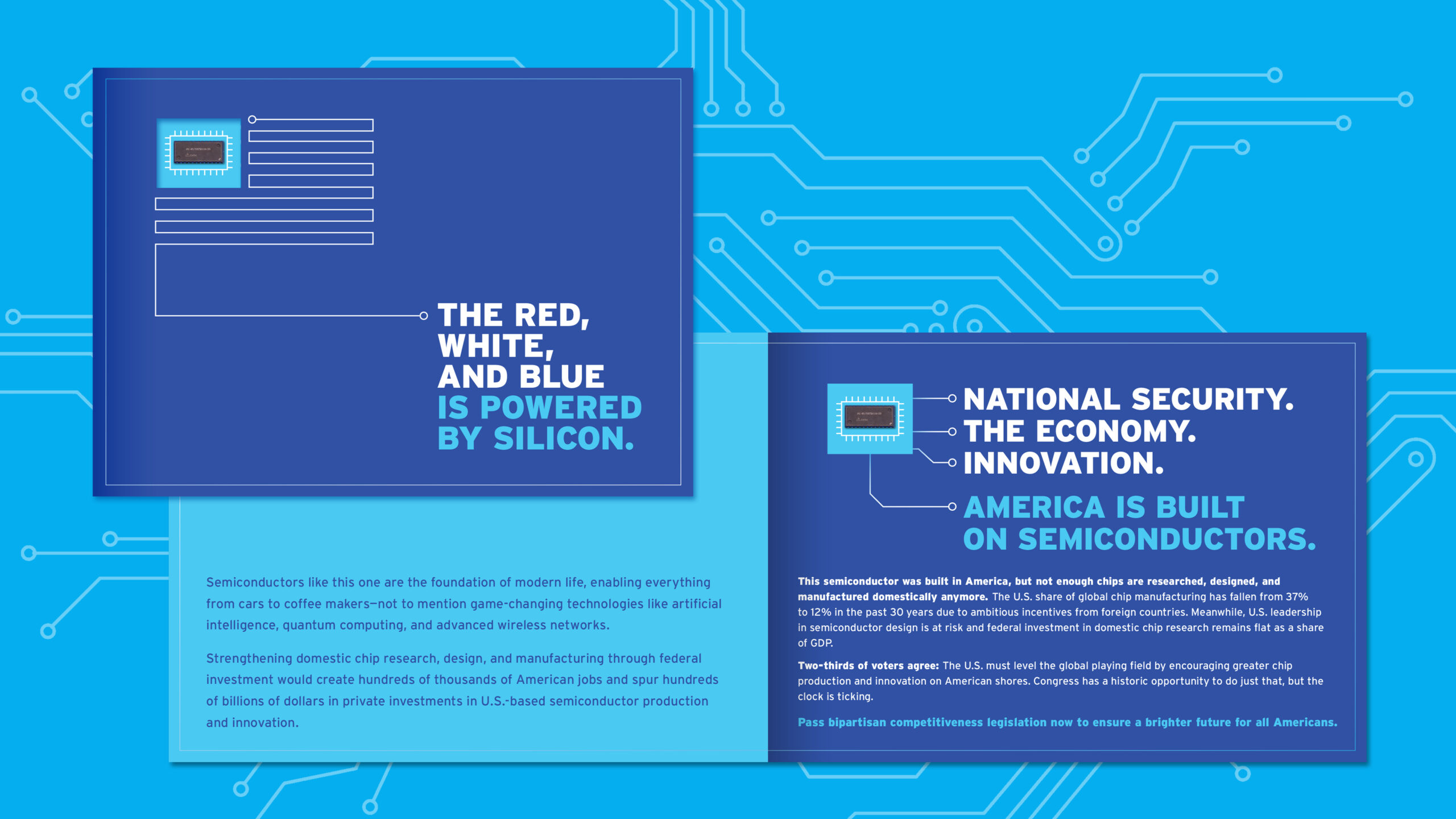
For the Semiconductor Industry Association, the scale changed but the logic did not. “Built on Semiconductors” used Avōq's research on policymakers' media habits to place advertising, earn coverage and send physical chips to Capitol Hill. The years-long effort accompanied the campaign for the CHIPS and Science Act, signed in August 2022 with $52.7 billion for American semiconductor manufacturing and research. No agency gets to claim a federal law as its own. It can claim that a complicated issue arrived in the right hands in a form people remembered.
The machine has started reading the machine
Avōq's longest-running product may be its annual study of how Washington policy insiders consume information. In 2026, a survey of 300 insiders found that 96 percent used AI personally or professionally. LinkedIn remained the unusual patch of shared ground among Democrats, Republicans and MAGA respondents, while news and opinion habits fractured elsewhere.
The firm has responded with more than a report. In September 2024, it invested in Sundogs, founded by the former leader of Google's Unskippable Labs, to develop AI-driven creative guidance and workshops. Avōq now markets Avoq IQ, a dashboard for sentiment, news and issue intelligence, and GEOmetriq, which examines how generative engines describe an organization. That last product contains a shrewd observation: when people ask machines for an answer, the machine's summary becomes a reputation surface.
This is also where restraint matters. A dashboard can notice a narrative faster; it cannot decide which compromise a chief executive should make, which community voice has earned trust or how a senator will react in the room. Avōq's more credible proposition is not “AI replaces judgment.” It is that intelligence should reduce the time senior humans spend finding the signal.
Scale, then depth, then a new driver
Coral Tree Partners took an ownership position in predecessor Subject Matter in 2022. The private-equity sponsor's thesis was expansion: new capabilities, new cities, strategic acquisitions. The Kivvit combination followed in 2023. In 2024 Avōq acquired Pennsylvania public-affairs firm SRA Communications and brought founder Steve Aaron in as a partner. The transaction prices were not announced.
Leadership changed, too. Nicole Cornish, who had run Subject Matter and then the combined company, announced her transition in 2025. Kelli Parsons became chief executive in February 2026 after serving as global CEO of Hill & Knowlton and holding senior communications roles inside Fortune 50 companies. That operator-client combination suits the next job: making a merger-built firm feel coherent to buyers who do not care about its org chart.
The culture pitch follows the same integration theme. Avōq asks employees to “show up,” “go beyond” and “jump in.” Its published package includes employer-paid health coverage, at least three weeks of vacation, 10 wellness days, paid parental leave and a four-day in-office week with a limited bank of remote flex days. There is a trade in that policy: more proximity for cross-disciplinary work, less freedom than a remote-first shop. The firm has decided the shared table is literal.
What another company can actually copy
- Keep research attached to the campaign all the way through distribution.
- Give one leader responsibility for the outcome, not separate teams credit for outputs.
- Use a temporary merger identity until the operating model is real enough to name.
- Promote the people who already connect disciplines; Avōq named 14 partners at launch.
What cannot be copied cheaply is the bench: bipartisan relationships, experienced crisis advisers, creative production and media buying under one roof. The model earns its overhead when the problem genuinely crosses systems - a policy fight with consumer consequences, a reputation crisis with regulatory risk, a public-health message with a hard-to-reach audience. For a simple press release, a local government introduction or a neatly bounded media buy, the specialist may be faster and less expensive. Integration is useful only when there is something difficult to integrate.
That is the bet hidden inside the strange little name. “Avōq” suggests emotion and action, but the firm's most practical achievement is more prosaic: it took away a plus sign. The company will be judged on whether it also took away the meetings, translations and dropped context that plus signs usually conceal.
Keep exploring