The first version of AutoDS was not a company. It was a hacked-together answer to a question familiar to anyone whose “passive” online business has begun eating the evening: must I really check this again? Lior Pozin had been selling online since he was 14. He says his first dropshipping sale arrived within roughly four hours and produced about $40 in profit. The dopamine was immediate. Then came the tabs.
A dropshipper does not own the stock. That is the attraction. A supplier holds the product and ships it after the seller makes a sale. But the absence of boxes does not mean the absence of operations. Supplier prices move. Inventory disappears. Product pages require copying and cleaning. Orders need placing. Tracking numbers must travel back to eBay or Shopify. As Pozin added listings, his side hustle acquired the temperament of a needy houseplant.
So he programmed most of the early system for himself. In a later interview, he described AutoDS plainly: “software for myself.” This is the least cinematic and most useful origin story in software - an operator notices that scale has turned a small irritation into a tax, then writes the tax collector out of the loop.
The warehouse was never the point
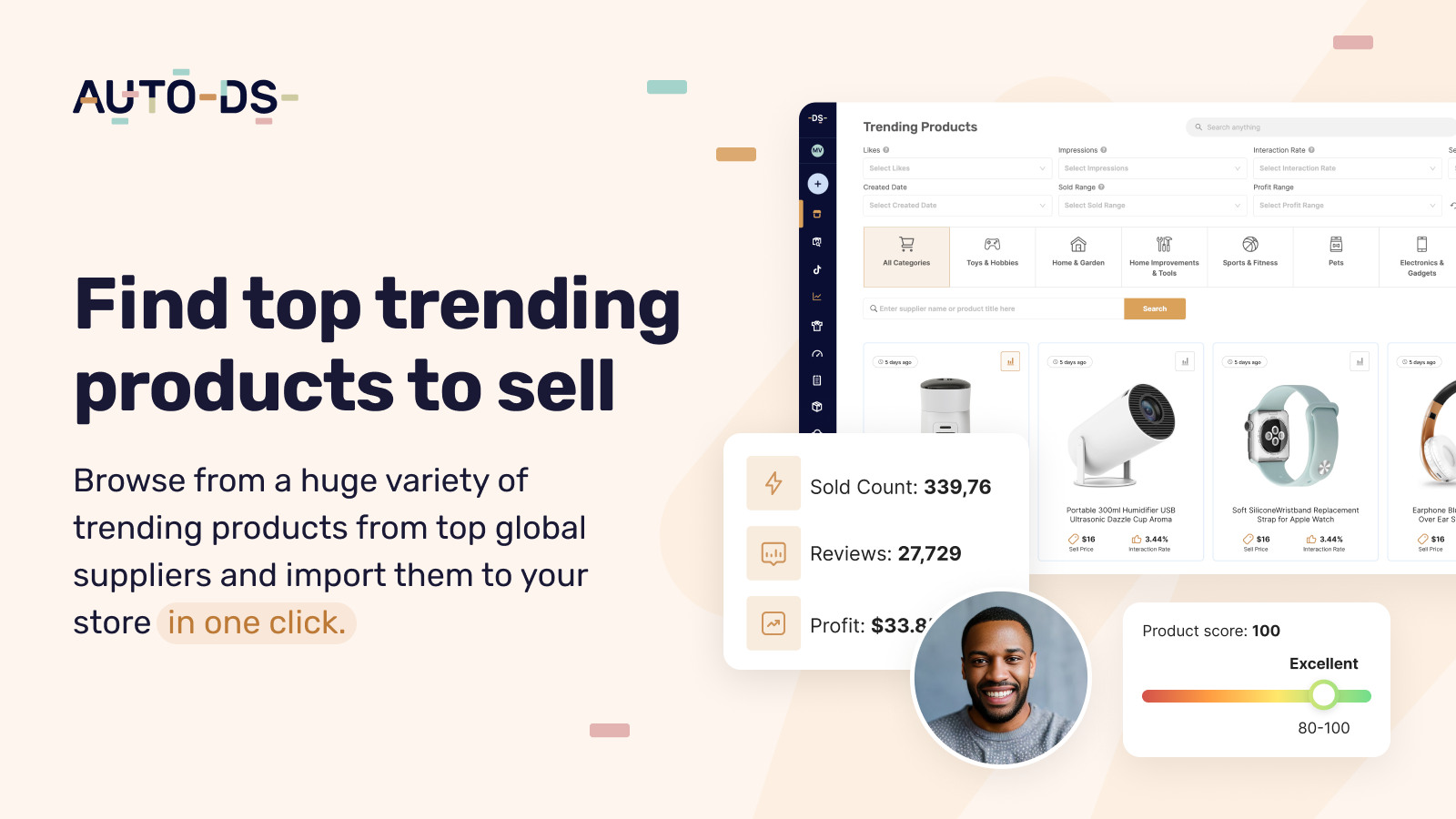
AutoDS became the layer between storefront and source. A seller can search products, import a listing, rewrite its title and description, monitor the supplier's price and stock, apply pricing rules, route supported orders and return tracking information to the sales channel. One dashboard can manage stores on Shopify, eBay, Amazon, Etsy, WooCommerce, Wix, Facebook and TikTok Shop. The marketplace reaches into retail sources such as AliExpress, Amazon and Walmart, as well as private suppliers and AutoDS warehouse inventory.
The company has kept swallowing adjacent work. There is print on demand, product sourcing, an education library, ad-spy tools, AI-generated titles and descriptions, and an AI Store Builder pitched as a two-minute route to a Shopify starting point. The product is broad because the customer is usually one person. To a large retailer, product research, merchandising, inventory control and fulfillment are departments. To a new dropshipper, they are Tuesday.
This all-in-one posture separates AutoDS from narrower alternatives. DSers is closely associated with AliExpress bulk ordering. Spocket emphasizes US and European suppliers. Zendrop leans into sourcing, fulfillment and branding. CJDropshipping combines sourcing with its warehouse network. Dropified also automates multi-store operations. AutoDS's pitch is orchestration: more channels, more supplier types and more of the operating loop in one subscription.
The customer is a tiny retailer with a large-company problem
The obvious buyer is the beginner who has watched enough tutorials to open a store but not enough hours in the day to operate it. AutoDS's courses, guides and mentoring meet that person before the dashboard does. The more durable customer is farther along: a seller managing hundreds of product variations, several suppliers or more than one storefront. At that point, a missed stock change is not an inconvenience. It can create cancellations, refunds and a marketplace-account problem.
Agencies and experienced operators use the same machinery for a different reason. They are not buying permission to start; they are buying consistency across a larger catalog. That explains why plans are measured in product variations and why price monitoring sits in the Starter tier rather than the cheapest import tier. The bill grows with operational complexity. AutoDS also courts the other side of the exchange. Its private-supplier program gives qualifying suppliers a route into a marketplace populated entirely by people looking for goods to resell. The platform is therefore part software, part demand channel and part school. Each piece feeds the next: education creates sellers, research gives them products, automation keeps them operating, and supplier access gives them somewhere to point the machine.
A subscription with moving parts
AutoDS charges by selling channel, feature tier and the number of product variations a user can manage. In the 2026 Shopify App Store listing, Import 200 cost $26.90 a month, Starter 500 cost $39.90 and Advanced 1K cost $66.90. Annual billing lowered the effective rate. Research features and fulfillment can add costs. Amazon plans are priced differently from Shopify plans. The tidy starting price is real; so is the need to calculate the full stack before trusting a margin.
That model gave Fiverr something its freelance marketplace does not naturally produce: recurring software revenue. It also gave Fiverr a customer arriving one step earlier. Someone building a store with AutoDS may soon need a logo, a product video, ad creative, a developer or a customer-service freelancer. Fiverr co-founder Micha Kaufman called the audiences highly synergistic. In less corporate language: the same person has two shopping lists.
“Other” combines an accrued payment and the fair value of unvested options. Separate employee retention hold-backs totaled $12.168 million.
Fiverr's filing recorded $55.658 million in total fair-value consideration: $39.339 million in cash, $14.116 million as the fair value of an earn-out, $1.556 million accrued and $647,000 in unvested options. The agreement allowed up to $36 million in earn-out consideration if AutoDS hit financial targets over three years. Fiverr also placed $12.168 million into separate employee hold-backs tied to continued employment. The filing assigned $26.453 million to the technology itself. Almost half the deal was, quite literally, the machinery.
What failed first was manual scale
There is no single public founder confession in which one spectacular disaster produces AutoDS. The early failure was more ordinary: every additional listing multiplied monitoring, ordering and tracking. Manual scale failed before demand did. Pozin's change of mind was to stop treating software as backstage equipment for his stores and recognize that other sellers had the same backstage problem.
The product expanded by the same logic. AutoDS launched its Shopify app in 2020, reported crossing one million dropshippers in 2022, and bought DSMTool and ViralVault in 2023. By Fiverr's July 2024 announcement, it aggregated more than 150 million products and served tens of thousands of paying subscribers. AutoDS now advertises 1.8 million dropshippers across its wider ecosystem, more than $1 billion earned by sellers and 800 million products available. Those larger figures are company-reported reach metrics, not a count of current paid accounts.
Its culture mirrors the product story. The company names four values - Freedom, Innovation, Think BIG and Community - and says its distributed team includes more than 200 people across 65 countries. A newer LinkedIn update put the team above 250 and noted that, after nine years in WeWork, AutoDS finally opened a home of its own. For a company selling freedom from the office, it turns out an office can still feel like arrival.
Automation is a multiplier, including of mistakes
The hard limit of AutoDS is visible in its architecture. It depends on storefront rules, supplier feeds, carrier events, regional availability and APIs it does not control. A supplier can change a price. A carrier can provide tracking a marketplace does not accept. An item can arrive late or disappoint the customer. Review sites contain plenty of praise for time saved and centralized management, alongside complaints about billing, support, supplier reliability and tracking. Both sets of experiences make sense.
AutoDS can synchronize a decision. It cannot make the product desirable, the supplier careful, the shipping lane fast or the unit economics generous. Test those before turning up the volume.
The service is a poor fit for a seller who needs an unsupported supplier or region, wants a free AliExpress-only tool, cannot absorb add-ons, or has margins so thin that a shipping change erases the sale. It also will not work as advertised if “automation” is interpreted as abandonment. The sensible rollout is small: connect one store, import a few products, place test orders, verify the landed cost, watch the tracking handoff and read the selling channel's rules. Trust is earned order by order.
The bit worth copying
Do not copy AutoDS by bolting twelve features onto a pitch deck. Copy the sequence. Pozin used the workflow himself. He found the repetition that became expensive at volume. He automated one loop. Only then did the private tool become a public product. Competitors were not a reason to hide; they were a map of customer expectations. In a later post, Pozin wrote that he watched what rivals shipped, used it and tried to improve it.
That is the company in one sentence: AutoDS turned the unlovely middle of dropshipping into software. The research tools bring customers in, the AI makes the front door feel current, and the education helps novices imagine the first sale. But the enduring value is quieter. At 2 a.m., when a supplier changes a price, the software notices before the seller does. Fiverr did not pay $55.7 million for a dream of effort-free retail. It paid for fewer tabs.