Some watches whisper good taste. The Autochron Orange Automatic arrives carrying a pit board. Its black dial burns outward into orange, two beige counters sit at twelve and nine, and a black timing bezel fences in the commotion. The effect is peculiar, warm and instantly readable as a product of the 1970s, even though this particular version landed in August 2026.
Why should anyone care? Because many vintage-flavoured chronographs have become polite. They borrow a panda dial, trim the case and call the past back to work. Nivada Grenchen has revived a design that was strange even when it was new. The Autochron descends from an estimated batch of roughly twenty late-1970s prototypes that never reached regular production. It now brings an established Swiss automatic movement, modern water resistance and a scratch-resistant crystal to the party.
This is for the collector who has already seen enough symmetrical subdials, the motorsport fan who prefers paddock typography to sponsor logos, and the smaller-wrist buyer tired of 42 mm chronographs. It is less convincing for someone seeking a thin dress watch, a discreet office companion or maximum chronograph value per dollar. Orange has never been employed by the diplomatic service.
Origin story / the one that escaped
A prototype gets another lap
The original watch sat in an awkward, interesting territory between a dive watch and a racing chronograph. Its dial is associated with Jean Singer, the Swiss dial maker whose work appeared on celebrated chronographs from Omega, Heuer and Rolex. The unusual arrangement puts a counter at twelve, small seconds at nine and the date at three. Vintage orthodoxy might raise an eyebrow. The eyebrow is part of the appeal.
When Nivada rebuilt the design for modern production, the company did not own an original example. According to a conversation reported by Hodinkee, the team worked from photographs, measurements and judgment. That sounds reckless until you remember that archaeology also involves a good deal of educated squinting. The first modern revival was known as Chronosport; the family is now marketed as Autochron.
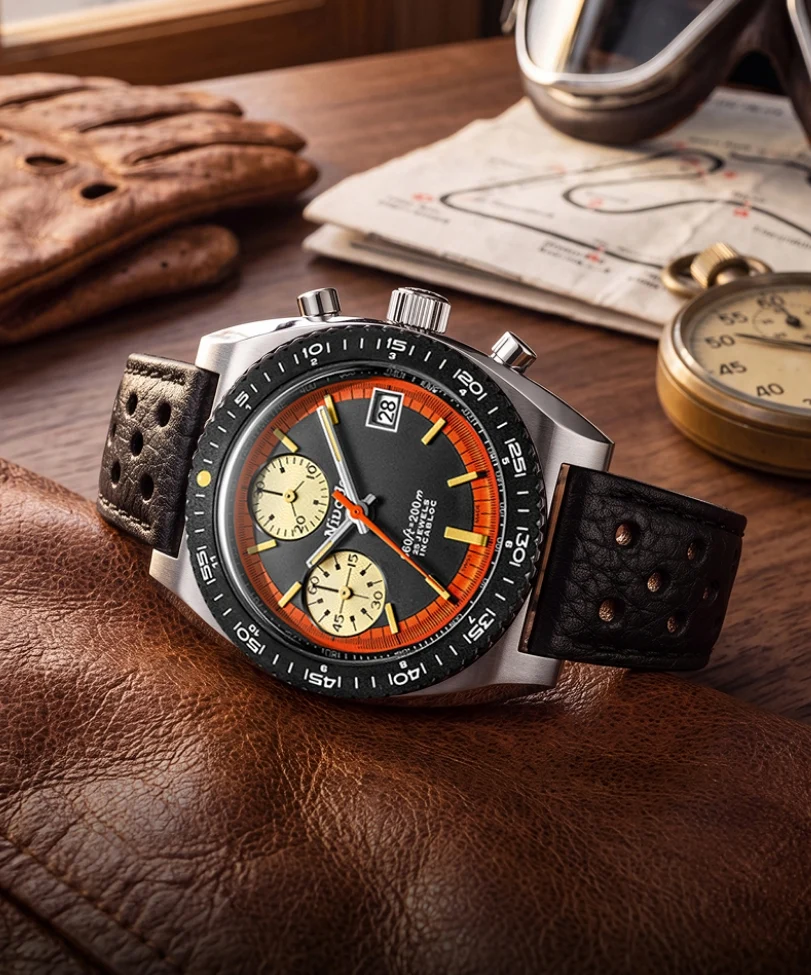
For 2026, Nivada built a five-watch Autochron group. Four use the TMI VK67 mecaquartz calibre and cost from $530. The orange automatic stands alone with the ETA Valjoux 7750 and starts at $2,295. This is more than a colour option. It changes the dial layout, the feel of the pushers, the ownership ritual and, eventually, the servicing bill.
“The oddness is not a flaw to be airbrushed. It is the reason the watch survived.”YesPress verdict
On the wrist / compact, not thin
The footprint saves the height
The case is 38 mm wide and 44.3 mm from lug to lug. Those are friendly numbers. The thickness needs a footnote: Nivada states 12.7 mm without the crystal and 15.2 mm including the domed sapphire. A Valjoux 7750 is not a movement one slips under a cuff with forged papers. The crystal exaggerates the vertical measurement, while the short lug span keeps the watch planted.
Earlier automatic Autochron owners describe the 15 mm profile as wearing better than the number suggests, including on a 7.25-inch wrist. An earlier Hodinkee hands-on found the case noticeable and somewhat top-heavy. Both can be true. Wrist shape, strap tension and tolerance for mechanical chronograph bulk matter. If possible, try one before buying. If not, compare its 44.3 mm span with a watch you already own rather than staring only at the diameter.
The shape of the proposition
The case mixes vertical brushing with polished details. This is useful visual tailoring: brushing calms the broad cushion shape, while the polished bevel catches enough light to separate it from a steel biscuit tin. A signed screw-down crown and 20 ATM rating give it credible sports-watch utility. Nivada offers a 24-month warranty, a sensible detail for a machine containing more moving parts than many small kitchens.
Mechanics / an old engine with a job
What the 7750 brings
Inside is the ETA Valjoux 7750, beating at 28,800 vibrations per hour, or 4 Hz. It winds from wrist motion and provides a stated 48-hour reserve. The functions include central chronograph seconds, a 30-minute counter, a 12-hour counter, small seconds and a date window. This is an established cam-operated automatic chronograph architecture, chosen here for function and historical texture rather than exhibition-case theatre.
The watch can time a drive, a coffee extraction, a meeting or the interval before someone asks about the orange thing on your wrist. Its 37 mm aluminum bezel rotates in one direction through 120 clicks. That is a meaningful update over the friction-style bezel found on the earlier revival. Use the bezel for elapsed minutes and the chronograph for a second event. The tachymeter can estimate average speed over a known mile or kilometre, though the dense dial rewards good eyesight.
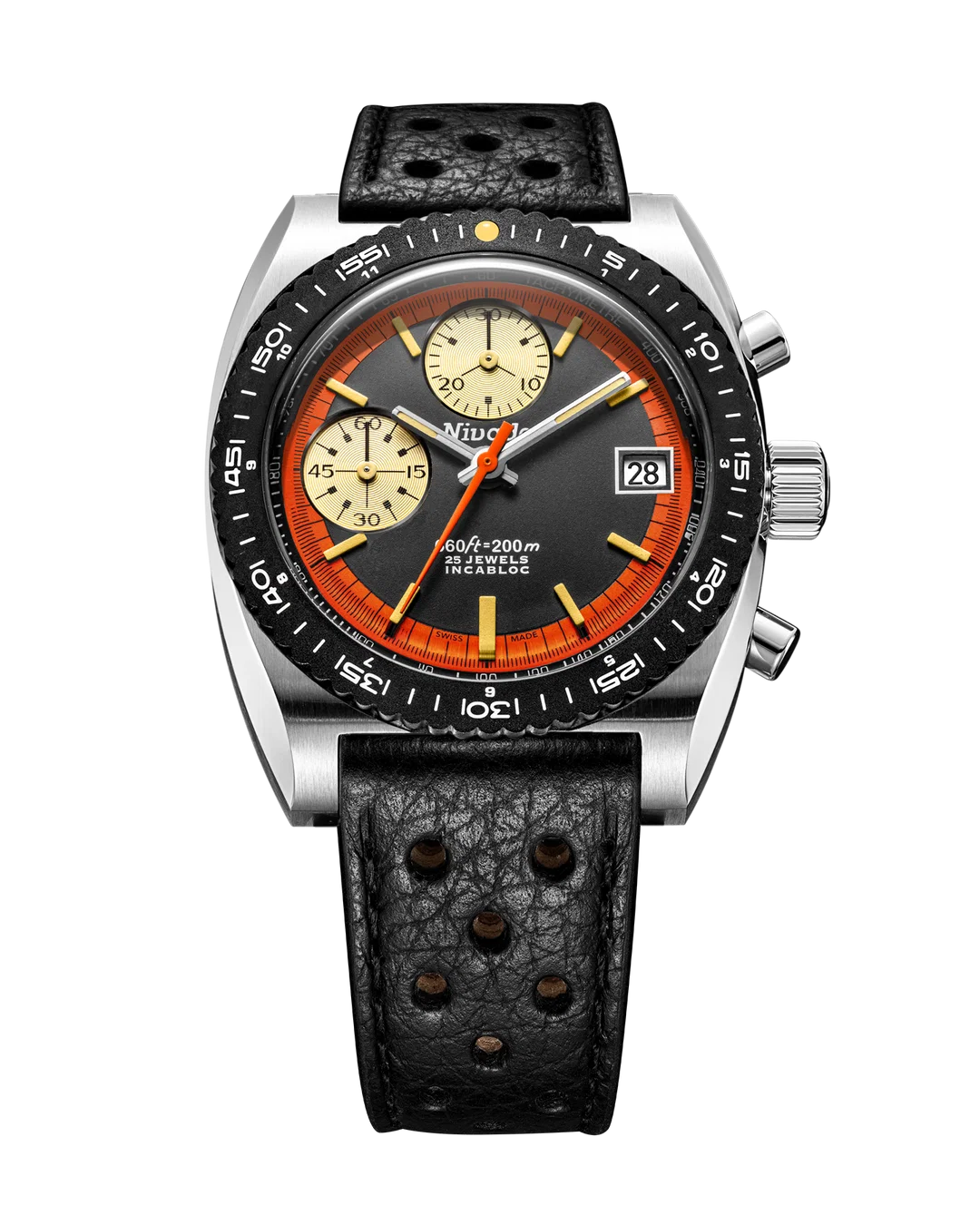
Readability deserves a test drive
Owners of earlier blue automatic Autochrons have praised the fit and functionality while noting that black hour and minute hands can disappear in some light. The orange model uses a different high-contrast field, but the layered dial remains busy. Check the hands at a glance, indoors and outdoors, before deciding.
Buying guide / where the money goes
The $2,295 question
On the black racing strap or orange Tropic rubber, the US launch price is $2,295. The steel bracelet costs $2,495. That puts the Autochron near serious mainstream rivals. The Tissot PR516 automatic chronograph is listed at $2,150 with a 41 mm case, 68-hour reserve and 100 m rating. Hamilton’s 40 mm Intra-Matic Auto Chrono starts around $2,595, with a 60-hour reserve and 100 m rating.
| Watch | US price | Case | Reserve | Water rating |
|---|---|---|---|---|
| Autochron Orange Automatic | $2,295 strap | 38 mm | 48 h | 200 m |
| Tissot PR516 Automatic Chronograph | $2,150 | 41 mm | 68 h | 100 m |
| Hamilton Intra-Matic Auto Chrono | $2,595 | 40 mm | 60 h | 100 m |
| Autochron Mecaquartz | from $530 | 38 mm | battery | 200 m |
The Tissot wins the reserve contest and undercuts the Nivada. The Hamilton offers a tidier, familiar racing-chrono face. The Autochron answers with the smallest diameter, twice their stated water depth and a design you are less likely to meet across the conference table. Value here depends on whether eccentric provenance counts as a feature. For a buyer who only wants the shape, the $530 mecaquartz version is the ruthlessly rational choice.
Remember that automatic chronographs cost more to service than quartz or simple three-hand watches. The 7750’s familiarity should make qualified servicing easier to find than an obscure calibre, but “easy” is not the same as inexpensive. Budget for periodic maintenance and never operate pushers underwater unless the maker explicitly says the construction supports it.
Straps / choose your volume
Leather, rubber or steel?
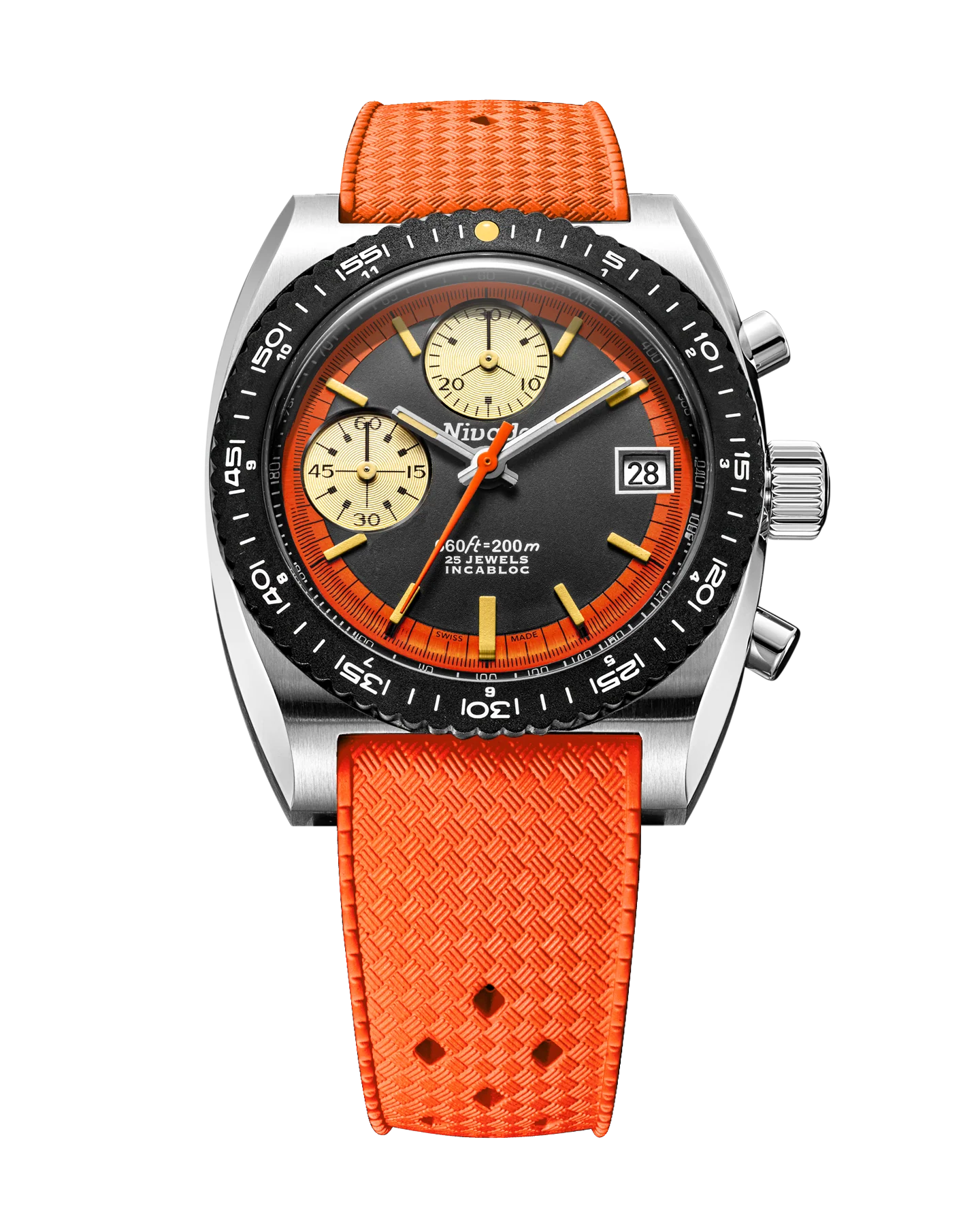
The black perforated racing strap gives the dial room to perform and keeps the initial price down. It is the easiest pairing for daily wear. Orange Tropic rubber turns the watch into a full-colour summer object and makes practical sense near water. The bracelet adds visual weight, period flavour and $200. Its steel continuity may help a thick watch feel more balanced, though it also makes the whole package louder.
- Buy it if: you want a compact automatic chronograph with genuine visual oddity and useful water resistance.
- Pause if: a 15.2 mm total height, busy dial or orange gradient will become a daily irritation.
- Choose leather if: you want contrast, lower cost and the clearest vintage-racing mood.
- Choose rubber if: you plan to use the 200 m rating and consider moderation suspicious.
There is no public model-level sales count and the watch was listed as a pre-order at launch. Nivada said in a 2023 interview that the brand produced around 4,000 watches per year at that time, so this operates on a smaller scale than Hamilton or Tissot. That can add charm and reduce the odds of wrist duplication. It can also mean fewer retail locations for a try-on. Confirm delivery timing, return terms and local taxes before paying.
The verdict
The Autochron Orange Automatic is not the spreadsheet champion. Two close rivals offer longer power reserves, and Nivada itself sells the same broad visual idea with mecaquartz power for less than a quarter of the price. The automatic earns its place through a narrower case, deeper water rating, tactile bezel and the lively behaviour of the Valjoux 7750.
More important, it has a point of view. The offset counters, orange perimeter and cushion case do not dissolve into the vague paste of “vintage inspired.” They belong to a failed commercial experiment that became interesting precisely because it failed. Nivada gave that experiment modern shoes, a sapphire helmet and another lap.
Buy it for the story only if you also enjoy the object. Buy it for the mechanics only if you also accept the thickness. If both answers are yes, the Autochron delivers something increasingly rare at this price: a watch that can be identified from the other side of the room without shouting a famous logo.