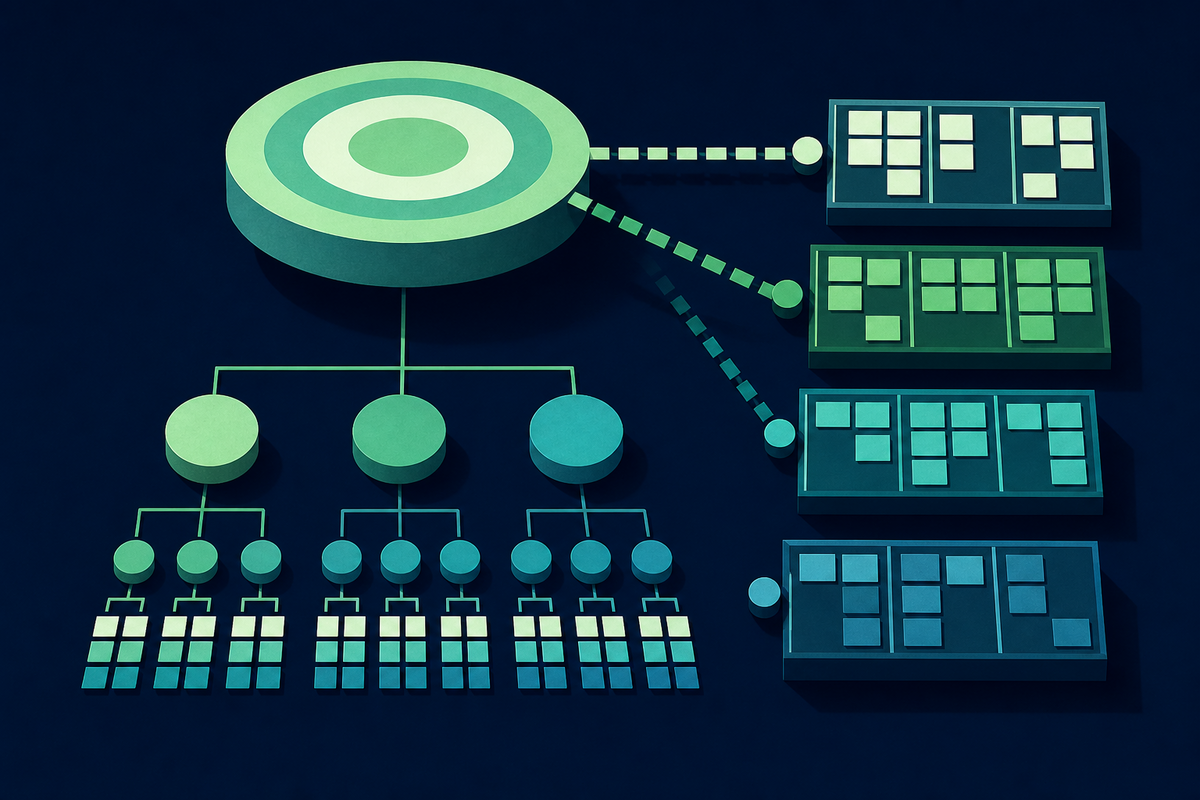
The most revealing moment in a project-management demo comes after somebody changes a task. Ignore the confetti, the colors and the satisfying drag across a board. Look instead at the company goal three levels above it. Did its progress change? Can you see why? Can an executive move from that percentage back to the work, or does somebody have to reconcile a dashboard before Friday’s review?
That is where Asana and monday.com separate. Both products can plan projects, assign work, automate routine steps and put charts in front of leadership. Both can be configured to track objectives and key results. monday.com even markets a PMO product that connects goals to projects and provides portfolio-level reporting. Calling it unable to track goals would be false.
The important distinction is structural. Asana treats a goal as a native object. It has an owner, a time period, a status, an accountable team and a place in a parent-and-sub-goal hierarchy. Its progress can be updated manually or calculated from connected sub-goals, projects and tasks. Reporting can point directly at goals as a category of data. monday.com’s own OKR instructions begin somewhere else: set up a board, use groups for objectives, items for key results, columns for their attributes and subitems for the initiatives underneath.
A goal object beats a goal-shaped board
This sounds like database trivia until a company grows. A ten-person team can keep its definitions in everyone’s head. “Done” means what the founder says it means. The marketing lead remembers which launch board supplies the quarterly objective. If a metric is stale, somebody fixes it in the meeting.
At a hundred teams, the invisible conventions become infrastructure. One group calculates progress by completed tasks. Another weights milestones. A third enters the number manually because its board has different columns. All three dashboard tiles may be green. They may not mean the same thing.
Asana narrows that ambiguity by giving the strategy layer its own schema. A goal can be an objective, key result or individual goal. It can belong beneath another goal. Its automatic progress source is declared, and supporting work is connected rather than merely placed nearby. A goals dashboard can chart goals by team or status because “goal” is something the system knows, not just a row arranged to look like one.
The useful number is not the percentage at the top. It is the path that lets you audit the percentage all the way down.YesPress analysis
That structure has a practical consequence: the goal-to-work connection is reusable. Teams can change how they view a project without redefining the existence of the goal. Leaders can filter a goal view without asking every department to reproduce the same board template. The object persists across views and reporting contexts.
Two paths from strategy to execution
Progress sources and hierarchy are defined on the goal.
The path is assembled from configurable board components.
Flexibility sends an invoice later
monday.com’s board model is not a mistake. It is the product’s appeal. A group can represent an objective, a phase, a region or a client. Items and columns can be adapted to nearly any operational vocabulary. Its dashboards combine data across boards, and its newer project boards add a project overview, health status and a connection to enterprise portfolios. A capable operations team can build a convincing chain from goals through projects to execution.
But “can build” belongs in a different column from “already modeled.” Each connection introduces choices: which board owns the metric, which column supplies progress, whether subitems count, how weights work and who protects the formula when a local workflow changes. monday.com can govern these choices with templates, permissions and portfolio practices. The customer carries more of that governance.
The difference resembles the one between a spreadsheet model and a ledger. A spreadsheet is more flexible. A ledger is more opinionated about what a transaction is. When the question is unusual, flexibility wins. When the same question must be answered every month across a large organization, the opinionated object earns its keep.
Where setup responsibility sits
Teal indicates the relative Asana advantage discussed here; coral indicates the relative monday.com advantage. These are an editorial framework, not measured product scores.
This is why a comparison framed around “ease of use” misses the consequential issue. Ease is situational. A team fluent in monday.com may build a board faster than it can persuade colleagues to adopt a new Asana hierarchy. A company with rigorous monday.com templates may already have reliable reporting. Interface preference is real, but it says little about how strategic data travels.
Run the demo backward
Buyers should stop asking vendors to show a pristine executive dashboard. Every vendor can prepare one. Ask for a dirty scenario. Create a company objective, two supporting projects and a handful of tasks owned by different teams. Make one task late, complete another and remove a third from scope. Then watch what happens above.
Does the key result update automatically? Does it expose the source and the calculation? Can a project be connected without being forced into a special template? What happens when one team measures percent complete and another measures a numeric target? Can the goal owner override the number and leave a visible explanation? Can leadership report on every at-risk goal without knowing which boards contain them?
Asana’s documentation gives direct answers to much of that test. Automatic goal progress can come from sub-goals, projects or tasks. Goals can be arranged beneath parent goals. Reporting offers prebuilt charts such as goals by team and goals by status, as well as custom charts that report on Goals. Status updates add narrative context to the number.
monday.com answers with a toolkit. Its OKR guide uses groups, items, columns, formulas and subitems. Cross-board dashboards provide a higher-level view. Project boards can calculate health from task status and, on Enterprise, connect into portfolios for project-level rollups. That toolkit can produce strong reporting. It also means the architecture of the answer is partly your work.
Define one canonical progress rule before choosing a tool. Name the permitted sources, weighting method, owner and exception process. Then make each vendor reproduce it live across several projects.
Completion is evidence, not impact
There is one trap neither product can solve automatically. Task completion is only a useful goal signal when the tasks represent the right theory of change. A team can finish every launch asset and miss the revenue target. It can close a migration project while customers remain stuck on the old system. Automatic rollups remove clerical work; they do not turn activity into an outcome.
A sound design therefore separates delivery measures from result measures. Tasks and milestones can update a delivery key result such as shipping a new onboarding flow. A numeric business result such as activation rate should come from the system that records activation, or be updated by an accountable owner with evidence. Mixing both into one completion percentage creates precision without meaning.
Asana’s model helps because it permits different progress sources and keeps a status narrative beside the measure. monday.com can represent the same distinction with separate columns, connected boards and integrations. In both cases, the buyer must decide which facts deserve to roll up. The native object makes the policy easier to repeat; it does not write the policy.
This is also why leaders should resist rewarding the greenest dashboard. A trustworthy system makes bad news travel quickly. It should show a delayed dependency, preserve the explanation and let the goal owner change course without erasing history. The purpose of alignment software is not to prove that the plan worked. It is to reveal, early enough to matter, when reality has stopped cooperating with the plan.
The winner depends on the question
If the job is to design unusual operational workflows, monday.com’s configurable boards may be the better instrument. If teams already share a mature board architecture, switching tools to gain a native goal object could destroy more clarity than it creates. Software does not arrive in an empty company.
If the job is to make strategy legible across many teams, Asana has the cleaner primitive. It reduces the amount of custom modeling required before a goal can own a hierarchy, inherit progress and appear consistently in reporting. The advantage becomes more valuable when workflows differ but leadership’s questions stay the same.
The distinction is modest on a feature grid and large in a quarterly review. A board can display a goal. A dashboard can summarize a board. A native goal layer can preserve the identity of the objective while the work beneath it changes. For companies tired of rebuilding the bridge between the plan and the task list, that is the part worth buying.
Goals-to-task reporting FAQ
Can monday.com track OKRs?
Yes. monday.com documents an OKR-board workflow and offers dashboards, project overviews and portfolio reporting. Its official guide models objectives and key results with board components.
What makes Asana Goals different?
Goals are a native Asana resource with owners, time periods, statuses, hierarchy and automatic progress sources from sub-goals, projects or tasks.
Does monday.com roll task progress upward?
It can aggregate work through formulas, connected boards, dashboards, project overviews and portfolios. How that reaches an OKR depends more on the customer’s board design.
Is Asana always the better choice?
No. monday.com may fit teams that value configurable workflows or already maintain disciplined board templates. The Asana advantage here is specifically native goals-to-work reporting.
What should a buyer test?
Change tasks across several projects, inspect the goal’s update, and trace the reported progress back to every source. Also test weighting, exceptions and cross-team filters.