A dispatch call has an unusually long afterlife. Someone answers it. Someone sends an officer. Someone writes a report. Later, another person needs to find the evidence, classify the incident or explain what happened. The original event keeps acquiring new administrative lives. At each transfer, the same question returns: does the next person have the information the last person already entered?
That is a useful way into ARMS, the public safety software company whose initials stand for Automated Records Management System. Its catalog is full of familiar institutional nouns: dispatch, records, parking, reporting. The interesting part is the space between them. ARMS sells the possibility that an agency can stop treating each stage of an incident as a fresh typing assignment.
- Connected dispatch, records and mobile tools carry incident information between roles.
- Campus reporting and everyday administration give the suite a specific audience.
- A 2026 acquisition adds jail management, with further integration still ahead.
The second entry is the expensive one
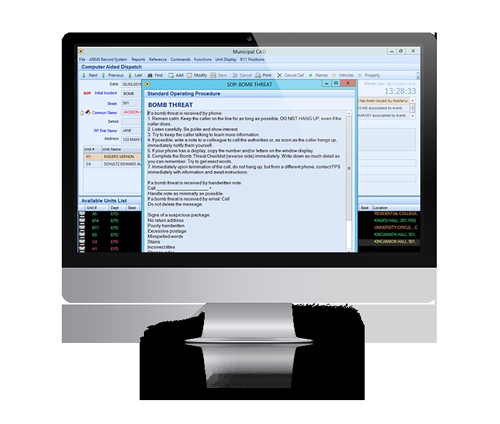
In ARMS CAD, dispatchers can see available units, pending calls and location histories. Procedures can be attached to incident codes, putting instructions beside the event that requires them. Warnings attached to a person, vehicle or location trigger visual and audible alerts. These are small interface decisions with a clear purpose: make relevant information available while somebody can still act on it.
The connective tissue matters more than the list. Names, vehicles and property entered into a CAD event become accessible across ARMS modules. A location can carry earlier incidents, contacts and hazard information. The software is designed to preserve context as responsibility moves from the communications desk to the field and then to the records office.
- 01DispatchCall + location + units
- 02FieldQueries + incident updates
- 03RecordsNarrative + evidence
- 04ReportingReview + disclosure
Chief Chris Robertson of New Albany, Mississippi, puts the appeal plainly in an ARMS-published testimonial: “ARMS has made it possible for our Police Department to put all information into one system.” That is a modest-sounding ambition. Anyone who has reconciled two incompatible records will recognize how much work the sentence contains.
A campus is a revealing customer
Consider the range of work inside a campus safety department. There are calls requiring immediate response, incidents requiring investigation and records requiring review. There are also parking permits, citations and appeals. ARMS serves this combination, alongside municipal agencies, school districts, hospitals and other public safety organizations. Its breadth makes more sense when viewed through the customer's working day.
The campus emphasis is especially visible in Clery-related tools. ARMS supports offense classification, scoring and reporting workflows, with a Report Center for reviewing annual reporting data. The practical proposition is to connect incident administration with disclosure work. Good software can help organize that work; the institution still needs people who understand the classifications and review what gets reported.
Parking belongs in the same picture. ARMS Parking joins permit registration, citation handling and appeals. It may seem like an odd neighbor for police records. But an agency buying operational software has to handle routine disputes as well as urgent events. A system's usefulness is tested on an ordinary Tuesday, too.
Give the camera a little context
The cleanest example of the handoff argument comes from Billerica Police in Massachusetts. In August 2025, Axis Communications completed an integration between its body-worn camera system and ARMS CAD. The connection uses dispatch information to match responders with footage and the nature of their response.
Axis Camera Station updates the footage category from CAD data. Those categories are associated with retention schedules reflecting local and state requirements. The value is wonderfully concrete: video arrives with more of the administrative context somebody would otherwise have to supply. The camera records what happened. The dispatch record helps tell the video system what it is looking at.
The dispatch record helps tell the video system what it is looking at.YesPress analysis
The server is only part of the purchase
ARMS emphasizes cloud SaaS hosted on Microsoft Azure Government, supported by security controls it describes as aligned with the FBI's CJIS Security Policy. Its mobile suite supports iOS, Android and Windows tablets, giving field personnel access to queries, incident details and report writing. Its records product adds approval tracking and evidence tools, including barcode-based chain-of-custody management.
Buying those capabilities also means changing habits. ARMS advertises a typical implementation period of 60 to 90 days, including migration, project management and training. ARMS Academy supplies self-guided courses, videos and assessments, with supervisors and power users able to become internal trainers. Those services address the human side of replacing an agency's working memory.
The sensible cost comparison includes subscriptions, conversion work, interfaces, devices and staff time. A browser does not remove those decisions. Buyers should also compare alternatives such as Tyler Technologies and Mark43, which offer connected public safety applications themselves. ARMS's more specific pitch combines operational breadth with campus reporting and support, rather than relying on cloud delivery alone as a distinction.
Now follow the record into the jail
A strategic growth investment from Vertica Capital Partners, announced in February 2025, backed plans for expanded support, cloud capabilities and product development. In February 2026, ARMS announced its acquisition of ATIMS, adding jail management to the portfolio. Intake, housing, movement and release now sit within the company's wider public safety offering.
There is a useful qualification inside that expansion. ARMS says ATIMS will remain a dedicated corrections solution, with shared infrastructure and future cross-platform capabilities part of the direction. A larger portfolio creates opportunities for connection. Buyers should distinguish those opportunities from interfaces already working in production.
The lesson other organizations can copy is simple: test the handoff. Take one realistic incident through dispatch, mobile reporting, evidence review and final reporting. Check what carries forward and what needs correction. Include a difficult historical record and an interrupted connection. ARMS's proposition becomes persuasive when the information survives that journey. The most useful demonstration ends where the next person's work begins.