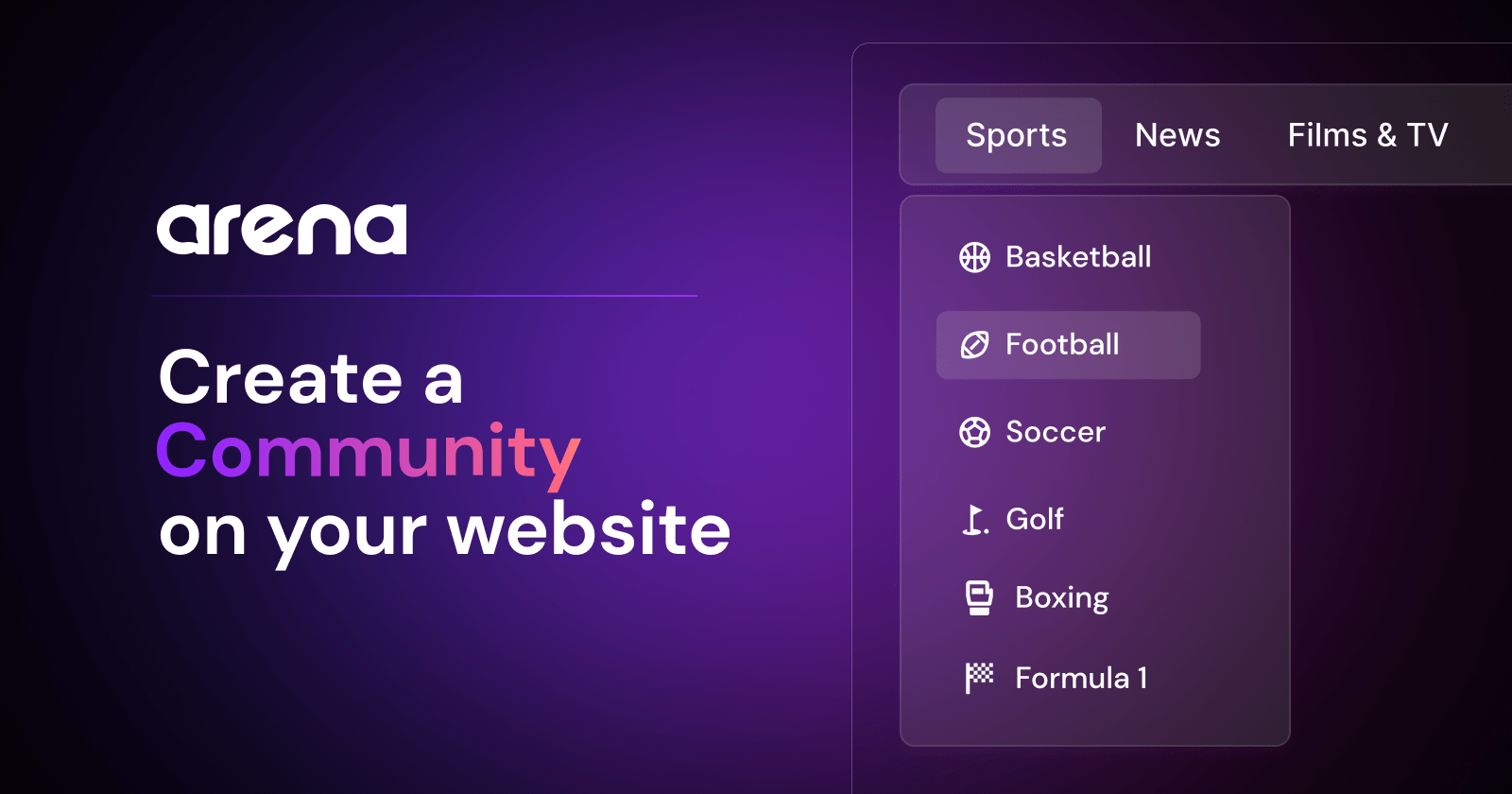
It's a Saturday night. A live football match is on, and a few hundred thousand fans are not on Twitter, not on Reddit, not even - mercifully - in a Facebook group. They're on Fox Sports' own website, arguing about a penalty, dropping reactions, voting in a poll about who deserved the red card. The chat is hosted by a company called Arena. Most of the fans have no idea. That, in fact, is the point.
Arena, the eleven-letter San Francisco software company quietly powering branded communities for more than twenty thousand organizations, is not a household name. It does not want to be. Its job is to be the very good plumbing under someone else's living room.
CONFIDENTIAL // OWNED AUDIENCE FILE: ARENA.IM01 / The problem they sawThe internet got loud. The audience went rented.
Around 2016, an uncomfortable truth was settling over every publisher with a CMS. Their readers were no longer their readers. They were Facebook's readers, who occasionally clicked through. They were Twitter's readers, who arrived only when the algorithm felt generous. The publisher paid for the journalism; someone else owned the relationship. This was the bargain. Most people pretended it was fine.
Paulo Martins, then an engineer with a stint at Hulu's ad-products team, looked at the bargain and decided it was not fine. Alongside his co-founder Rodrigo De Castro Reis, he started a company first called Stationfy - a name now politely buried in the company's old Facebook handle - and later renamed Arena. The premise was simple enough to fit on a napkin and stubborn enough to require eight years of execution: communities should live on the website that earned them.
02 / The founders' betBuild the boring plumbing nobody else wanted to build.
There is something almost Oscar-Wilde-ish about Arena's position. Every brand insists it adores its community. Very few brands had been willing to do the unglamorous engineering work of actually hosting one. Chat at scale is, charitably, a misery. Live blogs are deceptively hard. Comment sections are where the internet's worst impulses go to take selfies. Building a stack to handle all three, with moderation, AI, and analytics, was not an obvious career move. Arena did it anyway.
The bet paid out, slowly at first. The company went through Techstars. Redpoint eventures, the regional venture firm with a long memory for Brazilian software, put in early capital. By March 30, 2022, CRV's Murat Bicer led a $13.6 million Series A, with Craft Ventures, Artisanal Ventures, Vela Partners, Incubate Fund and Primeset joining. Bloomberg Línea, ever fond of a narrative, framed the round as part of a wider Brazil-to-Silicon-Valley migration. Arena framed it as a quiet expansion of headcount and a louder expansion of ambition.
03 / The product, brieflySix tools, one promise: keep them on your site.
Arena's product surface is wider than its press hits suggest. There is a Live Blog, designed for the second-by-second adrenaline of breaking news, championship matches, and product launches. There is Group Chat, the closest analogue to Discord that brands can drop into their own domain without asking permission from a server admin in a Vader avatar. There are Comments, which Arena treats less as a regrettable necessity and more as a revenue opportunity. There are Polls AI, which let publishers ask questions and get tagged, structured answers. There is a Content Wall that pulls in social posts, RSS, and AI-curated streams. And there is Audience Analytics - the part the CMO cares about, because it generates the first-party data that everyone in 2026 is suddenly remembering matters.
It is, in plain language, a kit. The no-code deployment means a publisher does not need an engineering sprint to put any of it live. That is the kind of decision a company makes when it has watched too many promising features die because someone, somewhere, refused to file a Jira ticket.
What can people actually do with it
Run a live blog during an election night without sending readers to a third party. Host a fan chat during a Champions League match. Build a moderated community around a D2C brand. Add comments to articles that don't immediately turn into a public-health crisis. Quietly capture an email and a preference along the way. Show advertisers a number that has nothing to do with Facebook's pixel.
The Arena timeline, abbreviated
04 / The proofNumbers that don't need the marketing department's help.
Skeptics, of which there are many in any room where SaaS metrics are presented, deserve numbers. Arena offers them with minimal varnish. Fox Sports Australia uses the live blog and live chat across a property that does three million-plus page views a month, and reports longer session times and higher return rates since installing it. The customer roster covers media, sports, entertainment and commerce, with deployments in twenty thousand organizations and counting. Total funding sits at $15.9 million. Annual revenue runs around $7.5 million by public estimates, the kind of revenue that says we are real without saying we are a unicorn. Headcount is roughly 120.
Arena, by the numbers
05 / The missionA market-leading communication platform. They mean it.
Arena's own mission language is restrained: a market-leading communication platform for communities to engage and connect in a digital world. It is the kind of sentence written by people who have watched competitors get hurt by their own taglines. The action sits underneath. Arena's underlying argument is that the relationship between a brand and its audience is too important to outsource to advertising platforms with quarterly priorities. If you control the room, you control the conversation. If you control the conversation, you control the data. If you control the data, you control the outcome. That is a chain Big Social spent fifteen years convincing publishers to ignore.
There is, predictably, an AI layer. Arena's product now includes AI-powered chatbots, AI-curated content streams and content moderation that no longer requires a small team in a basement. The phrase "AI-powered community" appears on the homepage with the casual frequency that "cloud-native" once did. The interesting part is not that Arena added AI - everyone added AI - but where they put it: at the moderation seam, where most communities fall apart.
06 / Why it matters tomorrowThe first-party data trade is on.
Cookie deprecation, the GDPR regime, the slow tightening of platform-as-distribution: the trend is unmistakable. The companies that own a direct, identifiable relationship with their audience will own the next decade of monetization. The companies that don't will keep buying back access to their own readers. Arena's pitch is the unfashionable side of that trade, which is exactly what makes it look durable.
There is a slightly poetic detail. Arena's tech stack reads like an AWS bingo card: Lambda, Kinesis, DynamoDB, SQS, Fargate, CloudFront, with Vercel and Next.js on the front end and Salesforce in the enterprise lane. The plumbing required to make community feel weightless is, in reality, extraordinarily heavy. Twenty thousand brands do not notice. That is the design.
07 / Back to Saturday nightThe Fox Sports tab is still open.
It is, still, a Saturday night. The match is over. The chat is still going - someone is wrong about offside; somebody else is celebrating in caps. None of them left for X. None of them migrated to Reddit. Fox Sports kept the audience, the data, and the next ad impression. Arena, somewhere in the background, kept the lights on.
That is the company. Quietly rebuilding the comment section. Quietly reclaiming the audience. Quietly making the case that the future of community on the web is local, owned, and slightly boring in the best possible way. Twenty thousand brands have already filed the paperwork. The rest will catch up when the next platform-policy change reminds them that renting is not owning.
Arena does not need to be the loudest name in the room. It only needs to be the room.
Where to find Arena
- Website -> arena.im
- LinkedIn -> linkedin.com/company/arenaim
- Twitter / X -> @stationfy
- Facebook -> facebook.com/stationfy
- Founder LinkedIn -> Paulo Martins
- Live Blog product -> arena.im/live-blog
- Series A announcement -> arena.im/post/series-a-announcement
- TechCrunch coverage -> TechCrunch, March 2022
- Bloomberg Línea coverage -> Bloomberg Línea
- Fox Sports case study -> arena.im/customer/fox-sports
- YouTube search: product demos -> YouTube demos
- YouTube search: founder interviews -> YouTube interviews
Filed for YesPress by an editor who watched their own comment section and was, briefly, unafraid.