Anthony Ackil’s first restaurant influence had a habit of telling people what to do. His uncle Faris cooked for the family, offered opinions freely, and sent the boys away with an instruction: be good. Years later, Ackil and his childhood friend Jon Olinto put those words above the door. A family sign-off had become a business name. It was a modest piece of advice with an unexpectedly long commercial life.
Ackil grew up in Canton, Massachusetts. When his mother returned to school to study law, her brother helped feed Ackil and his three brothers. Olinto often joined them. Burgers and baked pasta were part of the arrangement. The future founders had a place to eat, a familiar adult to listen to, and a friendship that would eventually have to survive the less leisurely business of feeding strangers.
Faris also became a presence inside B.GOOD. His photograph appeared in the restaurants. Customers asked him for autographs, and he threw out a first pitch at Fenway Park. Most companies must invent a mascot. These founders could invite theirs to dinner. The joke worked because the connection was real: a person who had fed them became part of how they explained feeding other people.
The friendship came before the brand. Ackil and Olinto met in sixth grade, and their early attempts at enterprise included a seventh-grade landscaping business that failed to last. There is something useful about that small false start. Their eventual partnership did not emerge from a search for complementary résumés. They had already spent years imagining a business together, well before anyone was ordering lunch from them.
A government degree, then a very large menu
Ackil graduated from Harvard in 1999 with a B.A. in government. He played varsity football and wrestled, earning six varsity letters. His working life initially followed a more conventional route: strategy consulting at PricewaterhouseCoopers and work at IBM on internet strategy and corporate structure. Those jobs put him close to questions about how organizations functioned. Running a restaurant would make those questions considerably more immediate.
He was restless in an office. “And I didn’t like having a boss,” he recalled. He and Olinto kept talking about a food business until the conversation became a decision. They had saved money and had relatively few obligations. The appeal of independence was plain. So was their lack of restaurant experience. They would learn a trade while their customers were already waiting to be served.
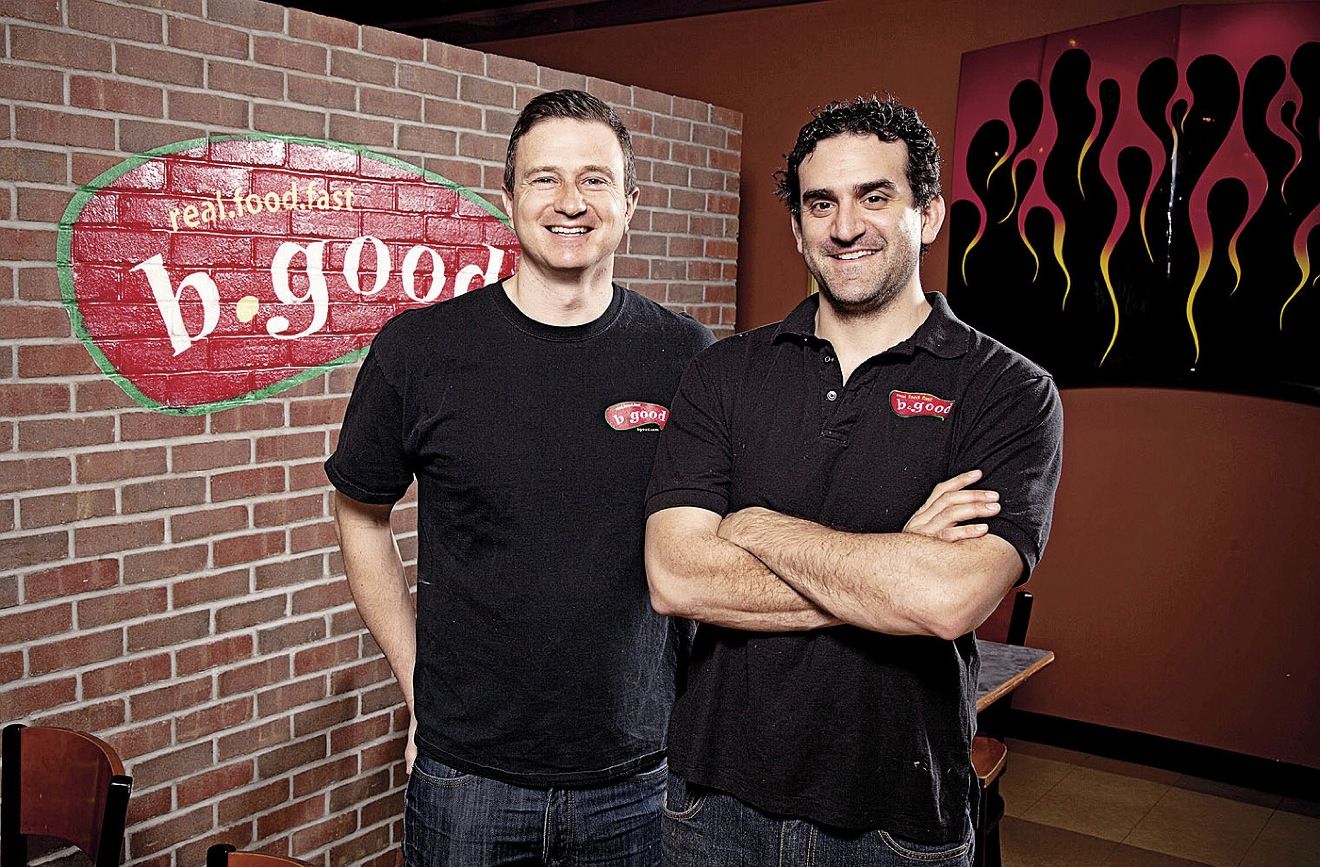
The first B.GOOD opened in Boston in 2004. Its early menu tried to accommodate an alarming number of possibilities, from burgers and fries to dinners and cold sandwiches. Fear of disappointing a potential customer had produced a kitchen with too much to do. By the second location, the menu had been cut in half. Less choice gave the founders a better chance of delivering what they promised.
That adjustment is more revealing than an immaculate founding legend. A menu can look generous on paper while asking too much of the people preparing it. Every extra item introduces another ingredient, another task, another opportunity for inconsistency. Ackil and Olinto’s early lesson was practical: a concept needs boundaries. The dinner rush is an unsentimental editor, and it does not care how affectionate the origin story is.
“We want hundreds.”Anthony Ackil, on B.GOOD’s expansion plans in 2013
The potato test
By 2013, the founders were thinking seriously about expansion. Their first franchise opened in Shrewsbury, Massachusetts, that March. They had studied the business down to how many potatoes an employee could cut in fifteen minutes. The detail sounds comically small beside an ambition to build hundreds of restaurants. It also explains the ambition. A chain is assembled from small jobs that other people can repeat.
Ackil put the desire bluntly: “We want hundreds.” The company had plans for additional corporate restaurants and franchise locations across New England. Its wallboards identified farmers supplying the food. The founders wanted recognizable ingredients and recognizable relationships to remain part of the experience as the business traveled. Growth meant translating their own habits into instructions that could work without them standing beside every cutting board.
In Portland, Maine, the thirteenth location opened in 2013 with beef from New Gloucester and potatoes from Wells. The building also made room for a tap room upstairs. Geography supplied more than a pin on an expansion map; it supplied ingredients and a reason for the restaurant to belong there. For Ackil, regional sourcing was part of the proposition customers were being asked to recognize.
The people doing the work mattered just as much. In 2016, B.GOOD involved employees in community meal donations and in a Boston Harbor island farm project with Camp Harbor View. Three-quarters of that farm’s crop went back to the community. Ackil described recruiting people who believed in the company’s purpose as a central challenge. A location could be found; a culture needed people willing to carry it.
This is where a restaurant founder’s work becomes difficult to photograph. A burger has a finished shape. Training, purchasing, hiring, and the daily maintenance of trust do not. Yet they determine whether the next burger resembles the last one, and whether the person serving it wants to come back tomorrow. The potato test was one visible fragment of a much larger effort to make the business repeatable.
The founders measured how many potatoes an employee could cut. Expansion had to work at the cutting board.
When the map gets ahead of the kitchen
B.GOOD eventually grew to more than eighty locations. Ackil served as its CEO from 2004 to 2018. Expansion gave a Boston idea a life far beyond its original market. It also supplied lessons he would later discuss with unusual candor. In a 2022 conversation with Roger Beaudoin, he described growth that had become too fast and restaurants spread too widely apart. More openings had created harder operating problems.
His account included an early division of responsibilities: Olinto took brand and marketing, while Ackil handled operations and finance. Each could offer input on the other’s work, but they separated decisions. It was a practical arrangement for two close friends whose arguments could otherwise follow them into every corner of the company. Affection does not decide who approves a budget. Someone still has to do that.
The same interview traced a shift from informal management toward detailed budgets, performance expectations, and bonus structures. Ackil’s story of learning restaurant finance was a story of making responsibilities explicit. At a single restaurant, a founder can notice a problem personally. Across a scattered group, the problem must become visible through reporting, and someone must know that fixing it belongs to them.
The distance between restaurants adds its own complication. A growing brand must move knowledge as well as money. Who teaches the next manager? Who checks the purchasing? How quickly can an experienced operator reach a struggling store? Those questions help explain why a larger restaurant count can conceal a less manageable business. A map is particularly flattering when nobody has drawn the travel times on it.
- 2004B.GOOD opens in Boston
- 2013First franchise opens in Shrewsbury
- 2019Streetlight Ventures is founded
- 2025Red Robin board chair
A company for the work behind the counter
Ackil founded Streetlight Ventures in 2019. Its remit brought his operating experience to small and mid-sized restaurant brands through management, investment, and acquisitions. Instead of developing every concept from the beginning, he could work with businesses that already had customers and identities. The job became supporting several different restaurants without expecting them all to look or taste alike.
Streetlight’s portfolio includes Anna’s Taqueria, OTTO Portland, Burtons Grill & Bar, Margaritas, Red Heat American Tavern, Howling Wolf Taqueria, Upper Crust Pizzeria, and B.GOOD. Pizza shops, taquerias, and dining rooms present different experiences to customers. Behind them sit familiar needs: financial reporting, capable managers, suitable locations, and reliable operations. That shared work is the basis of the platform Ackil built.
The company describes support across operations, brand development, finance and analytics, technology, real estate, and team development. It also considers founder-led businesses, management restructuring, and distressed situations. This is a broader brief than opening another branch of a favorite restaurant. It requires working out what an existing business needs, and which parts of its character customers expect it to keep.
Ackil works alongside partners including Eric Holstein, Streetlight’s COO, and Paul Twohig. His responsibilities also include chairing Burtons, Margaritas, and Anna’s. These connections put him at the junction of restaurant ownership and restaurant management. For a founder who once wanted freedom from a boss, the later career contains a considerable amount of responsibility for other people’s work.
The burrito and the harder decision
The relationship with B.GOOD became especially complicated in 2024. Three Boston-area locations closed as Streetlight reassessed the brand. The Woburn restaurant became an Anna’s Taqueria, and another conversion was planned for the former B.GOOD near Northeastern University. Workers at the Woburn and Northeastern locations were offered positions elsewhere in the Streetlight group. An operating portfolio had become a place to move people as well as capital.
Ackil said Streetlight still believed in B.GOOD while describing Anna’s as ready to grow. His words held affection and calculation in the same sentence. Founding a brand does not exempt it from decisions about its locations. The old name carries memories; the next tenant must make sense of the space. For the person who helped create both the attachment and the business, those considerations sit unusually close together.
At Northeastern, he talked about Anna’s cooking from scratch and about the location being a good fit. The proposed change was specific: a different restaurant in a familiar food court. Customers would encounter the decision through a new menu. For Ackil, it represented a question he had been working on for years: what should this particular restaurant be able to do, in this particular place?
In April 2025, he became chairman of Red Robin’s board, having joined it in March 2020. He also serves as CEO and a director of Launchpad Streetlight Acquisition Corp., formed in 2025 to pursue hospitality businesses. The responsibilities now extend from regional restaurant groups to public-company governance and acquisition work. The scale has changed considerably since two friends were arguing over their first menu.
Ackil’s career is easiest to understand through that menu. It began with the hope of making room for everybody. Experience brought narrower choices, clearer responsibilities, and a willingness to reconsider what belonged where. Uncle Faris supplied a name and a way of treating people. The restaurants supplied the rest of the education, one decision at a time, with lunch still due to be served.