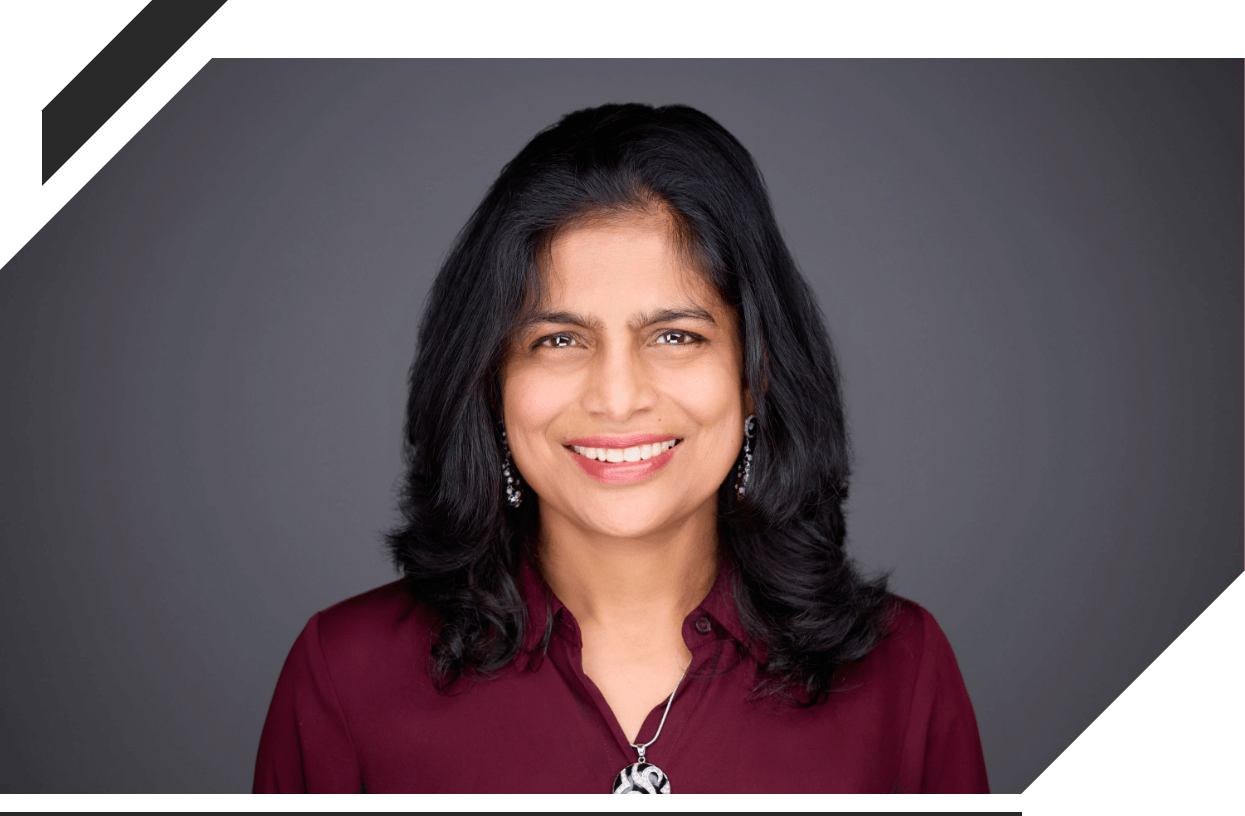
Anshu Agarwal does not pitch from theory. When a B2B founder walks into Converge's Silicon Valley office and starts describing the messy middle of scaling an enterprise product - the integration meetings after the LOI, the bizdev hire who's secretly running product, the customer who keeps asking for a feature you cannot ship - she has already lived that exact week. Five times.
In July 2023, the Cambridge-based venture firm Converge announced what its press release called "Silicon Valley muscle," and her name. She had spent the previous twenty-plus years inside four startups that ended in public-company stock - Speedera Networks, sold to Akamai in 2005; Ankeena, sold to Juniper Networks in 2010; ConteXtream, sold to HP in 2015; Cedexis, sold to Citrix in 2018 - followed by Nimbella, the serverless-computing pioneer she co-founded and ran as CEO, which DigitalOcean acquired in 2021. After each of the first four exits, the acquirer hired her back to run integration. After the fifth, she became VP and General Manager of DigitalOcean's Serverless and Kubernetes business, with 600,000-plus customers on the other side of the dashboard.
That is the resume, but it is not quite the point. The point is the pattern. Agarwal kept choosing the same shape of company - B2B, infrastructure-flavored, technically dense, sold to engineers and operations leaders rather than marketing departments - and kept finishing the job. In an industry that prizes the founder-CEO arc but rewards the early-stage operator who knows how the second act ends, she is rare on both counts.
Converge, which she now helps lead alongside founding partners Nilanjana Bhowmik and Maia Heymann, invests in early-stage B2B software. Bhowmik and Heymann brought the investment track record. Agarwal brought the operator's seat - and the West Coast zip code Converge had not previously occupied.
Her own portfolio relationship with the firm predates the partnership. Nimbella, the company she ran from ideation to exit, was a Converge investment before she joined Converge. It is the kind of detail that explains why this announcement read less like a hire and more like a homecoming. The check writer turned into the check writer's colleague.
The serverless arc is worth dwelling on, because it is the part most readers will not have heard. Nimbella launched as the cloud world was finally agreeing that operators did not, in fact, want to think about servers. The company built a platform that let developers ship functions, APIs and front ends without provisioning anything. The thesis - that infrastructure should disappear into the code - turned out to be correct, expensive to build out, and uncomfortable to monetize on its own. DigitalOcean, which was already wooing a developer audience hungry for opinionated simplicity, absorbed Nimbella's team and technology. Agarwal stayed on to run the combined Serverless and Kubernetes group at the public company. She had done the post-acquisition tour four times already; she knew the choreography.
Then she left. Operators who go to VC often do so because they want to step off the elevator. Agarwal's stated reason, in interviews and her firm's announcement, was the opposite: she wanted to keep being useful to founders, on a longer time horizon than any single company would allow, and from the city - San Francisco - where the next set of B2B infrastructure plays would start.
The Converge thesis fits her resume the way a sweater fits its original owner. The firm writes early-stage checks into B2B software companies. It has done so since well before the current AI boom converted every fund deck into a generative AI deck. Bhowmik, a former Comcast Ventures partner, and Heymann, a longtime venture investor, built the partnership around discipline and patience. Agarwal's presence widens the aperture without changing the shape: the firm now has a partner who has stood inside the room where a board votes on the acquisition price, on both the selling and the buying side.
There is also the matter of network. The four buyers in her exit ladder employ a meaningful percentage of the senior product and infrastructure talent on the West Coast. People she onboarded at Akamai are now CTOs. People she ran teams with at Juniper are now founders. The post-acquisition jobs were not pit stops; they were her LinkedIn graph, built one integration at a time.
Engineers tend to like working with her. She trained as one - electronics and communications at IIT Roorkee, electrical engineering at Rutgers - before adding a Kellogg MBA. The combination shows up in the way she talks about products in public: comfortable with the schematic, comfortable with the income statement, impatient with hand-waving in either direction. Her past board service at the Linux Foundation's OpenDaylight Project, alongside her current role on the IIT Bay Area Association board, suggests an investor who reads the README before the deck.
What she is looking for now, in the polite language of GP introductions, is "the next wave of B2B founders." In the less polite, more accurate language her own track record implies: technical founders building infrastructure-adjacent companies, with a willingness to sell to skeptical buyers, and the patience to spend a decade getting the second product right after the first one works. The kind of company she could imagine running.
The Silicon Valley desk is small. Converge is not a sprawling platform fund. Agarwal's value to the firm is not headcount but coverage - of pitches, of post-investment operating help, of the boring quarterly cadence that turns a portfolio company into an exit. Her value to founders is the same thing every great operator-turned-investor offers: a partner who will say "I have seen this movie" and mean it specifically, not generically.
What is interesting is what she has not done. She has not built a thought-leadership Twitter feed. She has not published a podcast. She has not, despite four acquisitions involving public companies, become a stage personality. The pattern of the career is also the pattern of the personality: ship, sell, integrate, ship again. The kicker on the press release in 2023 read "Silicon Valley muscle." It was meant as a metaphor. Looking at the resume, it reads as a job description.