There is a particular sort of person who notices the defensive possession. The crowd remembers the three-pointer, the broadcast saves the dunk, and tomorrow's clip begins at the scoreboard. Anne Parkes Armistead once watched a Utah Jazz sequence and wrote about the other half of the game. Defense, she observed, tends to vanish from the highlight reel. Yet when it is handled properly, everything else begins to move. Her conclusion was plain: “Doing the small things are worth it.”
It is an economical description of account development, her work at Workstream. Sales organizations produce their own highlight reels: the signed contract, the jubilant message, the number at the end of the quarter. Before any of that comes the quieter labor. Someone prepares. Someone listens. Someone asks the second question, remembers the first answer and follows up when the moment is right. Much of the job resembles defense in exactly the way Armistead meant. Its value accumulates before it announces itself.
Her public biography is composed in the same manner. It does not arrive as one glossy origin story. It appears in small, sharply different scenes: a childhood in Nashville, a drive west, a summer on a horse ranch, a guitar, a place on Utah Valley University's dean's list, an intimate piece of writing and, later, a desk in the world of workforce software. Put those scenes together and the ordinary title on the business card becomes more interesting.
“Doing the small things are worth it.”Anne Parkes Armistead, on the work behind a winning team
The road west was not an elevator
Armistead grew up in Nashville, where music is less a local industry than a second weather system. Her own account begins with family, church and the kind of childhood moments that stay vivid because they acquire meaning later. The story she eventually wrote is frank and spiritually minded. It is also interested in people who offer structure, welcome and belief at the exact moment those things can be useful. One sentence is allowed to stand by itself: “They believed in me.”
One of those people was a mentor named Brandon Hanks. He taught her to play guitar and later invited her to work with his family on a horse ranch. The day after graduation, Armistead packed her car in Nashville and drove to Antimony, Utah, a settlement whose scale was startling after home. A small town can feel either like the end of the map or the first place where the map makes sense. In her telling, this one quickly became the latter.
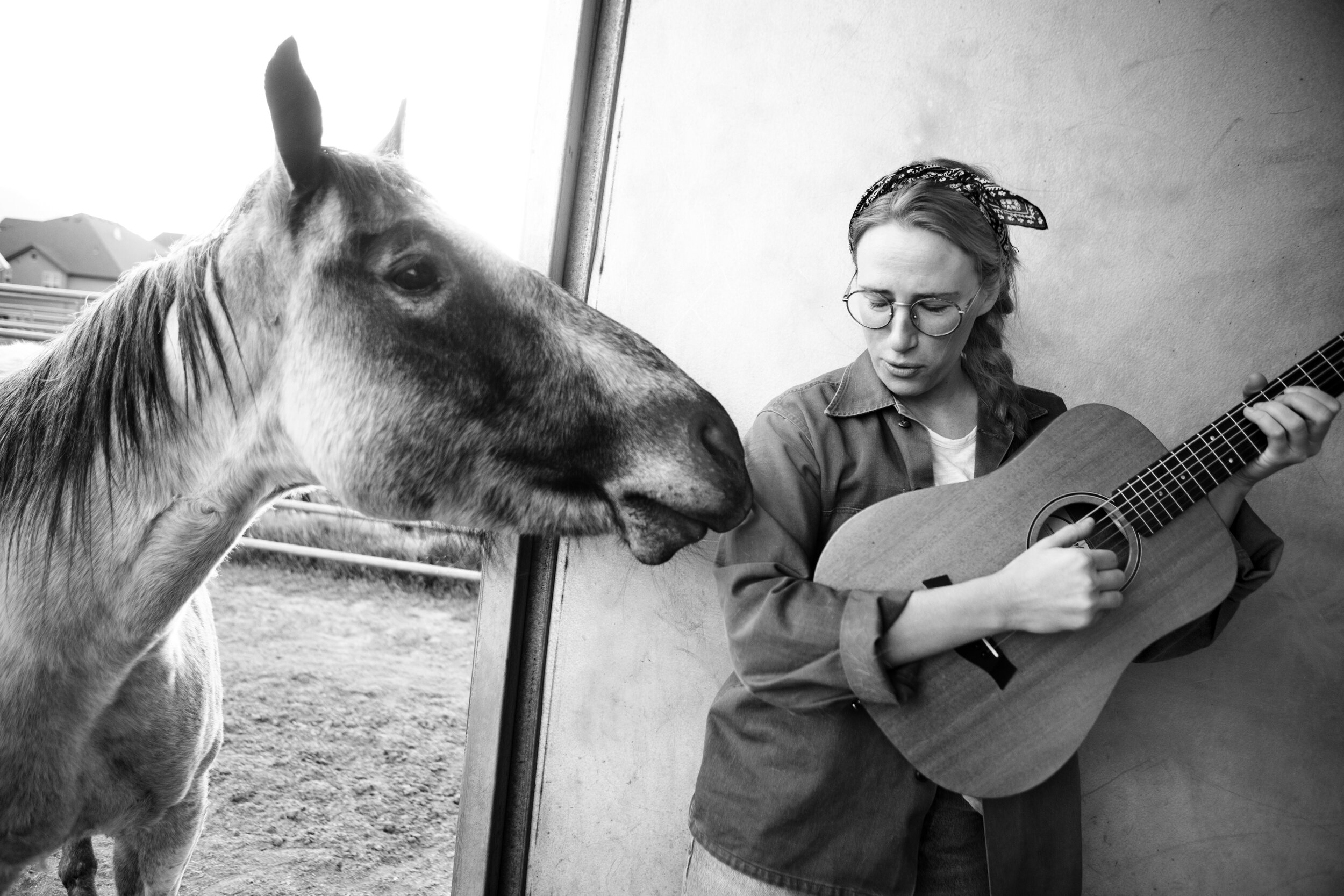
The ranch chapter has the texture of a proper beginning: horses, work, a family of strangers who did not remain strangers for long, and a landscape capable of making a person reconsider what “far away” means. It also gave the guitar a setting. Photographs from this period show Armistead with an instrument, beside horses and sometimes with both in the same frame. The images are not staged as professional branding. Their charm comes from their refusal to decide whether the musician or the ranch hand should occupy the foreground.
A public route in three stops
A guitar that declined to become a résumé line
There is outside evidence that the music endured. In a personal blog post, a friend included one of Armistead's songs in an end-of-summer video and called her a favorite singer-songwriter, adding that she did not do it professionally. That last detail is nearly perfect. Modern profiles tend to treat every aptitude as an undeveloped revenue stream. A song is permitted no quiet life; it must become content, catalog or career. Armistead's guitar seems to have escaped that machinery.
This does not make the music trivial. Quite the opposite. Work done without a promotional plan often says something clean about appetite. A person plays because the sound matters, writes because the words need arranging, and shares a song because a friend might like it. Nashville may be full of professionals, but it also understands the durable category of the person who keeps an instrument nearby.
Songwriting is a useful parallel to sales, though only if one avoids the motivational-poster version. Both require an ear for cadence. Both go wrong when the performer is too enamored of their own voice. Both depend on the unshowy business of editing: remove the line that exists merely to impress; keep the phrase that helps another person recognize what they already felt. Account development is not a chorus, but timing still matters.
The university record is brief, and precise
Armistead attended Utah Valley University from 2016 to 2020. One institutional record places her on the dean's list in the spring of 2016. It is a small item, just a name in a long alphabetical document, but it belongs in the story precisely because it resists embellishment. Academic records are rarely lyrical. They mark the completed work and move on.
By the time her professional profile places her at Workstream, the geography has settled around northern Utah. Workstream builds hiring and workforce tools for hourly businesses, including restaurants and franchise operators. The company's software world is full of scheduling, onboarding, payroll and compliance. Those are practical nouns. None belongs in a ballad. All belong to the daily reality of a manager trying to keep a shift staffed and the paperwork straight.
Account development sits near the beginning of that relationship. It is the point at which a large software proposition has to become a specific human conversation. What is slowing this operator down? Where is the hiring process losing people? Which routine task has quietly become the day's recurring nuisance? The representative has to understand enough of the system to speak clearly and enough of the person to avoid sounding like a system.
Armistead's known public comment about basketball offers the most credible clue to how she thinks about such work. She praised the overlooked aspects of a job and the effect they have on a team. It was not a grand doctrine. It was a comment beneath someone else's post, prompted by a coach talking to a player during a game. Yet stray observations can be more revealing than polished manifestos. They catch a value before it has dressed for an audience.
A career is rarely one clean melody. Armistead's has room for the sales call, the ranch gate and the song a friend still remembers.
The virtues of an uncollapsed life
The temptation with a profile like Armistead's is to force the parts into a lesson. The ranch must have taught grit. The guitar must explain empathy. The dean's list must forecast professional discipline. Lives are not obliged to be so tidy, and people are more interesting when their experiences are allowed to remain experiences rather than converted into corporate competencies.
Still, a pattern is visible without being imposed. Armistead's writing gives weight to mentorship and to the people who made room for change. Her basketball comment gives weight to duties that occur out of frame. Her friend's recollection gives weight to creative work that never needed a professional label. The common element is attention: to the person who believes in you, to the possession nobody clips, to the song played for a circle smaller than the market.
That may be why the contrasts in her story do not feel contradictory. Nashville and Utah. Sales and songwriting. A software company and a horse leaning toward a guitar. Each setting asks a person to listen before acting. Horses are famously indifferent to job titles, guitars expose impatience at once, and prospective customers have acquired a similar resistance to empty performance. All three reward presence.
There is also something refreshing about a public identity that remains proportionate. Armistead has not turned every personal chapter into a branded pillar. The web offers glimpses rather than a campaign. Her professional page records Workstream and Utah Valley University. Her essay preserves a longer account in her own voice. A friend's blog keeps the musical footnote. Together they form a portrait with enough white space to breathe.
The work before the highlight
A good headline usually wants a conquest, a dramatic pivot or a number with several zeroes. Armistead's story proposes a quieter subject: the useful work that happens before the visible outcome. The follow-up before the deal. The practice before the song. The long drive before a place begins to feel like home. The defensive stop before the scoring run.
It is easy to make quiet work sound saintly. Often it is simply tedious. Details repeat. Calls go unanswered. Fingers land on the wrong string. A horse has opinions about the schedule. The virtue lies less in romance than in returning with attention intact. Armistead's line about small things avoids grandeur. They are worth it, she said. Not magical. Not destined to change everything. Worth it.
That phrase earns its place because it can survive outside the highlight reel. It works in a sales office, on a university list, near a ranch fence and inside a song no label ever released. It describes the parts of a life that resist compression into a title. Account Development Representative is accurate. Songwriter is vouched for by a friend. Neither is large enough alone.
The better portrait holds several notes at once: Anne Parkes Armistead, based in Salt Lake City, working at Workstream, carrying Nashville in her musical history and rural Utah in her personal geography. The chord is unusual but not discordant. Its least conspicuous note may be the one that gives the rest their shape: notice the overlooked work, and do it anyway.