Profile / Physician-Founder
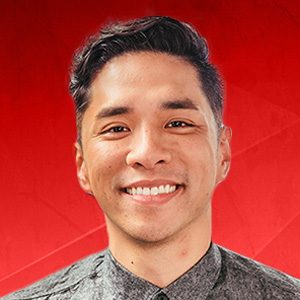
Andrew Le
He left the exam room because the real diagnosis was the waiting room itself.
CO-FOUNDER & CEO, BUOY HEALTH // HARVARD MD // LOS ANGELES
He left the exam room because the real diagnosis was the waiting room itself.
CO-FOUNDER & CEO, BUOY HEALTH // HARVARD MD // LOS ANGELES
Open Buoy Health and it feels like messaging a friend who happens to have an MD. Type how you feel. Answer a few questions. Get told, plainly, whether to rest, call a clinic, or go now. Underneath that calm conversation sits an AI sorting through roughly 30,000 possible questions, narrowing toward the handful that matter for you.
That product is Andrew Le's life's work. He is co-founder and chief executive of Buoy Health, the company he started in 2014 inside the Harvard Innovation Lab and has run ever since. The pitch is small enough to fit on a napkin and large enough to reorganize an industry: give people a trustworthy first step before the panic-Googling begins.
Le trained as a physician at Harvard Medical School. He did not finish the conventional path into practice. Instead he took three years off, then kept going, deciding the bottleneck worth fixing was not any single patient in front of him but the millions deciding, alone and anxious, whether their symptoms were nothing or everything.
Besides the act of healing, everything else should be automated away in healthcare.- Andrew Le
The first moment came during his last clinical rotation in the emergency room. Patient after patient arrived having already consulted Dr. Google - and guessing wrong an uncomfortable share of the time. Some convinced they had a rare cancer. Some who waited too long. The internet had become the waiting room's waiting room, and it was making people both more frightened and less safe.
The second moment was closer to home. Le's own father hesitated and waited too long to seek care while having a mini-stroke. He survived. But the lesson landed: the gap between feeling something is wrong and doing something about it is where a lot of harm hides. Hesitation, it turns out, is a clinical problem.
So Le stepped back from the standard medical track. In 2014, with co-founders Adam Lathram, Nathanael Ren and Eddie Reyes, he built Buoy at the Harvard Innovation Lab - a team of doctors and computer scientists chasing one question: when do I actually need to go to the doctor?
Le's research focused on glioblastoma, an aggressive brain cancer. He brought experience from Massachusetts General Hospital, Baylor College of Medicine and the Institut Pasteur before turning to software.
An Economics degree from Harvard College, magna cum laude, then an MD from Harvard Medical School. The economist's eye for systems shows up in how he frames healthcare as a navigation problem, not just a medical one.
Buoy started as an attempt to answer one plain-language sentence most people are too embarrassed or too scared to ask: “Should I be worried about this?”
That trust, not data, is the scarce resource online. Make the first step feel like a conversation, and people will take it.
- ANDREW LE, ON WHAT HE IS ACTUALLY BUILDING
Co-founds Buoy Health at the Harvard Innovation Lab.
Raises a $6.7M Series A to bring the AI symptom checker to providers and payers; plans to grow engineering and marketing.
Closes a $15M Series B as Buoy positions itself as an AI platform for navigating healthcare.
Lands a $37.5M Series C, pushing total funding past $66M with backing from major insurers.
Most health tech promises to find the rare diagnosis. Le's contention is quieter and more radical: the bigger problem is the everyday paralysis. The person at 2am wondering if chest tightness is anxiety or an emergency. The parent unsure whether a fever warrants a clinic. The 72% who reach for a search bar and walk away more scared than informed.
Buoy's design philosophy follows from that. Make it feel like texting, not filling out a form. Earn trust in the first ten seconds. Then route - to rest, to a nurse line, to a doctor, to the ER. Le talks about the tool as a “sidewalk” rather than a destination: it does not try to replace the doctor, it tries to get you to the right one faster, and to skip the ones you do not need.
It is a deeply economic idea wearing a stethoscope. Reduce the friction and the fear at the front of the system, and the whole thing runs cheaper and kinder. That is the thesis insurers wrote checks for.
Buoy was developed in direct response to the downward spiral we've all faced when we attempt to self-diagnose our symptoms online.- Andrew Le
Away from the dashboard, Le is a culinary hobbyist - the kind of founder more comfortable with a recipe than a victory lap.
He plays in an adult basketball league. Set plays, role players, knowing when to pass - not a bad metaphor for running a startup.
His first Harvard degree was in Economics. He thinks about medicine in systems and incentives, which is exactly why Buoy looks like infrastructure, not an app.
He could have been a practicing physician with a tidy career. He decided the more useful patient was the system itself.
A Boston-born company, a CEO now based in the Los Angeles area - the long commute of a man building something national.
Nine million. The count of people he says Buoy helped make more informed decisions. He brings it up the way other founders cite valuation.
Le's stated ambition is blunt and big: keep the human moment - the actual care, the actual healing - and let software absorb the rest. The scheduling, the triage, the figuring-out, the 2am dread. If he is right, the most important thing Buoy ever does is make a million doctor visits that needed to happen happen sooner, and a million that didn't never start.