Before Andrew Housser had a company, he had a list of ideas that deserved to remain a list. Import beer from Belize. Buy taxi medallions. Create a Netflix for jewelry. The beer had benefited from the atmosphere in which he first encountered it: spring break. A business plan was less forgiving than a holiday. By late 2002, after months of searching, the Stanford MBA was considering a rather conventional entrepreneurial pivot: getting a job.
Then a friend described an argument with a debt collector. He had owed $30,000 and eventually negotiated a settlement of $9,000. Housser was surprised that such bargaining was possible. His friend had discovered an opening in a system Housser knew professionally, yet had never examined from that particular angle. A career spent studying financial businesses had left him with something useful to learn from a person who owed one money.
That conversation became part of the origin of Freedom Financial Network, founded with his Stanford friend Brad Stroh in 2002. Twenty years later, the business took the name Achieve. Housser remains its co-founder and co-CEO. The jewelry subscription would have to wait.
A finance education, interrupted by a customer
Housser arrived at entrepreneurship with an orderly collection of credentials. He attended Brentwood College School in British Columbia, graduated summa cum laude from Dartmouth, joined Phi Beta Kappa, and earned his MBA at Stanford, where he was an Arjay Miller Scholar. Before business school, he worked in investment banking at Salomon Smith Barney in New York and in private equity at Littlejohn & Company in Connecticut.
Those jobs supplied a vocabulary for evaluating businesses: markets, operating models, risk, returns. They also supplied a career he wanted to leave. The appeal of business school included the chance to become an entrepreneur. The complication was finding a business worth becoming one for.
Stroh has described their early approach as a combination of market analysis, personal values and luck. They saw a large consumer-finance market with underserved customers. More unusually, they discussed what working together might feel like a decade into the future. Before there was much of a workplace, there was a conversation about the people they would want beside them in it. Their shorthand became “The Heart and the Dollar”: care for customers and colleagues, alongside an economically viable company.
“You don’t always have to be right. If it’s not critical, let it go.”
Andrew Housser, on advice to his younger self
The phone rang. The model didn’t.
The first test was decidedly unglamorous. An advertisement in the National Enquirer sent callers to an 800 number ringing in a spare bedroom of Housser’s rented Menlo Park house. There was demand. There was also a problem: many callers had debts too small to support the labor involved in negotiating them. A ringing telephone can be a remarkably persuasive distraction from an unworkable business model.
The early correction was practical. Stroh worked on Google advertising; Housser put together a rudimentary website. The company began with direct contact and adjustment, rather than a finished system unveiled to applause. It is an origin that makes the later emphasis on data less abstract. The first information they needed concerned who actually needed their service, and whether they could serve those people economically.
In a later account of the company’s beginnings, lending executive Joe Toms pointed to the timing. The founders graduated after the internet bubble burst, when raising money on an attractive presentation was a less reliable occupation. He described that constraint as formative. They needed a functioning business. The spare bedroom was inexpensive; it was not a permanent answer.
When the dollar had to wait
One of the company’s difficult passages concerned when it could collect its money. In Housser’s telling, early customers paid monthly fees from the beginning of the relationship. The 2010 advance-fee ban changed the economics. Waiting for results before collecting revenue meant carrying the costs of doing the work first.
By July 2011, he recalled, the company was approaching a payroll deadline it could not meet. He and Stroh discussed covering payroll personally. An investment from Vulcan Capital closed on July 21, ten days before the deadline. The episode gives their founding formula a less decorative meaning: a company can care about its work and still run out of cash.
It also helps explain the distance between starting a service and financing one at scale. The founder who once answered calls in a bedroom would eventually be talking about securitizations, the transactions that connect lending portfolios with investors. In December 2022, Achieve announced a $175 million securitization backed by nearly 3,300 home equity lines of credit. The company’s consumer-facing language had grown warmer; behind it, the financing had become considerably more elaborate.
A promise meets a public test
The consumer-advocate ambition also faced scrutiny. In November 2017, the Consumer Financial Protection Bureau sued Freedom Debt Relief and Housser. It alleged misleading statements about fees and negotiating capabilities, charges without settlements as promised, and other violations. These were allegations, and the distinction matters in an account of an individual’s career.
The 2019 resolution required Freedom Debt Relief to pay $20 million in restitution to affected consumers and a $5 million civil penalty. The stipulated order said the defendants neither admitted nor denied the allegations, apart from the jurisdictional matters specified in it. The action against Housser individually was dismissed with prejudice. The company said it had agreed to changes in disclosures and policies, some already introduced when the case began.
That chapter belongs beside the founding values. The promise of advocacy is tested in the details of what customers are told, what they pay and what happens when a creditor will not cooperate. For a business built around complicated financial circumstances, those details are the product as much as the technology is.
Twenty years, then a shorter name
On September 22, 2022, Freedom Financial Network introduced Achieve. The launch presented personal loans, debt relief, home equity loans, financial tools and education under a broader identity. At that point, the company reported serving more than one million consumers since 2002, resolving over $16 billion in debt and facilitating more than $7 billion in loans. Those are different measures of activity, rather than interchangeable measures of customer savings.
Housser framed the audience as people left out of a system catering to wealth and pristine credit. The company described a combination of technology and personal relationships, with ambitions extending into banking and budgeting. His own launch announcement stressed continuity of mission beneath the new name. The business was expanding its vocabulary without abandoning the subject that had started the conversation.
consumers served since 2002
Design studio Pentagram worked with Housser, Stroh and brand executive Tanya Peterson on the identity. Michael Gericke’s team developed an upward-pointing A and a lowercase wordmark. The name was intended as a call to action; customers became members. For a company selling help with an uncomfortable subject, even the nouns had a job to do. A shorter name also gave a growing collection of services something they could share.
The next question is what the borrowing is for
Housser’s recent public writing returns to a familiar problem: a financial product can be available without being appropriate. In April 2026, he argued that connected account data and agentic AI could help build debt strategies around a person’s changing circumstances. His ambition is for systems that consider several obligations together and adjust when income or expenses move.
It is a recognizable extension of the original discovery. The friend’s settlement had revealed a possibility hidden from view. Housser now wants technology to make a wider range of possibilities visible, and to match them to individual circumstances. The aspiration remains a proposal for how the industry should work; a description of technical possibility is no guarantee of a particular customer’s result.
In July 2026, he turned to financing rent. His argument distinguished a temporary mismatch between payday and the rent deadline from a persistent inability to afford housing. Spreading a payment can address timing. Repeating that maneuver while expenses exceed income can leave yesterday’s rent competing with today’s. He asked readers to pay attention to why people need the product and how often they return to it.
In August, commenting on Achieve’s back-to-school research, he made the same distinction in plainer terms: “Back-to-school costs are predictable, but that does not make them affordable.” The calendar can announce an expense months ahead without supplying the money to meet it.
A founder returns to the classroom
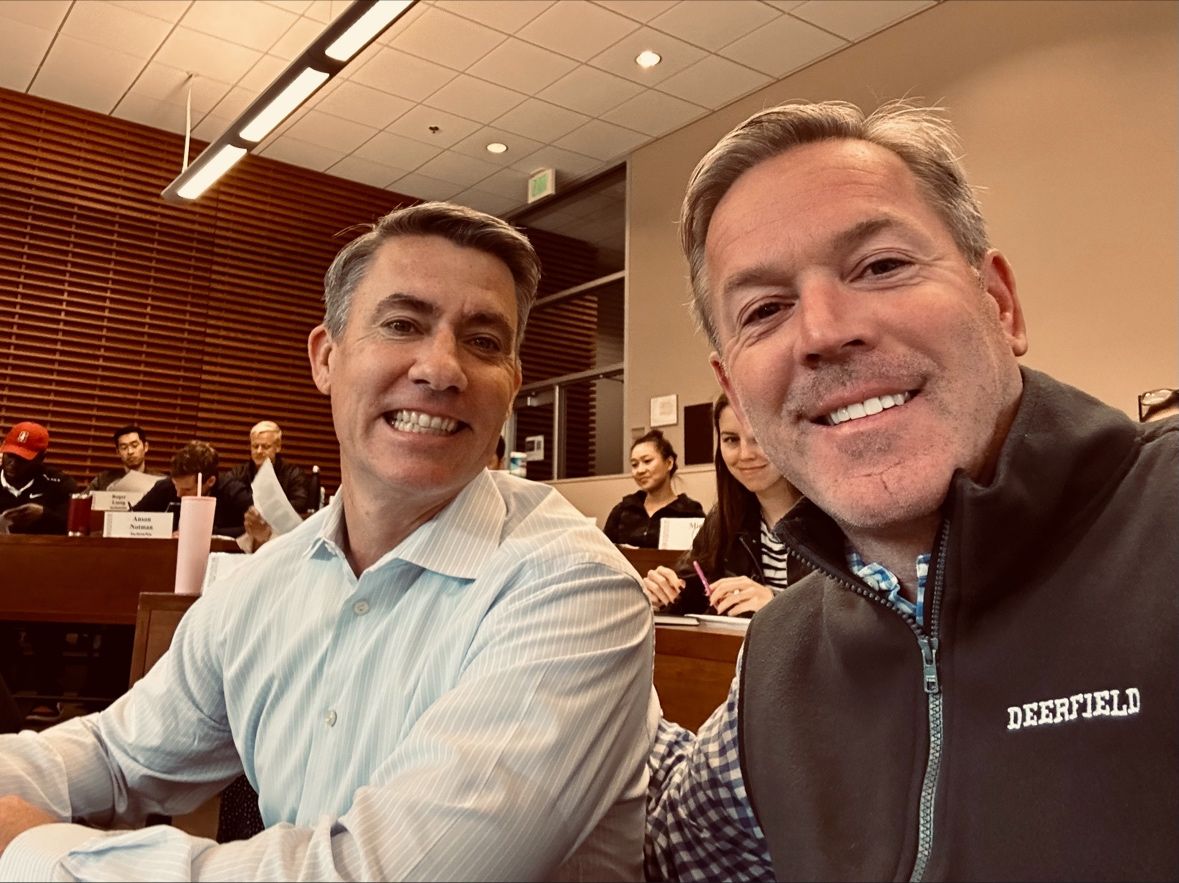
The institutions in Housser’s early biography remain part of his working life. His public company biography lists advisory service at Dartmouth’s Magnuson Center for Entrepreneurship and board service at Brentwood. A photograph Stroh shared in 2023 places the two founders back at Stanford, guest lecturing about the business they began after leaving it.
There is something fitting about the return. Housser’s qualifications helped him analyze an industry; an ordinary conversation exposed something he had missed. More than two decades later, his public questions still concern the gap between a financial system’s offerings and a person’s actual life. A lecture can supply the framework. The person on the other end of the telephone may supply the question worth asking.