On the train from Bandra to Churchgate, Anand S had a task that would have puzzled a productivity consultant. He was typing out Calvin & Hobbes. Every strip. By hand. Excel displayed an image; he supplied the words. A small boy and a stuffed tiger were becoming a searchable body of text, one Mumbai commute at a time.
There was a practical reason for this rather extravagant hobby. He wanted to find particular strips by their dialogue. Remembering a joke is easy; locating it among years of newspaper cartoons is a different occupation. Anand made himself a tool. Years later, when he needed to annotate hundreds of photographs, the same Excel technique was waiting for him.
That small journey from comic strip to working software is a useful introduction to Anand. His career includes IIT Madras, IBM, IIM Bangalore, Boston Consulting Group and the data company Gramener, which he co-founded. Yet a telling line in his biography concerns a cartoon. Personal curiosity keeps finding its way onto the office desk, usually with some code attached.
at a time
the meaning
THEN Comic dialogue, typed into a searchable archive.
LATER Photographs, tagged against specific criteria.
The chemical engineer who kept returning to code
Born in Tirupati on 23 November 1974, Anand grew up in Chennai, then called Madras. At Vidya Mandir, his interests included music, Tamil film songs, basketball and computer graphics. In 1992 he went to IIT Madras. His degree was in chemical engineering. His account of those years makes clear that computers were already exerting a competing attraction.
He learned the mridangam, played keyboard and travelled to present seminars. In 1996, he joined IBM in Bangalore as a software engineer, working with Lotus Notes and Java. Within roughly eighteen months he was a project leader. An IBM Way award followed. The work offered things he enjoyed: programming, learning and colleagues who became friends.
Management then looked interesting enough to study. He entered IIM Bangalore in 1999, spent a summer at Lehman Brothers in Tokyo and took an exchange term at London Business School. Somewhere along that route, finance lost its claim on him. Technology remained the stronger attraction. He graduated in 2001 with two gold medals and joined BCG in Mumbai.
Consulting supplied an education in corporate life. His recollection includes being served soup by L&T chairman A. M. Naik, a pleasing reversal of the usual hierarchy at a client meeting. But the technical itch persisted. In 2005 he moved to Infosys Consulting in London. Alongside the job, he began building more things for himself.
A £500 rehearsal for entrepreneurship
By 2009, those projects included an Indian music search engine, transliteration tools and an IMDb Top 250 tracker. These were specific answers to specific appetites. Music needed finding. Films needed tracking. A programmer could arrange the world a little more conveniently, provided he was willing to spend the evening doing it.
In January 2010, at an airport, he picked up Rashmi Bansal’s Stay Hungry Stay Foolish. Its accounts of entrepreneurs made running a small company seem attainable. He imagined trying repeatedly until a business survived. This was his way of making the leap manageable: several attempts, a modest definition of success, and permission for the first attempt to fail.
It duly obliged. With a friend, he built a product for dynamically resizing digital images and tried to sell it to retailers. After a year, £500 spent and no sales, they closed it. They had built something for which they saw demand. They had not worked out how to sell it. The distinction was expensive enough to remember and cheap enough to survive.
Meanwhile, a former IBM boss was exploring a venture that eventually focused on data analytics and visualization. Anand helped in his spare time. A classmate’s school-report-card company, Reportbee, also drew him in. By his account, he was carrying a day job and three night jobs. He doubted whether he had done justice to any of them; he was also learning and making more than before.
“Sometimes, quantity beats quality or reliability.”
Anand S, January 2012
In January 2012, he wrote about leaving consulting on a one-way flight from London to India. He was moving to Bangalore and joining Gramener as chief data scientist. The aircraft was descending into Delhi as he finished. The future had acquired both a job title and a landing time.
A company where the picture had to mean something
Gramener brought together three interests he names plainly: statistics, programming and design. The combination matters. Statistics can identify a pattern; programming can make the work repeatable; design can help another person understand why the pattern deserves attention. A chart that fails at that last task leaves much of the job unfinished.
Anand became Gramener’s CEO and helped develop Gramex, its low-code analytics platform. The company’s work centred on turning data into visual stories for decisions. His public talks carried the same concern into conference rooms: how to make complicated material intelligible to someone who has a reason to act on it.
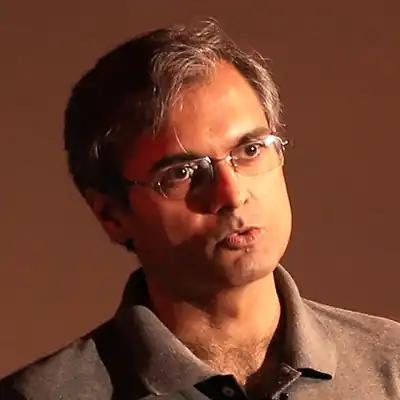
Even PowerPoint could become an instrument for that work. At PyCon India in 2013, he demonstrated using Python to control it, including an arrangement of IMDb film posters. The setting was familiar office software; the behaviour came from code. His interest in films had once again found employment.
The cartoon archive belongs in this company history, too. It shows a willingness to do repetitive work for an answer he actually wants. The later reuse of its image-tagging method is a reminder that a hobby can leave behind useful machinery. The machine does not much care whether its first assignment involved a tiger.
- 1996IBM
Software engineering - 2001BCG
Consulting in Mumbai - 2005Infosys
Consulting in London - 2012Gramener
Data stories - 2023Straive
Data, analytics & AI
The founder at the wedding
In August 2023, Anand moved to Singapore. That November, Straive announced its acquisition of Gramener. The business he had joined full time in 2012 was entering a larger organization. He marked the occasion with an image more domestic than financial: he felt like the father of the bride.
Gramener had been registered on 26 February, the day before his daughter’s birthday. He joked that the company was his elder child, having received more of his time. Now it was moving into a new household, and he was coming along. It is an unusually affectionate account of a corporate transaction.
He also gave survival some credit. The founders had not mastered blitz-scaling, he wrote, but had avoided its disastrous counterpart. He thanked Ganes, Mayank, Naveen, Ram, Ravi and Vengatesh, acknowledged luck, and remembered that most days had been fun. Success, in this telling, had room for colleagues and contingency.
His proposed next titles included data storyteller, data detective and data psychologist. By his 2026 CV, the description had settled into head of innovation and LLM psychologist at Straive. He researches model behaviour, tests new capabilities and turns promising results into prototypes and reusable tools. The question has shifted from what a dataset contains to how an AI system behaves when asked about it.
Please put the name on both sides
For a view of Anand at work, consider his instructions to event organizers. He presents interactive demonstrations rather than fixed slide decks. He needs a podium where he can type, an internet connection and a clip-on microphone. He asks organizers to make sure circles look like circles on the screen. Anyone who has watched a projector stretch a diagram will understand.
He also asks for his name to be printed in large letters on both sides of his badge. His usual attire is a T-shirt, jeans and open sandals. For public talks, he says he charges no fee and accepts dry fruits or donations to Wikipedia or GitHub as an honorarium. The requests are practical, with just enough personal preference to make the speaker recognizable before he arrives.
His audience extends to IIT Madras, where he teaches Tools in Data Science in the BS programme. His recent teaching work considers a classroom in which students can ask AI for help. His CV describes assessments built around open-ended problems, debugging, verification and judgment. The challenge is to teach students to handle the tools they can actually use.
There is a familiar maker’s instinct here. Instead of treating a changed environment as an inconvenience, he changes the assignment. His experiments include LLM-assisted grading; he reports that evaluating 500 code submissions went from about two weeks to about two hours, with agreement close to that of teaching assistants. It remains a reported experiment, rather than a promise about every classroom.
The detours are still arriving
In October 2026, Anand was publishing updates on his innovation team’s experiments: turning photographs into navigable 3D worlds, analysing sports broadcasts and improving small models with rules and checks. He named the people doing the work and described where prototypes still made mistakes. The old concern with making an answer visible survives in a different set of tools.
His private enthusiasms remain visible as well. His speaker biography credits his daughter for Minecraft and anime. He still wants to watch the IMDb Top 250, with an exception carved out for The Shining. A completist, apparently, is entitled to negotiate the final terms.
The cartoon project offers a thread through all of this. Anand wanted to retrieve a joke, so he typed a library. He wanted to work closer to technology, so he kept building alongside consulting. He wanted to start a company, so he accepted that the first one might close. Now he studies AI systems by giving them tasks and examining what happens. The detour keeps becoming the work.
Keep following the detours
Read Anand’s blog, browse his GitHub projects or explore Tools in Data Science.