The perfume arrived inside a chocolate heart. To get at it, the recipient needed a hammer. In January 2018, KKW Fragrance sent editors and influencers an edible obstacle course with its name on the tool. The reveal was designed to be watched. Amy Denoon, whose business involved persuading people to pay attention to beauty products, found herself thinking about everything surrounding the bottle.
“No one can literally keep up with the Kardashians,” she said. There was humor in the observation and a business problem underneath it. Once a package becomes entertainment, the next package needs a better act. Somewhere in this competition, a publicist has to explain why a perfectly serviceable box no longer seems sufficient.
Denoon had spent more than a decade building BEACH HOUSE. She knew the value of presentation. Her objection came from inside the trade, where elaborate ideas had clients, budgets and people expected to make them happen. The question she began asking was how much of that activity helped anyone understand the product.
A beauty business with an East Coast address
Denoon founded Beach House PR in 2005. Beauty and fashion gave the agency its focus; media relations, digital marketing, social media, events and influencer work gave it several ways to operate. Its client history included Urban Decay, Anastasia Beverly Hills, Schwarzkopf Professional, Julep, ghd and Voluspa. Those names put the business among products people encountered in salons, shops and their own bathrooms.
By August 2016, the agency had moved four places up an Orange County ranking of public relations firms, reaching number eight. Its staff had increased by 33 percent to 16. It had also opened a New York office. These were useful, unromantic measures of expansion: more people to employ, another city to work in, more responsibilities attached to the founder’s name.
The New York opening accompanied the announcement that BEACH HOUSE would represent BABOR for North American public relations and social media. Jordan Landes-Brenman, previously a director in the West Coast office, was named to lead the New York operation. A permanent presence there gave the agency a person on the ground rather than another destination on an itinerary.
A 2018 biography described Denoon commuting between Los Angeles and Newport Beach, with several weeks each year spent in New York. It also described her as a mother of three and a member of the Women Presidents’ Organization. The geography alone suggests the practical demands of the job. An agency operating across those cities needs a great many things to happen while its founder is somewhere else.
The people on the other side of the pitch
In March 2018, Denoon was a panelist for an Orange County event about succeeding in a changing media environment. The agenda covered pitching stories, connecting with journalists through social media and responding to crises. Other panelists included Orange County Business Journal financial editor Peter J. Brennan and communications executive Gloria Janata. The setting placed Denoon among people discussing how messages travel and what happens when their reception becomes unpredictable.
A month later, she led a discussion at Beauty Biz Roundtable 17 in Santa Monica. Her topic was building a better beauty brand on social media. Around the same event were executives and founders discussing influencer relationships, operations, company culture and entrepreneurship. Beauty’s public face may be a photograph; the conversations behind it can sound rather more like running any other business.
These appearances add something useful to the picture of Denoon. Alongside the campaigns was the work of explaining communications to peers. A social post, a journalist’s interest and a product launch require different judgments. Knowing the difference becomes especially valuable when everybody has been asked to produce attention by Friday.
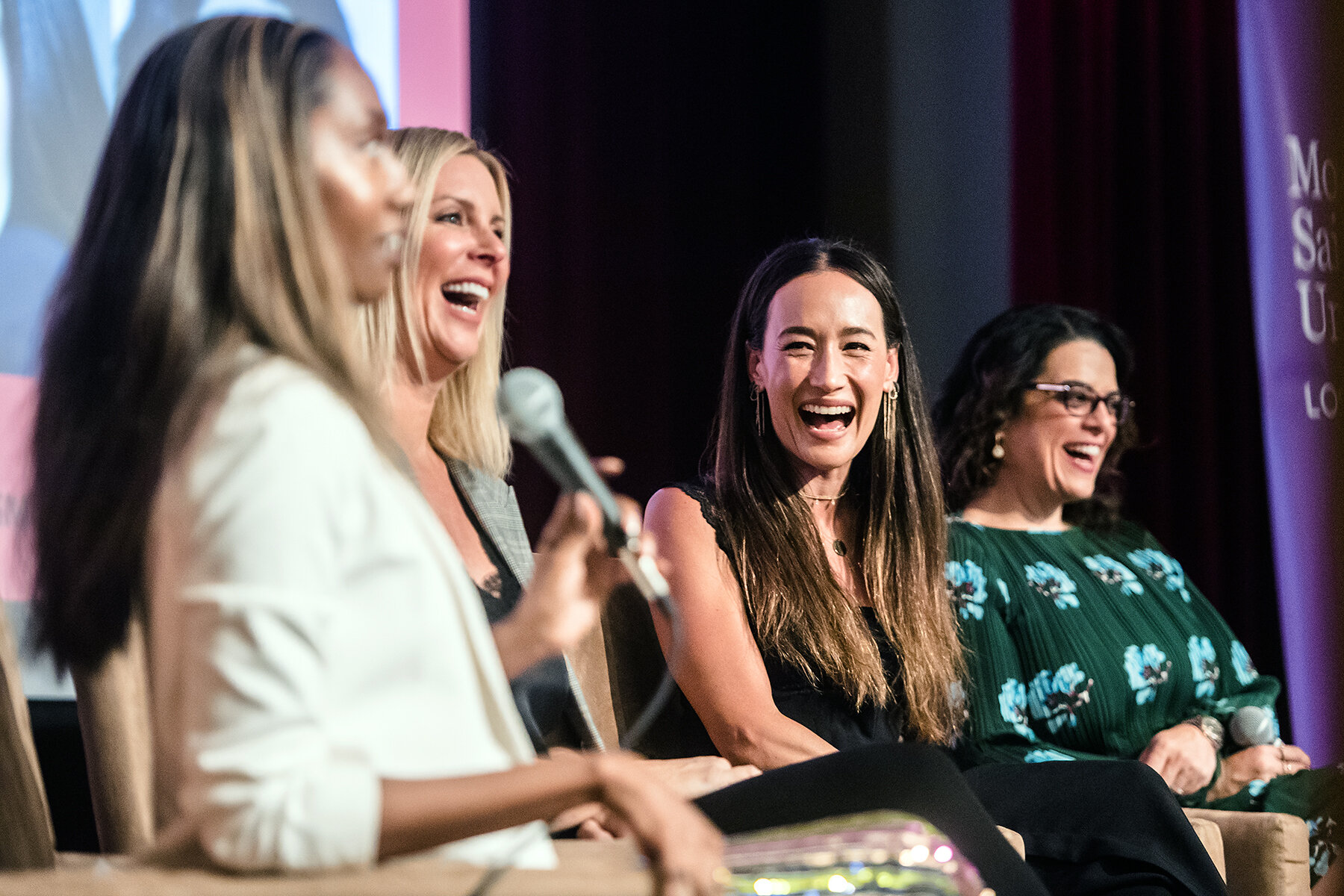
In September, she joined the Women’s Leadership Conference presented by Mount Saint Mary’s University in Los Angeles. More than 400 professional women attended the gathering, organized around leading through change. Denoon appeared alongside moderator Joy Donnell, actor and activist Maggie Q, and executive Jess Weiner. The photograph catches the panelists laughing together. It is a welcome interruption to the formal language that accumulates around a founder: strategic guidance, capabilities, expansion. Here is the person among other people, sharing a moment onstage. Her professional circle reached beyond the beauty brands whose names appeared in the agency’s client lists.
A photograph without the usual corrections
One campaign from Denoon’s years at BEACH HOUSE concerned what a beauty photograph could show. In January 2018, BABOR announced a collaboration with the All Woman Project. Its imagery featured women of different ages, shapes and backgrounds without retouching. The agency was the campaign’s public relations contact, with Denoon and Brittany Hohl named on the announcement.
The partnership included a limited-edition Beauty Ampoule Set, with BABOR pledging half its sales to the nonprofit. Models, activists, mothers, designers and editors were among the women represented. The creative work gave a commercial launch an identifiable point of view, backed by a specific donation commitment.
It also asked viewers to look carefully at something beauty advertising has often polished away: the particular features of an individual face. The campaign’s interest lay in the visible choice. An audience could see what the collaborators meant without needing to decode a paragraph of corporate adjectives.
That is a useful companion to Denoon’s later packaging argument. In each case, there was a question about where attention should land. The photograph asked people to look at the women. Her outreach changes asked recipients to spend time with the product. Read together, these choices suggest a shared interest in giving the subject room to be seen.
What stays in the box
During 2018, BEACH HOUSE introduced Change The Beauty Game, challenging excess in PR mailings. Denoon spoke about brands feeling compelled to top their previous efforts, even as the waste and expense grew. She wanted other agencies and brands to participate, making a simpler delivery easier to choose across the industry.
That ambition had a social dimension. A single agency can choose its packing materials. Changing expectations takes other people. A client who believes every competitor is sending a more elaborate gift has a reason to hesitate. Getting peers involved could give restraint a little company.
“Brands can’t keep up.”Amy Denoon, 2018
The changes reached the packing bench: biodegradable packing peanuts, recycled tissue and different ribbon choices. BEACH HOUSE also developed guidance encouraging influencers to make substantive reviews. By the end of the year, Denoon described reducing the frequency of routine mailers from monthly to quarterly, apart from launches. The effort addressed both what went into a delivery and how often one arrived.
delivery→02Time with
the product→03A considered
review
The proposed alternative still gave creators something to do. They could demonstrate a product, test it and explain the experience. The moment worth recording would come after the wrapping. Denoon acknowledged that the agency might supply fewer unboxing spectacles while encouraging attention to the products it represented.
For a publicist, that is a practical wager about the reader or viewer. A reveal can make somebody stop scrolling. A useful demonstration gives that person a reason to stay. The two activities can coexist, but a budget spent making the first increasingly elaborate deserves a question or two. Denoon was willing to ask them.
The distinction also changes what a communications team must prepare. A visual surprise needs a reveal. A demonstration needs information: what the product is supposed to do, who might use it and what a recipient should look for while trying it. The brief becomes a little less theatrical and a little more useful. There is still room for wit and pleasure in the presentation. Denoon’s proposal leaves the agency with a demanding creative assignment: make the actual object interesting enough to justify the delivery. Sending less asks more of the story that accompanies it.
The next owners already knew the clients
In March 2020, Denoon sold BEACH HOUSE to Brittany Hohl and Brittany Savastano. Both were senior executives who had worked at the agency for four years. The terms were undisclosed. Denoon agreed to stay on as a consultant for six months, providing a defined period for the handover.
Her explanation was unusually personal for a business announcement. She had reconsidered where she spent time and energy, including work, family and friendships, and her enthusiasm for owning and operating the agency had changed. She wanted to explore new opportunities. The buyers were people whose work she already knew.
A sale to colleagues carries a particular kind of continuity. These buyers had dealt with the business from the inside. The announcement anticipated that the Los Angeles and New York teams would remain intact, and that there would be no staff changes apart from new roles supporting growth. The new leadership also pledged to maintain the environmental commitments established during Denoon’s tenure.
The handover completes a less familiar agency story. Founding is an act of taking responsibility. Expanding distributes that responsibility across more people. Selling to members of the team recognizes that the people entrusted with the work can also become the people who own it.
Denoon’s career at BEACH HOUSE contains both the enthusiasm required to build a communications business and the willingness to reconsider its routines. She helped brands seek attention, questioned the escalating expense of dressing up that request, and eventually chose successors from among her colleagues. A bottle, a box and an agency each prompted a decision about what should happen next. The hammer, at least, could be left out of the mailing.