Ride a chairlift on a busy Saturday and you inherit a small mystery. Is your favorite run groomed? Did the wind close the summit lift? How bad is the drive home on I-70? For decades the answer lived on a whiteboard at the base lodge, updated whenever someone got around to it, and by the time you reached the top the information was already stale. A group of Colorado skiers decided that was a solvable problem - and, more usefully, a business.
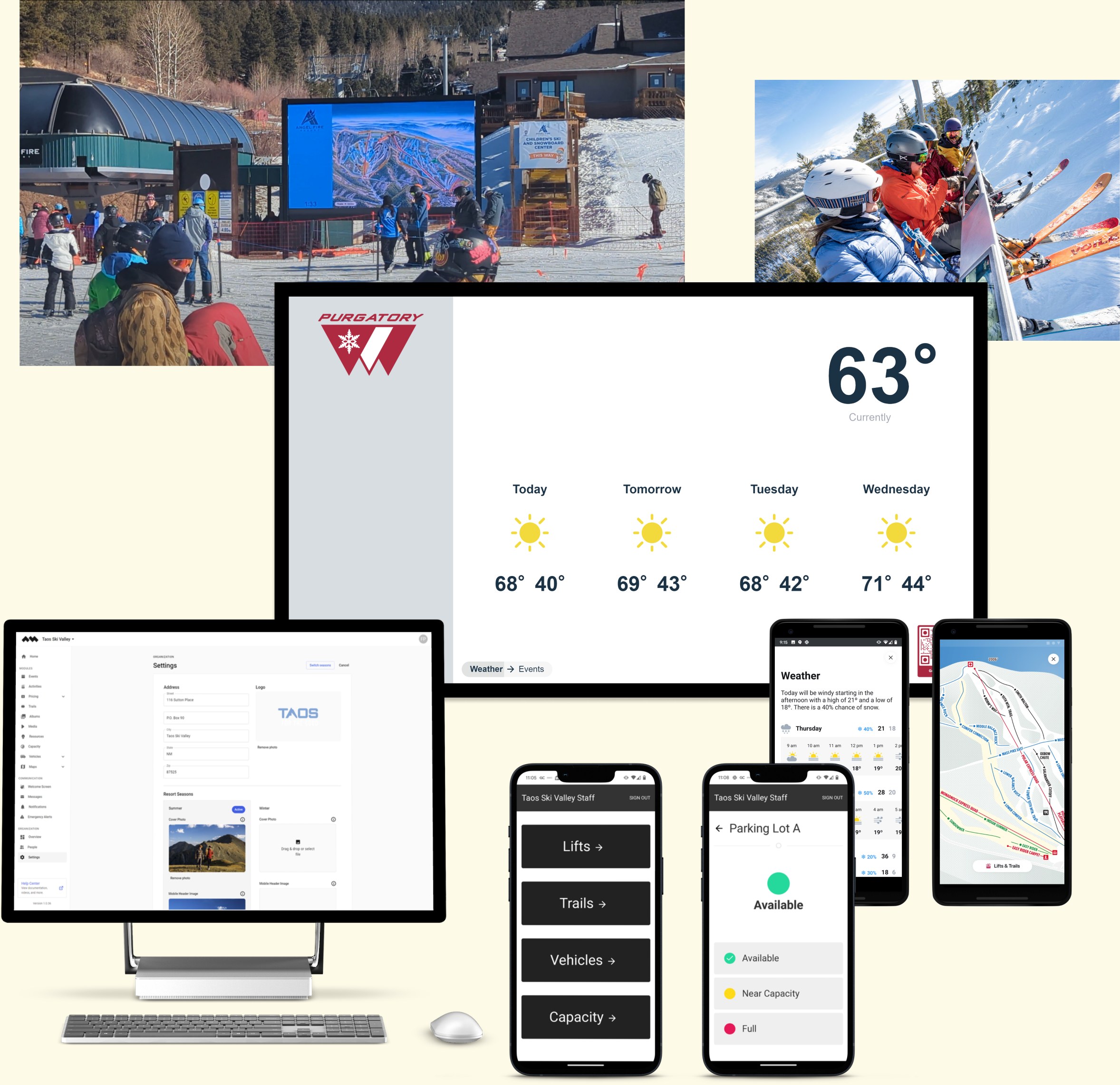
That company is Alpine Media Technology, founded in 2014 and run out of the Denver metro area in Centennial. Its most visible product is the one you can bolt to a chairlift: LiftDigital, a pair of tablet-sized screens mounted on the safety bar that show a trail map on one side and rotating real-time information on the other. It is, by the company's account and by the coverage around it, the world's only digital display system built for chairlifts and gondolas. The less visible product is the idea underneath it, which turned out to travel a lot further than the mountain.
The problem it actually solves
Alpine Media's founders - CEO Freddie Peyerl, chief revenue officer Gerrit VandeKemp, and CTO Jeff Connors - framed the company around a single sentence that still sits on its website: the key to building strong communities is effective communication. On a ski hill, that means the three data points skiers ask for most, delivered while they are captive on the ride up: grooming reports, lift status, and weather. Add a live trail map, event notes, safety tips, and I-70 traffic pulled from CDOT cameras, and the whiteboard suddenly looks like what it is - a relic.
"As avid Colorado skiers, we saw an opportunity to improve guest communication at ski resorts."
Freddie Peyerl, CEO & Co-FounderThe founding insight is almost boringly practical, which is part of why it works. Nobody on a chairlift is doing anything else. There is no cell signal in half these valleys, no menu to scroll, no reason to look anywhere but up. For a communicator, that is close to a perfect window - and for an advertiser, it is close to a perfect billboard.
The trick nobody else pulled off
The reason there is no rival product is mostly physics. A chairlift moves constantly, sits outdoors in brutal cold, and offers nowhere to run a power cable. Batteries die in the freeze and are miserable to service on hundreds of chairs. Alpine Media's answer sounds like a dare: don't carry power at all. As each chair whips through the base terminal, cabling delivers a rapid jolt - the company describes the screens getting "slammed" with a charge - enough to run the display for roughly the next 20 minutes until the chair laps the bottom again. The charging method is patented, and it is effectively the whole moat.
Because the screens are online, they are not just decorative. A closed lift can be flagged instantly. An avalanche warning or an emergency message can be pushed to every chair at once. One screen holds a digital trail map; its partner cycles through real-time updates at roughly 30-second intervals. It is small, mute, iPad-sized hardware doing a job that signage and websites never quite managed - being right, and being right now.
Who pays, and why that matters
The most quietly clever thing about Alpine Media is not the charging trick - it is the invoice. On the mountain, resorts do not buy the screens. Alpine Media installs the technology at no cost and recoups its money through advertising sold on the displays and in the resort's mobile app. The people who benefit most from the information - guests - see it for free, and the party that would have balked at a hardware bill pays nothing.
"We put the technology on the resort at no cost to the resort and we recoup our cost through advertising."
Freddie Peyerl, CEODigital-out-of-home (DOOH) advertising happens to be a strong fit for the captive-rider setup. Industry figures Alpine Media has cited put DOOH's return near $5.97 per dollar, meaningfully ahead of standard digital and print. A chairlift ad has something most screens envy: a viewer who cannot look away, scroll past, or close a tab for the length of the ride. For brands that would normally need a six-figure resort sponsorship, a per-season slot on the lift is a cheaper way to reach an affluent, hard-to-buy audience.
One stack, four industries
Here is where the story stops being about skiing. Strip LiftDigital down to its parts and you find a mobile app, a network of digital signs, and a web-based content-management system that lets a non-technical staffer publish updates everywhere at once. Alpine Media's bet, made around 2020, was that this exact toolkit solves the same problem in places that have nothing to do with snow. A grooming alert and an assisted-living dinner menu are, structurally, the same message: the right information, to the right community, at the right time.
So the company forked the platform into vertical products, each with its own name and its own audience.
It is a tidy example of a repeatable market beating a big one. Rather than chase a single enormous vertical, Alpine Media solved one strange niche completely, packaged the reusable machinery, and re-sold it to the next niche that gathers people in a physical place and struggles to keep them informed. The senior-living and HOA markets are, by headcount, far larger than skiing - and they carry none of the winter seasonality that makes a pure resort business lumpy.
When the screen becomes a safety tool
In May 2023, Alpine Media partnered with AirFlare, whose technology turns a guest's smartphone into a locator that can transmit precise coordinates to ski patrol during an emergency. Folded into Alpine Media's resort apps and promoted on its screens across 20-plus resorts, it is a reminder that a communication channel built for grooming reports and ads can, on a bad day, help find someone lost in a whiteout. AirFlare reported delivering coordinates more than 3,000 times in a single prior winter, sometimes shaving tens of minutes off a rescue.
"This partnership with AirFlare takes our dedication to guest safety to new heights."
Freddie Peyerl, CEOThe people and the money
Alpine Media is a small, veteran-owned team - a handful of full-time staff plus product and sales roles - which is part of the point. The founders were the customer, avid skiers noticing what the mountain failed to tell them, and the company's culture still leans on that: ride the lift, watch where attention goes, build for it. Peyerl's own path is an outlier for a signage startup - a Ph.D. in virology from Harvard and an MBA before he landed on chairlift screens.
The funding history is modest and unflashy, which suits a business that scales one cold chairlift at a time. Reporting in 2018 pegged a roughly $1 million seed round to expand LiftDigital, and records show a $760,000 convertible note in 2019. In 2021 The Tech Tribune named the company a Best Tech Startup in Centennial. There is no blitzscaling story here, and there does not need to be: hardware on a mountain grows at the speed of installs and winters, not viral loops.
Where it fits - and where it wouldn't
Against the alternatives, Alpine Media occupies an odd, defensible corner. Resorts can build their own apps, and many have; static signage and websites are everywhere; HOA, senior-living and school software markets each have incumbents. What competitors do not have is the one piece Alpine Media patented - a working, battery-less screen on a moving lift - paired with a business model that removes the buyer's biggest objection by handing over the hardware for free. That combination is hard to copy and harder to undercut.
It is worth being honest about the edges. The ad-funded model leans on enough foot traffic to sell DOOH inventory, which favors larger resorts over tiny hills. The hardware lives outdoors in punishing conditions and grows the unglamorous way, chair by chair. And the vertical products - HOAM, Quiltt, CampusHub - step into markets with entrenched software vendors, where the advantage is the shared platform and the ad layer rather than a physics trick no one else has. None of that is fatal. It just means the company's real product was never the screen. It was the discipline of noticing that a lot of very different communities are all bad at the same thing.
Explore Alpine Media Technology