A county courthouse employee named Peaches is an unlikely supporting character in the history of an energy software company. Allen Gilmer remembered her anyway. Before Drillinginfo became Enverus, before the subscriptions and acquisitions, there were people driving around Texas, collecting lease records. The information existed. Getting hold of it was another occupation entirely. Somewhere between a filing cabinet and a drilling decision, a business was waiting.
Gilmer and his fellow founders started Drillinginfo in 1999. Their early work involved permits, production records and the decidedly physical business of visiting courthouses. Mark Nibbelink supplied the seed of the idea: put drilling permits on a map. For small operators, the attraction was practical. A prospect beyond familiar territory became easier to investigate. For competitors accustomed to knowing more than their neighbors, the attraction probably required less explanation.
“The lady that ran the courthouse was named ‘Peaches’,” Gilmer recalled. It is a useful detail to retain about a company that would eventually trade in analytics. Its raw material came with office hours, local gatekeepers and somebody’s handwriting. The internet could make information travel. Somebody still had to fetch it.
The lawyer who took geology
Gilmer grew up in El Paso and went to Rice University intending to become a lawyer. Geology classes interrupted that plan. He graduated with a bachelor’s degree in 1984, returned to El Paso and earned his master’s in geological sciences at UTEP in 1987. A career that might have involved interpreting arguments began with interpreting the earth. Both reward attention to what is missing from the visible record.
At Marathon Oil, he worked in geophysics, including research, seismic acquisition and South American exploration. Later came seven years as an independent oilman and the co-founding of three exploration and production companies. He also accumulated patents in multicomponent seismology. Those are useful qualifications for an entrepreneur proposing to organize the industry’s information: he had spent time making decisions that depended on it.
In a 2018 interview, he described the motive behind starting companies in unusually serviceable terms: finding needs that existing businesses were failing to meet. Being a customer of the thing you intend to sell helps. His seismic work demanded judgments about crews, projects and economics across different places. Expensive decisions were arriving faster than convenient information. He had already experienced the inconvenience before he tried selling the remedy.
A map gets a bigger audience
Early Drillinginfo was aimed at independent producers. The larger question behind that choice concerned access. Gilmer disliked the prospect of digital information becoming a privilege reserved for the largest companies. Small operators could work opportunities that bigger organizations passed over. Giving them usable information could change which projects they were willing to consider, and how far from home they were willing to look.
The distinction matters because an information business can grow in several directions. It can collect more records. It can sell the same records to more people. It can also help customers ask different questions of the records they already have. Drillinginfo’s subsequent history involved all three. The map was an opening invitation to a much larger set of decisions.
By March 2017, the company described itself as serving more than 3,200 businesses, with over 500 employees across five continents. Its web and mobile applications combined intelligence, analytics and tools. The scale was a considerable distance from a Texas courthouse. The practical aim remained recognizable: shorten the distance between a question and a decision someone could act on.
production records
in geographic context
evaluate a prospect
The name eventually lagged behind the business. On August 22, 2019, Drillinginfo announced it was becoming Enverus, marking its twentieth anniversary and annual recurring revenue above $300 million. Gilmer’s explanation was that customers did not always recognize the breadth of the company’s acquired products and expertise. Familiarity had become a small obstacle: people remembered the original service very well.
In an essay about the change, he described an energy industry spanning oil, gas, renewables and other connected activities. The company needed room in its name for that wider field. There is a particular founder’s predicament here. Spend years making a name mean something precise, and eventually you may need to persuade everybody that it means more.
How about next Thursday?
Gilmer’s account of handing over leadership contains a pleasingly abrupt turn. After recruiting an operating executive and watching him work for two years, he was ready to make the succession official. His colleague proposed a transition lasting roughly eighteen months. Gilmer suggested the following Thursday, when the company would hold an all-hands meeting.
“How about next Thursday?” is a fairly economical succession plan. Behind it was a less casual judgment. Gilmer had come to believe that the reasons for keeping the chief executive title largely served his own ego. He trusted the person doing the operating work. Jeff Hughes succeeded him as CEO in 2017, with Gilmer remaining executive chairman.
It is an interesting episode for someone whose professional identity was so bound up with the company. Delegation requires more than identifying talent. The new person needs enough room to make decisions. A founder can remain available while allowing a colleague to do the job. In Gilmer’s telling, recognizing that distinction made leaving the title easier.
“Bringing the scientific method to anything is very helpful.”
Allen Gilmer, on his approach to filmmaking
The other kind of prospect
Movies were already part of his life. Growing up in El Paso meant access to old movie theaters; at Rice, he took a class on Westerns taught by Brian Huberman. He has credited that class with encouraging attention to subtext and less linear ways of seeing a story. Geology had supplied one education in looking beneath surfaces. The cinema offered another.
His film work began in 2015, and included backing the documentary Nothing Stays the Same: The Story of the Saxon Pub, which won an audience award at SXSW in 2019. He and his wife and producing partner, Veronica “Riki” Rushing, also helped Tara Wood complete QT8: The First Eight, about Quentin Tarantino’s first eight films. Supporting a documentary about an Austin music venue was a rather different proposition from selling energy software subscriptions.
The partnership became more substantial with Death in Texas, their first produced feature, filmed in El Paso and Las Cruces and released in 2021. Then came Frank & Penelope, directed by Sean Patrick Flanery, and work in distribution as well as production. Its Big Bend setting had an additional attraction for a geoscientist with a fondness for the region. Location could appeal to both versions of Gilmer at once.

He has been candid about the learning involved. One early film investment taught him to read the script before committing. Reviews of later work offered their own education in how differently people can respond to the same picture. His first question as a critic is admirably portable: “Is it boring?” An audience member can administer that test without attending a finance meeting.
The film business also gave his humor fresh material. Asked about acting ambitions, he offered the familiar verdict that his face belonged on radio. He had learned to respect how difficult good acting is. Funding a project does not automatically furnish the skills needed in front of its camera. Even a producer has to recognize the limits of transferable expertise.
Data meets the screening room
In November 2022, Gilmer delivered Fordham’s Clavius Distinguished Lecture, carrying his experience from energy into a discussion of film. He described a business where useful information could be hard to access. Evaluating projects meant working with incomplete indicators and finding ways to gather audience feedback. A successful first career had brought him to another industry with an information problem.
The resemblance has limits, which makes it interesting. A film involves creative judgments, distribution and an audience whose response cannot be guaranteed by a spreadsheet. Gilmer was trying to make the decisions around that uncertainty better informed. After the lecture, mathematician D. Frank Hsu joked about a possible new field of movie informatics. It was a suitable suggestion for a room containing both a data scientist and a movie financier.
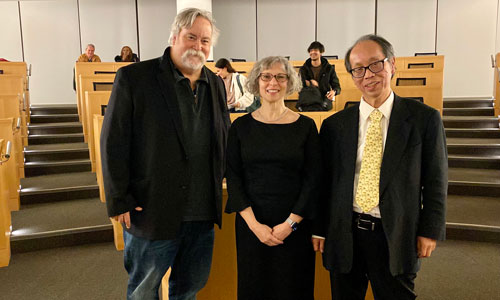
His connection to education has a financial expression, too. In 2018, UTEP celebrated a Data Science and Informatics Gift Fund established by Gilmer and his wife with Hsu. Gilmer and Hsu offered to match further gifts up to $100,000. The university had named Gilmer a Distinguished Alumnus in 2017. Years after his own graduate work, he was helping expand another way for students to interpret complicated evidence.
The credits keep changing
Today, Tiki Tāne Pictures lists Gilmer as a partner alongside Rushing, William Shockley and Tom Brady, the filmmaker. Its credits include Long Shadows and The Assessment. Gilmer and Rushing executive produced both; The Assessment, starring Alicia Vikander, Elizabeth Olsen and Himesh Patel, premiered at the Toronto International Film Festival in 2024. These are distinct productions, supported by teams considerably larger than a husband-and-wife partnership.
El Paso still figures in the story. Death in Texas premiered at the Plaza Theatre in 2021. The Plaza Classic Film Festival later programmed a filmmakers brunch with Gilmer and Rushing about financing, scripts, talent and distribution. Gilmer also serves on the El Paso Community Foundation board. The place where he learned to enjoy movies has become somewhere he can discuss the work of getting them made.
Energy has remained in his conversation. In 2026, he and Cody Davis have been hosting Crude Awakenings, talking with industry operators and executives. His current interests do not require a clean break with his earlier career. A film project, a geological prospect and a conversation with an entrepreneur can each begin with an unanswered question.
Asked in 2023 about his work in film, Gilmer emphasized helping other people develop capabilities they might struggle to put to use. That ambition fits a career spent assembling information, colleagues and projects. He seems most interesting where those pieces meet: close enough to understand the difficulty, curious enough to try another approach, and willing, when the time comes, to let somebody else take the chair.