On the day Alice Bentinck was supposed to sign her contract with Google, she became Matt Clifford’s cofounder instead. There was a respectable future within reach: a recognised employer, a salary, a ladder with its rungs conveniently labelled. She had already worked at McKinsey. Google would have made the next line of her CV pleasingly easy to understand. Then she chose Entrepreneurs First, a business whose very premise required explaining.
Clifford had been working on the idea for a month. The two had discussed founding something together, and when he asked her to join him, Bentinck thought about the regret she would feel if she declined. In her later account of that decision, the Google offer had impressed the people around her more than it excited her. Their approval was beginning to steer her. A promising career could become an efficient way of living somebody else’s ambitions.
The contract story matters because it places Bentinck inside the problem she would spend her working life trying to solve. Before she was selecting potential founders, she was a potential founder tempted by a prestigious job. She knew the pull from personal experience. It came with sensible advice and good intentions, which made it harder to dismiss. Nobody needed to order her to stay on the familiar path. A few admiring nods could do the work.
She has a name for that path: the “Legible Career”. Its appeal is that everyone can read it. Parents understand the prospects. Friends recognise the employer. Promotions supply regular reassurance. Founding a company makes a much less tidy dinner-party answer, particularly when the company proposes investing in people who have neither a business nor a cofounder. The missing nouns are liable to worry the table.
“I thrive in chaos and ambiguity.”
Alice Bentinck
A business before there is a business
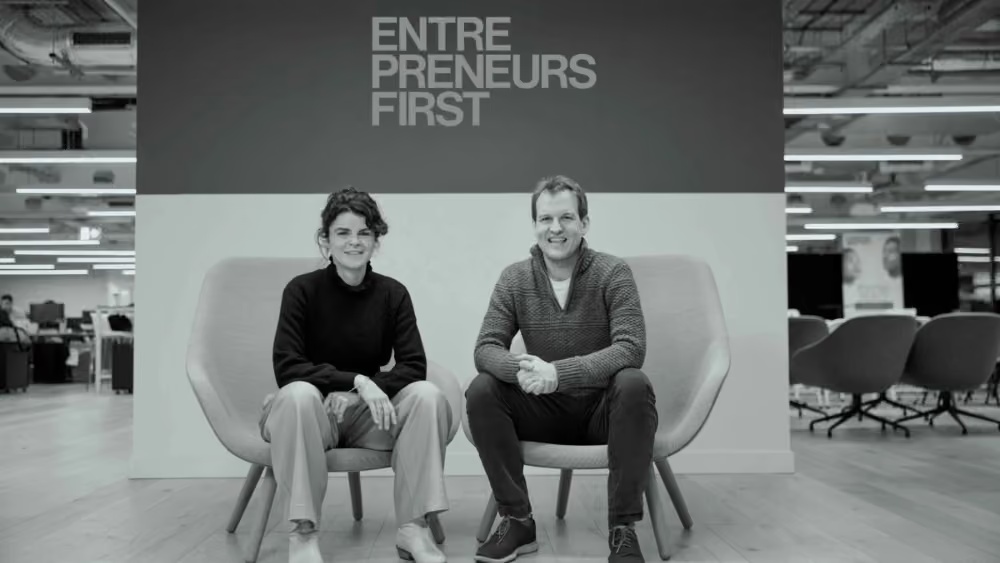
Bentinck and Clifford met at McKinsey in 2009 and founded EF in 2011. She had studied management at Nottingham University Business School, graduating with first-class honours. Their shared concern was the destination of ambitious people: why did so much talent seem to arrive in established professional careers, while entrepreneurship remained a less obvious choice? They set out to make the alternative easier to enter.
EF’s sequence puts the person first. Applicants are assessed individually; an idea and a cofounder are optional. The organisation brings selected people together, helps them form teams, then supports the development of businesses. Money, peers and practical help arrive around the moment when a person decides to start. Bentinck’s subject is the interval before a startup becomes recognisable enough to attract the usual startup machinery.
That creates an unusual job for an investor. A pitch deck can describe an existing product. A founder without an idea asks a different question: what might this person become capable of, working with someone they have yet to meet? The answer cannot be reduced to enthusiasm. EF’s process makes participants work together, giving their relationships something firmer to stand on than a good first conversation. Charm is pleasant. It has a disappointing tendency to miss deadlines.
- 01PersonIdentify potential
- 02PartnershipBuild together
- 03CompanyTest and develop
The other door into technology
There was another problem with the early pool of applicants. Too few were women. Bentinck’s response drew on her own education: she had attended an all-girls school, dropped maths and science at sixteen, and once treated programming as something outside her world. Working with technology businesses during her consulting career changed her interest. Learning to code changed what she felt able to do.
She took an intensive summer coding programme. In her recollection, it was difficult, but the satisfaction of solving a problem and making something herself became absorbing. She could laugh about the distance she had travelled: the names of programming languages and tools had once sounded to her like something altogether unrelated to software. The confidence came through practice, rather than a sudden discovery that she had always belonged.
Bentinck and Clifford cofounded Code First Girls. The first programme, in summer 2013, taught web development to 28 young women through a free, eight-week evening course. Seventy per cent came from arts backgrounds. Those numbers give the origin a human scale: a roomful of people trying a skill that might otherwise have remained outside their plans. The invitation was small enough to accept, and concrete enough to change a decision.
The classes also produced a network. Participants helped one another with programming and shared information about startup jobs. Bentinck had begun with a skills problem and found the importance of company in a second sense of the word. Learning was easier to continue when other people were doing it too. Code First Girls now reports more than 300,000 free learning opportunities delivered to women; Bentinck remains on its board.
Choosing somebody you can build with
The cofounder question runs through her work because she has lived both sides of it. She chose Clifford; EF helps others make their own choice. In a public reflection on their partnership, she described how he had changed the way she thought and operated. Early cohorts were taken to Downing Street to help establish EF’s credibility. More than a decade later, the pair were opening an office in San Francisco. The relationship had outlasted several versions of the business.
For participants, EF argues that friendship alone provides a weak basis for choosing a cofounder. Working on a problem together reveals more than discussing shared values over drinks. Can the pair generate ideas, test them and make progress? Do they become more productive together? Those are demanding questions, and usefully unromantic ones. A convivial evening gives everyone a chance to be fascinating. A stubborn prototype is less easily impressed.
The organisation also asks founders to identify their “edge”: the combination of knowledge, skills and experience that gives them a reason to tackle a particular problem. Team and idea develop together. The point is to discover something specific that these people can do well, rather than attach two ambitious strangers to whichever market happens to be fashionable. Bentinck’s investment work involves designing the conditions in which that specificity can emerge.
Learning without a ladder
Her writing extends the argument beyond EF. In “The Founding Career”, she treats entrepreneurship as a craft that can develop across repeated attempts. A first company can fail while its founder gains skills and judgement useful to a second. The conventional story of a single leap, followed by either triumph or retreat, leaves little room for that accumulation. She wants founding to become a career people can practise.
It is an appealing idea with an awkward practical consequence: the learning has to start somewhere. Bentinck argues that aspiring founders are too often advised to prepare by doing something else. Another qualification, another corporate role, another period of waiting can look responsible while postponing the experience they actually want. Her impatience is directed at the indefinite delay, the apprenticeship that somehow never reaches its own first day.
She and Clifford gave their approach a longer form in How to Be a Founder, published in 2022. The book follows the journey from mindset and team selection to customers, financing and culture. Reid Hoffman wrote the foreword. It won the Startup/Scaleup category at the 2023 Business Book Awards. For Bentinck, writing is another way of making the earliest decisions discussable, before an aspiring founder has a company with which to introduce themselves.
Recognition has also come through established institutions. She received an MBE for services to business in 2016 and joined the British Prime Minister’s Business Council in 2022. There is a pleasing irony in a critic of legible careers collecting distinctions that fit neatly into one. The honours record work already done. Her argument concerns the decisions made before the record exists, when other people still have trouble understanding the plan.
The experiment crosses the Atlantic
Bentinck became EF’s chief executive in December 2023, moving from the chief product officer role as Clifford changed his responsibilities. The following month she announced a permanent San Francisco hub in South Park. Startups from EF’s global sites would be invited to relocate after receiving investment approval. They would have local and Silicon Valley advice, alongside conversations with experienced founders and investors. The move gave the bridge metaphor an actual address.
She now lives in San Francisco. Her advice to European founders reflects the practical friction of crossing between startup cultures. In an October 2025 essay, she said she had helped more than 200 European founders raise money there over the preceding year. She described investors watching the pace of progress between meetings, expecting a clear US plan and interpreting messages as further evidence of how a team operates.
“Speed is ambition made visible,” she writes. The phrase suits her interest in observable behaviour. A large market estimate can be typed into a slide in an afternoon. A product shipped, a customer won or a difficult question answered supplies different evidence. Her fundraising advice makes the glamorous business of venture capital sound partly like a demanding correspondence course: even replying to an email becomes part of the assessment.
The relocation strategy also raises a candid question about her earlier work on access. Creating a route into entrepreneurship is one undertaking; making that route practical across borders is another. In October 2025, she announced The Bridge, an eight-week Bay Area residency for Europeans arriving before they had a team or idea. Its inaugural cohort was scheduled for April 2026, with housing, board and visa support. The programme addressed logistics alongside ambition.
“Speed is ambition made visible.”
Alice Bentinck, on fundraising in the US
A larger cheque, the same first question
In March 2026, EF announced $200 million in fresh capital. Its backers included Stripe’s John and Patrick Collison, Eric Schmidt, Claire Hughes Johnson and Greylock. The organisation says the companies built through its programmes are collectively worth more than $16 billion. That figure describes the portfolio companies; it is distinct from the money EF raised. The distinction matters in a business where several very different numbers can all arrive wearing dollar signs.
For Bentinck, the practical purpose remains identifying people early and helping them build. There is room for candour about outcomes, too. In a GBx interview, she acknowledged that Code First Girls had helped many people move into technical careers, while producing fewer female founders than she and her colleagues had initially hoped. She sees more work ahead. Access to a skill and the decision to start a company sit at different points on the journey.
Return to the unsigned contract and her career acquires a consistent shape. Bentinck has spent years trying to make an uncertain choice easier for others to take, while keeping its demands visible. A peer group, a coding class, a compatible cofounder, a place to live in California: each gives ambition somewhere to go. Google would have been an intelligible next step. She chose a step she would have to explain, then built a business around helping other people take theirs.
Follow the questions further
Read Bentinck’s essays, hear her explain the early decisions, or explore the organisations she helped start.