The first property in Alex Rodriguez’s business story had two units. The baseball contracts would eventually run to hundreds of millions of dollars, but a duplex in Miami required a more modest kind of arithmetic: roughly $48,000 for the down payment. He recalled selling two watches and doing a signing appearance to help put the money together. A watch tells you the time. An apartment can send you a rent check. He had begun to develop a preference.
As a boy, he had watched his mother, Lourdes, work two jobs while rent kept coming due. Years later, he described wanting to trade places with the landlord. That memory gives the purchase a significance no portfolio chart can quite capture. Before ownership became a professional title, it was an answer to a household problem.
Today, Rodriguez is founder, chairman and chief executive of A-Rod Corp, a Miami-based investment business whose interests include real estate, sports and entertainment. The route from that duplex to basketball ownership was long enough to contain most of a baseball career. It also contained an education in how differently people judge you when you change jobs.
The job everyone was watching
Rodriguez was born in New York on July 27, 1975, to Dominican parents. His childhood took him to the Dominican Republic and then Miami. At Westminster Christian School, he played shortstop and quarterback, a combination suggesting that one heavily scrutinized position was insufficient. The Seattle Mariners selected him first overall in the 1993 draft. He was 17.
He made his major league debut in Boston on July 8, 1994, shortly before his nineteenth birthday. Seattle already had Ken Griffey Jr., whose swing could make baseball seem an unusually agreeable way to spend an afternoon. Rodriguez was arriving in a sport where talent came with daily measurement. Every at-bat produced evidence, and every newspaper had room to print it.
By 1996 he was the American League batting champion. After the 2000 season, he signed a ten-year, $252 million contract with the Texas Rangers. A salary that large acquires a public life of its own. People who could not identify a shortstop could discuss whether one was worth the money. His first American League MVP award came with Texas in 2003.
The Yankees trade in 2004 required a practical concession: Derek Jeter already played shortstop. Rodriguez moved to third base. He won two more MVP awards, in 2005 and 2007, and a World Series championship in 2009. For someone frequently discussed as an individual production line, the championship supplied a collective achievement that a record contract could never purchase on its own.
The record also carries a disciplinary chapter. He missed the entire 2014 season under a Major League Baseball suspension. His later return, including his 3,000th hit in 2015, did not remove that absence from the story. Any account of his working life has to hold both things together: the large accumulation of baseball results and the damage done by his own decisions.
An office with a different scoreboard
A-Rod Corp dates to 1995. Rodriguez played his final major league game on August 12, 2016. Put those dates beside each other and the usual retirement narrative becomes less useful. He had been developing a business life while the public was still following his baseball life. The suit did not suddenly appear when the uniform went away.
Real estate supplied a foundation. In 2012, he and Ramon Corona started Monument Capital Management, focused on multifamily property. The company’s first fund followed in 2013. Apartment investing turned the original landlord ambition into an organization with partners, financing and operating responsibilities. The idea was simple enough to explain at a kitchen table; carrying it out required people who understood buildings and balance sheets.
Warren Buffett became one of Rodriguez’s business mentors after insurance arrangements around his Rangers contract brought them into contact. The relationship is an appealing reversal of the celebrity encounter. An athlete accustomed to being asked for something had found someone he wanted to ask. His education included seeking out people whose judgment had been tested somewhere other than a baseball diamond.
“I think the greatest collection you can build is of people.”
Alex Rodriguez, 2018
The investment activity widened. A-Rod Corp’s history includes a stake in Vita Coco, technology investments and an esports investment alongside Shaquille O’Neal and Mark Mastrov. These were different businesses, with different customers and different risks. A recognizable surname might get a meeting. The meeting still had to produce a useful relationship, and the relationship still had to survive the ordinary demands of running a company.
Celebrity adds a peculiar complication to that work. An athlete’s investment gets attention because of the athlete, whether or not attention is what the company needs. Rodriguez has discussed both the advantages and disadvantages of that visibility. His business career invites the same distinction: appearing in a transaction and helping build something after the announcement are separate forms of participation.
A seat beside the old rivals
Broadcasting gave him another position to learn. He joined FOX’s postseason coverage in 2015, while he was still a player. Retirement expanded the space for that work. Television rewards a different use of knowledge: the private calculation a hitter makes in an instant has to become an explanation another person can follow. The experience is valuable only if you can make it audible.
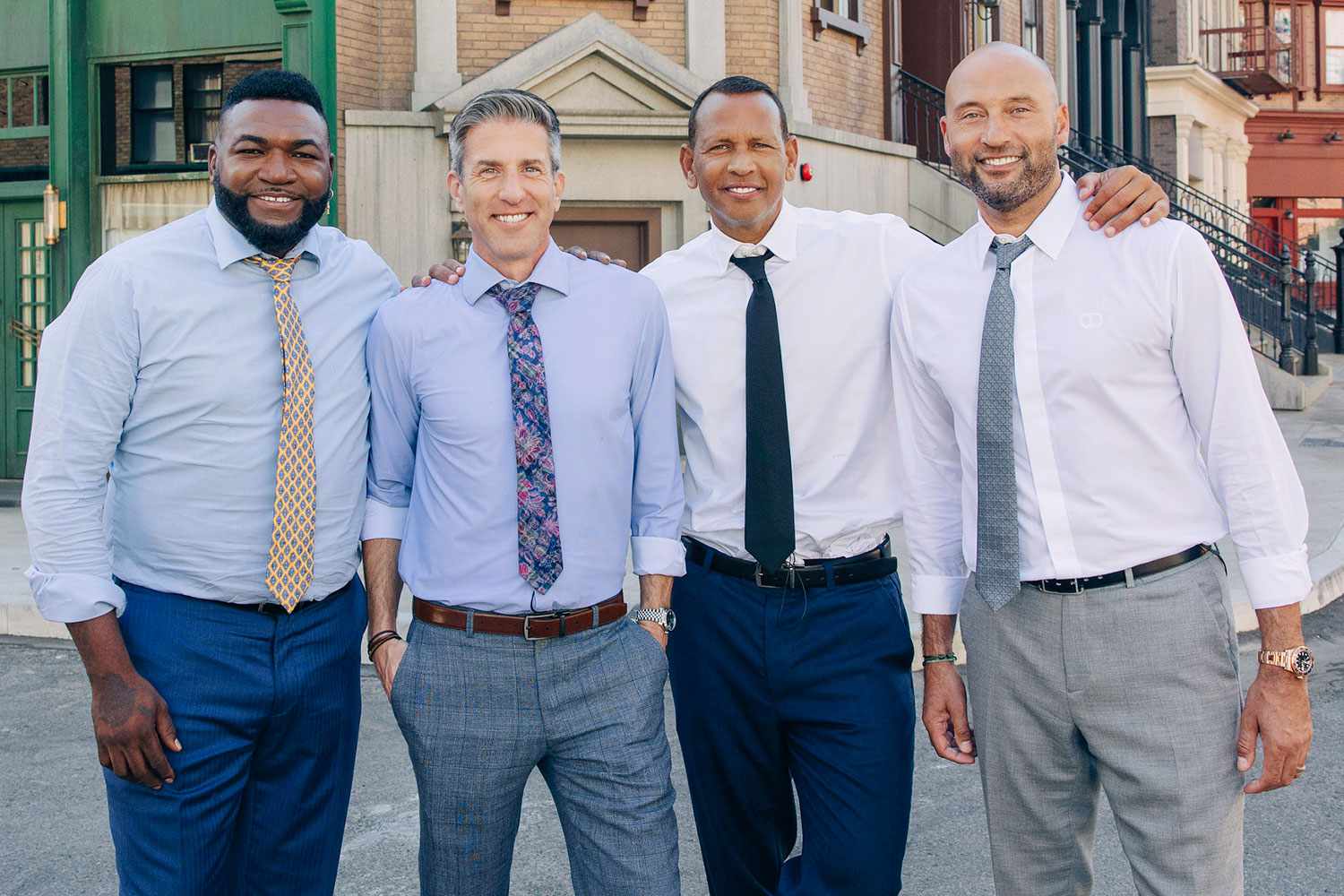
The company is part of the attraction. Jeter and David Ortiz bring their own memories, loyalties and baseball arguments to the FOX desk. The Yankees and Red Sox once furnished the rivalry; television furnishes the chairs. For Rodriguez, a familiar cast allows a new kind of performance, one built around conversation rather than the expectation that he will personally drive in the winning run.
His business conversations have their own home in The Deal, the Bloomberg Originals series and podcast he co-hosts with Jason Kelly. Guests have included Serena Williams, Derek Jeter and Maria Sharapova. The subject is the business around achievement: investment decisions, ownership and the choices that come after a public identity has already been established.
In October 2026, the series returned with Dynasty Equity co-founder Don Cornwell, with further guests announced for weekly episodes. The format suits the overlap in Rodriguez’s working life. He can ask an athlete about money without approaching the subject entirely from outside sport, and ask an investor about sport without treating a team as an unfamiliar asset on a spreadsheet.
Basketball takes its time
The Minnesota Timberwolves and Lynx brought those interests into the same transaction. Rodriguez and entrepreneur Marc Lore first agreed to buy the franchises in 2021. The process stretched across years and a dispute with seller Glen Taylor. A deal announcement offers a photograph and a date. Completing a transfer can offer rather more correspondence.
In June 2025, the NBA approved the transfer of controlling interests. The arrangement placed Rodriguez in the co-chairman role and gave him a formal governing position with the Lynx. He had moved from being an employee whose performance could be read in the box score to an owner whose responsibilities extended well beyond the final buzzer.
- 2021Initial agreement with Glen Taylor
- 2025NBA approves controlling ownership transfer
- 2026Further ownership agreement reported
Different milestones: an agreement, a league approval, another proposed transaction.
That distinction matters again in 2026. In August, reports described an agreement for investor Marc Stad to acquire Lore’s controlling stake, valuing the Timberwolves and Lynx at $4.5 billion, while Rodriguez would remain a co-owner. The reported transaction required NBA approval. It was a new development in an existing ownership group, with its own steps still to complete.
Rodriguez’s continuing involvement places him inside a business where the obligations are public and the time horizon is long. Basketball organizations employ people, negotiate commercial relationships and occupy a place in a city’s life. The owner gets a seat near the court. He also inherits questions that will still be there after the television audience has gone to bed.
The address he keeps returning to
Miami runs through the story with unusual consistency. It is where Rodriguez attended school, where the duplex stood and where A-Rod Corp is based. It is also where his support for youth organizations has a personal connection. The Boys & Girls Clubs were part of his own childhood, before anyone was attaching a valuation to his future earnings.
His relationship with the University of Miami likewise outlasted the college career he never played. He chose professional baseball after the draft, but later committed $3.9 million to the university’s baseball facilities and scholarship support. In 2017, another $500,000 gift supported its business school’s work with professional athletes and other MBA students. The student who went straight to work helped pay for other people’s classrooms.
In December 2025, he returned to the Boys & Girls Club in Miami for an annual holiday party and toy drive. He described it as the eighteenth year of the event. That kind of repetition belongs in a life story alongside the spectacular dates. A draft happens once. Showing up again is a different sort of entry on the calendar.
He has two daughters, Natasha and Ella. Speaking to interns in 2025, he described telling them that he had “a PhD in failing, but a master’s in getting back up.” The joke works because the record supplies evidence for both halves. His public life has included celebrated results, conspicuous mistakes and a sustained effort to keep working afterward.
The duplex remains a useful place to begin. It puts the founder, the father, the athlete and the investor within reach of the boy watching his mother pay the rent. Rodriguez has occupied much more expensive seats since then. The early ambition was plain enough: own something that would still be there when the next month arrived.
Keep the conversation going
The business, the baseball and the conversations in between.