Every emergency begins as an information problem. A storm turns, a fire jumps a road, a threat appears online, a traveler misses a check-in. Someone knows something, but the company has to answer two blunt questions before the knowledge is useful: Who is affected? And did they get the message?
AlertMedia has spent 13 years turning those questions into enterprise software. Its system watches for threats, maps them against people and places, sends targeted messages over multiple channels, collects replies, and gives response teams a place to assign the next action. The pitch sounds obvious because the failure mode is familiar: an email nobody sees, a spreadsheet with last year's phone numbers, or a conference bridge assembled while the building is already being evacuated.
The Austin company now says more than 3,500 organizations use its platform across 150-plus countries, covering roughly 8 million employees. Customers range from Walmart and JetBlue to DHL, Whataburger, Coca-Cola Bottling, and Bechtel. In May 2026, AlertMedia reported well over $100 million in annual recurring revenue. This is no longer a clever way to send a mass text. It is becoming an operating system for the worst day at work.
The idea arrived in the gap between an event and an answer
Founder Brian Cruver began shaping AlertMedia in late 2012 and early 2013, while the Sandy Hook shooting, the Boston Marathon bombing, and the fertilizer-plant explosion in West, Texas exposed the same awkward truth: people at the scene were producing immediate, useful information, but institutions struggled to gather it and respond cleanly. Cruver had already lived through a different institutional collapse as a young Enron employee. He later described the businesses he built as an attempt to be the “anti-Enron” - mission-led, transparent, and useful when stakes were real.
The first product was cloud-based mass notification with two-way communication across voice, text, app push, and social channels. Silverton Partners led a $4.16 million Series A in 2015. An $8 million Series B followed in 2017, then $25 million led by JMI Equity in 2018 and another $15 million in 2020. Vista Equity Partners took a strategic majority stake in 2021; the price was not disclosed.
“The power of individual people, sharing their on-the-scene perspectives immediately in multiple mediums, was being ignored.”Brian Cruver, describing AlertMedia’s origin
What changed buyers' minds was rarely a theoretical disaster. It was friction with the tool already on the shelf. In a commissioned Forrester study, interviewed organizations cited old interfaces, costly licenses, IT upkeep, slow training, and systems that could not support new use cases. The four-company composite switched for a more approachable web and mobile experience, integrations, global infrastructure, and straightforward pricing. AlertMedia says new administrators can learn the platform in about 20 minutes. That is not a vanity metric when the next sender may be a facilities manager with an evacuation underway.
The first failure is usually the ordinary stack
AlertMedia got a live demonstration at home during Winter Storm Uri in 2021. Power, water, internet, and roads failed across Austin. The company's leaders convened, reviewed continuity plans, and sent a daily survey to employees. By Tuesday morning, more than 40% of the workforce had no power. The replies helped managers distinguish who could support customers from who needed support themselves.
The copyable lesson is disarmingly practical: prepare message templates before the weather arrives; use more than one channel; ask for a reply instead of treating delivery as proof of safety; and set a predictable check-in time so people can conserve phone batteries. None of this requires AI. It requires doing the boring work while electricity is still boringly available.
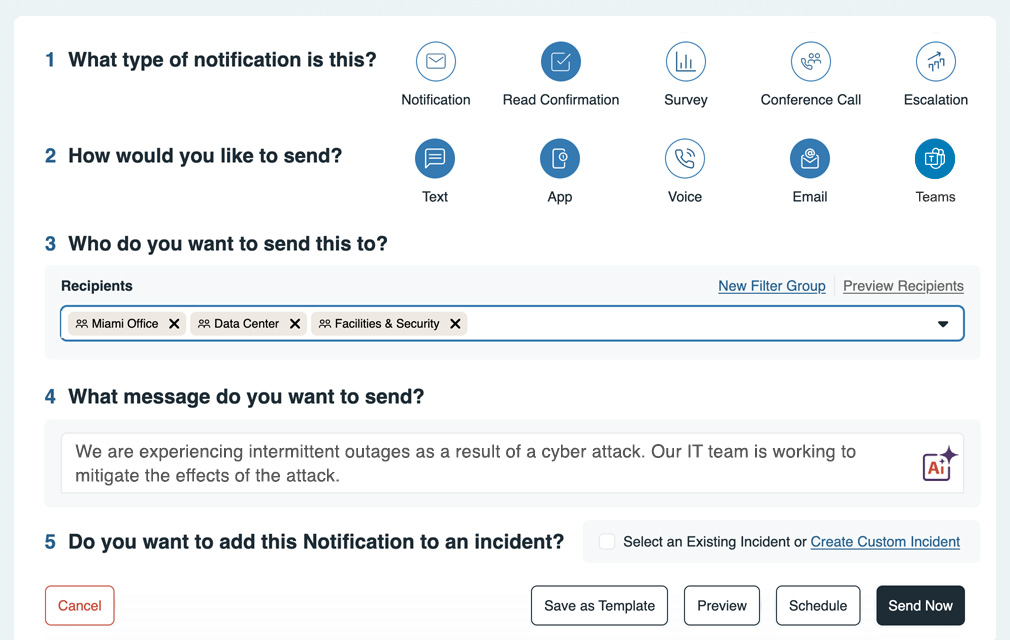
The platform's mass-notification layer uses templates, geofences, and dynamic groups to choose the audience. Messages can travel by text, email, voice, mobile app, Microsoft Teams, WhatsApp, or desktop alert. Recipients can acknowledge, answer a survey, or ask for help. Administrators see who received, opened, and answered. In a crisis, that last mile matters more than the send button.
From megaphone to control room
AlertMedia's product map has expanded in one direction: farther upstream and downstream from the alert. The company formed a global threat-intelligence division in 2021. Travel Risk Management added itinerary imports, destination briefs, traveler locations, and automatic warnings. Incident Response, launched in 2025, added plans, owners, tasks, and live status. Partnerships connect those workflows to BCD Travel, Ontic, Riskonnect, Securitas, and, most recently, Healix, whose medical and security teams can take over when a travel risk becomes a real incident.
| The old stack | The AlertMedia approach |
|---|---|
| Separate weather feed and employee list | Map verified threats against people, travelers, and facilities |
| One email to everybody | Geofenced, dynamic groups over multiple channels |
| Delivery assumed to mean safety | Two-way replies, wellness checks, and escalation |
| Response plan in a document | Tasks, owners, reminders, and live incident status |
This is where AlertMedia differs from a simple notification vendor and where it runs into heavier competitors. Everbridge and Crisis24 offer broad critical-event management suites; Dataminr is known for real-time event discovery; Rave, BlackBerry AtHoc, and Singlewire compete in alerting and public-safety contexts. AlertMedia's wager is that customers prefer one approachable system that runs from detection through resolution, with human-verified intelligence beside automated signals.
AI gets a job, not a cape
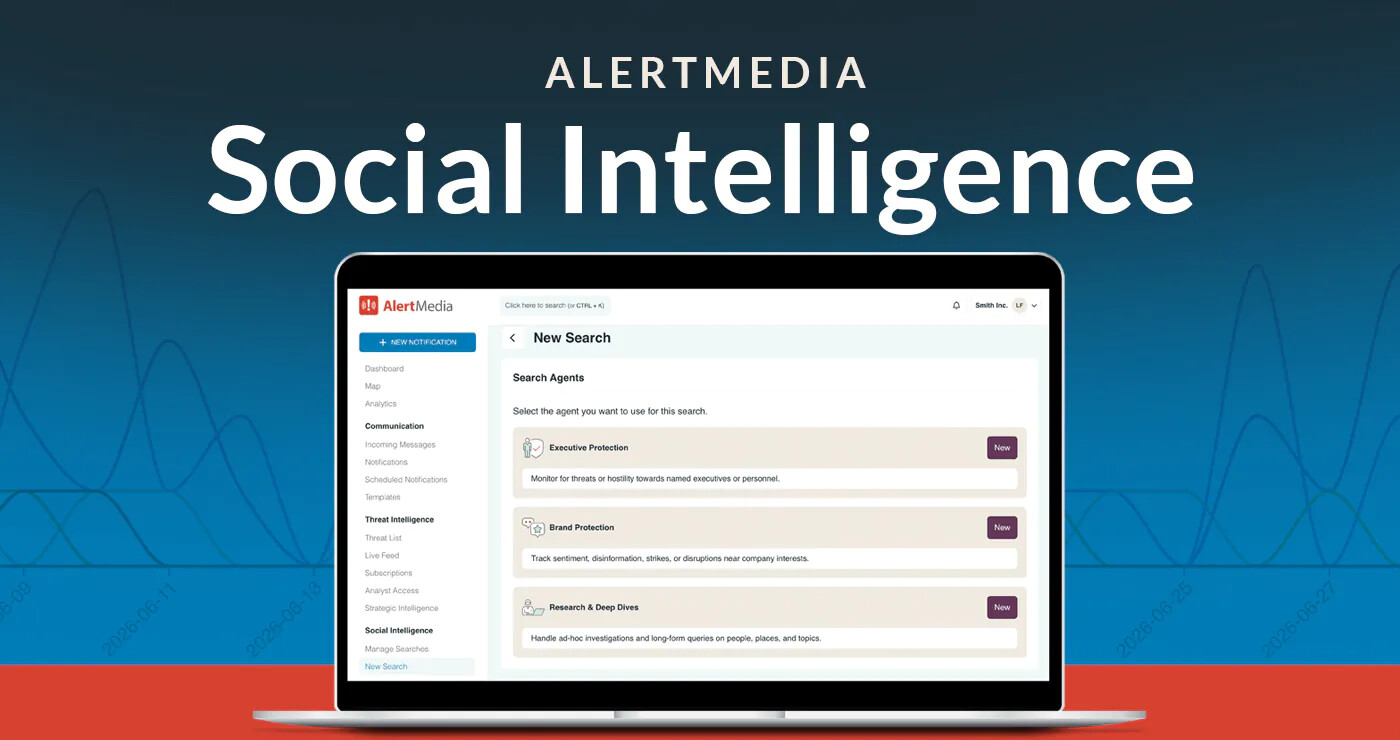
The biggest recent change came through AlertMedia's April 2025 acquisition of Pyrra Technologies. Pyrra monitored hard-to-reach online communities for emerging threats. By July 2026, AlertMedia said Social Intelligence was analyzing more than 15 million daily records across 65-plus mainstream, fringe, emerging, and dark-web sources. AI clusters posts, builds context around accounts, and surfaces concerning narratives; security teams decide what warrants action.
Elsewhere, AI Assistant drafts, edits, and translates emergency messages. Real-Time Signals groups early reports and refreshes summaries as facts change. AI Plan Builder, introduced in August 2026, turns a natural-language scenario into an editable response plan, improves an existing plan, and can compare it with current guidance. The useful pattern is narrow: give a rushed person a solid first draft, not an oracle.
Commissioned Forrester composite / three years
The economics are sold on avoided chaos. AlertMedia does not publish list pricing; customers request a quote for the products and scale they need. A 2021 Forrester Consulting study commissioned by AlertMedia modeled $1.7 million in benefits and 329% ROI over three years for a composite enterprise, with payback in under six months. It also found alerts went out 30 minutes faster and communications-related downtime fell 25%. Those figures are useful evidence, but they are still a modeled composite, not a coupon every buyer can redeem.
What to copy - and when the playbook breaks
A smaller organization does not need to copy the whole platform. It can copy the operating discipline: maintain one source of truth for contact data; segment people by location and responsibility; pre-approve templates; create at least two delivery paths; make every critical alert answerable; assign an owner to each response step; and review what happened after the incident. The software makes that behavior easier to scale, but the behavior comes first.
The five-minute resilience audit
Can you identify everyone near one facility? Reach them without email? See who answered? Give each responder a named task? Update the plan when an employee, office, or regulation changes? Every “no” is a handoff waiting to fail.
There are clear conditions under which AlertMedia will not work. Bad employee data produces the wrong audience faster. Weak authority produces a beautifully delivered argument. Unrehearsed plans remain unrehearsed plans. Connectivity failures can still beat every digital channel, which is why physical procedures and local backups matter. AI-generated copy can be wrong or tonally clumsy; threat signals can be noisy; location tracking requires thoughtful consent, policy, and governance. And a small team with simple needs may find a full risk-and-response suite heavier than a dedicated alerting tool.
The company’s strongest idea is simpler than its expanding product catalog: emergency software should reduce the number of decisions a stressed person must invent. AlertMedia began by making the message easier to send. It grew by helping customers decide whom to reach, what the threat means, and who does what next. On a normal Tuesday, that can sound procedural. On the other kind of Tuesday, procedure is the product.