YesPress / Profile / Identity Technology
Ajay Amlani
He's the one who built the line you skip at the airport. Now he's running the company that decides whether your face is really yours.
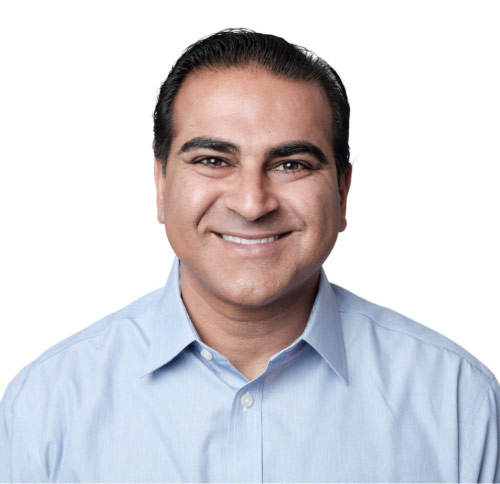
He's the one who built the line you skip at the airport. Now he's running the company that decides whether your face is really yours.
On February 4, 2025, Aware, Inc. - a 32-year-old biometrics company tucked into an office park in Burlington, Massachusetts - named Ajay Amlani its President and Chief Executive Officer. The press release ran the usual two paragraphs of capability statements. The interesting part is the resume underneath.
Amlani co-founded the original company that became CLEAR, the airport-lane service that now moves twelve million members through forty-three airports. He founded YOU Technology, a mobile loyalty platform that Kroger acquired. He ran Americas for iProov, the London-based liveness-detection firm whose technology distinguishes a real face from a printed photo from a deepfake. He spent 2019 to 2021 inside IDEMIA - the French identity-tech giant - as SVP of Corporate Strategy and the GM of its Commercial Business, where he stitched together the first partnerships with mobile handset makers, fintechs, and e-commerce platforms.
Earlier still, he was inside the Pentagon. From 2016 to 2019, under Secretaries Ash Carter and James Mattis, he helped stand up the Defense Innovation Unit - the Department of Defense's first Silicon Valley outpost, the one that asks why a fighter pilot can't have an app store. And before that, in 2003, President George W. Bush picked him as a White House Fellow and dropped him into the office of Tom Ridge, the first Secretary of Homeland Security, during the year a department of 180,000 people had to be assembled from scratch.
Read the resume top to bottom and a pattern shows up. Government. Then startup. Then operator at a large incumbent. Then advisor. Then back to operator. Every stop has something to do with the same problem: how do you prove a person is who they claim to be, fast enough that they don't notice, accurately enough that nobody else can pretend to be them.
Two decades in, the problem keeps getting harder. A deepfake costs less than a coffee. Generative models can spoof voices in three seconds of audio. The mobile checkout flow that took ninety seconds in 2014 has to take eight today, and the bad actors at the other end have better tools than the banks. The job description for Amlani's new chair could be written in one line: get Aware ready for the next decade of that.
Aware sells biometric SDKs, mobile capture libraries, and an identity-orchestration platform called Knomi. Its customers skew government and financial. Industry watchers - and there's a small industry that watches this industry - have already noted Amlani's first signal: a strategic pivot toward government contracts. It is the place he knows best.
"Today, biometrics are at a critical inflection point, reaching widespread societal acceptance as consumers realize it is possible and highly liberating to achieve convenience combined with superior security."- Ajay Amlani, on taking the Aware CEO role
Aware is older than most of its competitors. It shipped fingerprint SDKs when fingerprint SDKs were still the future. The challenge under Amlani is to make a 32-year-old company move at the tempo of an industry where the threat models change every quarter. Deepfakes, generative voice, synthetic identity fraud - the attackers iterate faster than annual reports do.
His pitch, repeated in interviews, is that biometrics finally cleared the consumer-acceptance bar. People unlock their phones with their faces. They board planes with their fingerprints. The cultural argument is settled. The technical argument - liveness, anti-spoof, modality fusion, on-device versus cloud - is wide open.
That second argument is the one Aware is built to have. Knomi, its mobile biometric framework, handles enrollment, authentication, and orchestration. The sales motion underneath is moving toward government, where multi-year contracts pay for the kind of engineering that hardens a stack for the next decade.
Most CEOs of a public biometrics company come up through one of three paths: engineering, sales, or the military-industrial complex. Amlani's resume includes pieces of all three plus a few harder to categorize. CSX Transportation. Baxter International. General Motors. PwC. The early Department of Homeland Security. A White House fellowship.
The pattern in those jobs is not the industries. The pattern is that each one happened during a transition - a merger, a launch, a crisis, a founding. He keeps showing up at hinge moments. The Aware appointment fits.
What does he do for fun? Sits on the advisory council of the Women's Coaching Alliance. Speaks at identity-and-payments summits with the kind of regularity that suggests genuine enjoyment of the work. Talks about deepfake prevention the way other executives talk about quarterly OKRs.
PUBLIC SECTOR   ##                  ###
                ##                  ###
START-UP / SMB    ###    ###############
                  ###    ###############
LARGE INCUMBENT      ############         #####
                     ############         #####
                ----+----+----+----+----+----+----
                  2003  2008  2013  2018  2023  2025

  Legend:  DHS / DoD       =  public sector
           CLEAR / YOU Tech =  startup era
           IDEMIA / iProov  =  incumbent operator
           Aware (CEO)      =  current
The Department of Homeland Security was twelve months old when Amlani arrived. The org chart was being drawn on a whiteboard. He spent that year representing U.S. identity policy in negotiating rooms with the G8, UN, OAS, and EU. Most thirty-year-olds get a desk; he got a portfolio.
The first version of CLEAR predated TSA PreCheck. It was a private-sector answer to a public-sector bottleneck. The thesis: identity is a service, and frequent travelers will pay for it.
DHS. DoD. DIU. PwC. GM. CSX. iProov. IDEMIA. Aware. Read his resume out loud and you'll run out of breath.
Undergrad: Michigan. MBA: Stephen M. Ross School of Business. Same campus, two stops. The maize-and-blue thread runs through every bio.
YOU Technology, his mobile-first retail loyalty bet, did not get acquired by a tech company. It got acquired by a grocer. The hint: identity and payments don't live in tech - they live in retail.
Aware's office sits at 76 Blanchard Rd in Burlington, Massachusetts. Amlani is based in California. The transcontinental commute is part of the deal.