Will Lee had a fairly clear idea of what he did not want. When he joined ADWEEK, he later told Gold House, he thought: “I don’t want to run an events company.” A reasonable reservation for someone taking charge of a publication. Yet by October 2026, he was describing the act of gathering people as essential to the business. Somewhere between the newsroom and the conference stage, the job had changed shape.
- The product: reporting, professional gatherings, and recognition for the advertising business.
- The buyers: marketers seeking useful information, and suppliers seeking those marketers.
- The lesson: one well-defined audience can have several reasons to pay.
That reversal is a useful way into ADWEEK. The company covers the people who decide what the rest of us see: the agency choosing a campaign, the brand buying the airtime, the platform selling the audience. Its opportunity is wonderfully circular. People whose working lives revolve around capturing attention need help deciding where to put their own.
A trade magazine with a social life
ADWEEK dates its first publication to 1979. Its founders, Jack Thomas, Ken Fadner, and W. Pendleton Tudor, assembled regional advertising publications into the venture. This was a business built around accounts, creative work, and the people making decisions. Knowing who had won a client could matter almost as much as knowing what the winning campaign looked like.
That professional focus still defines the company. ADWEEK is a business media publisher serving brand marketers, agencies, media companies, and advertising technology businesses. Its expertise sits at their intersections: how creative work reaches an audience, how platforms change distribution, and how money moves between the parties. A general business publication might cover the quarterly result. ADWEEK can follow the account review behind it.
Ad Age is the obvious direct alternative. Digiday, Marketing Brew, The Drum, and Marketing Week compete for parts of the same working day. ADWEEK’s proposition combines broad industry coverage with its own recurring gatherings and recognition programs. The useful question for a potential reader is which outlet consistently explains the decisions that reader actually has to make.
The same person, three different needs
Consider an agency executive. In the morning, she needs to understand an account move. Later, she needs to meet a potential client. By year-end, she wants her team’s work recognized. These are different jobs, with different budgets and different definitions of success. ADWEEK offers something for each occasion.
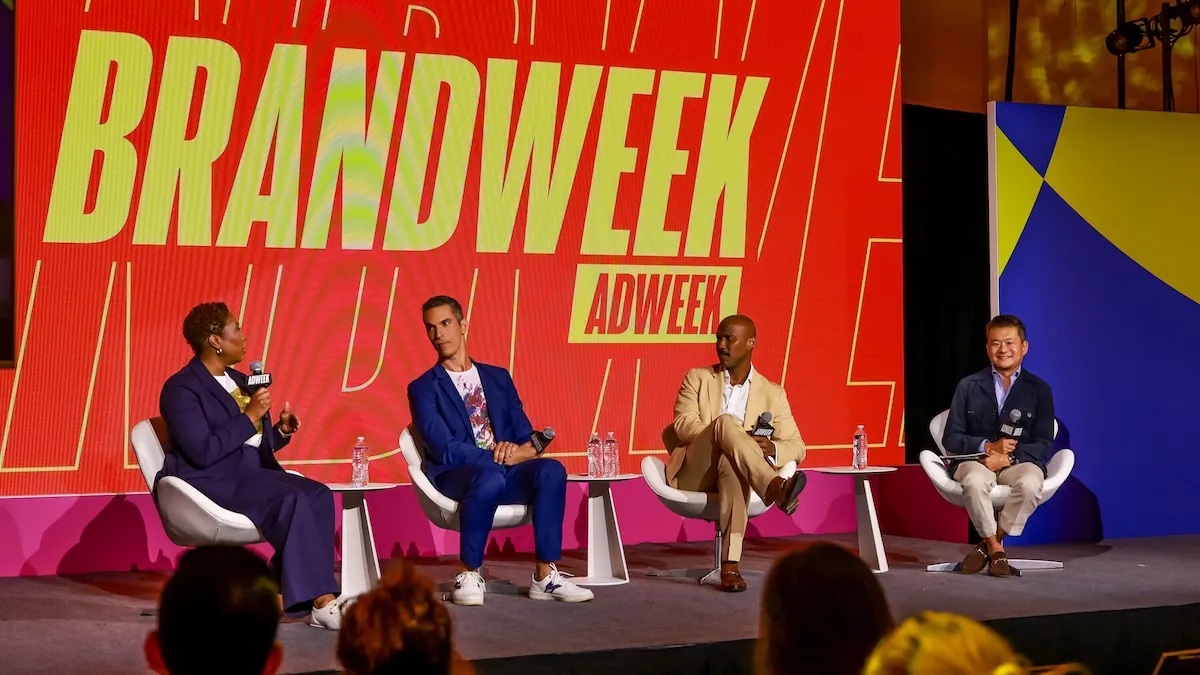
The newsroom supplies articles, interviews, and analysis. Newsletters organize the flow into subjects a professional can follow. Podcasts, including Marketing Vanguard and ADSPEAK, offer longer conversations. Conferences such as Brandweek and Social Media Week create a setting for introductions. Awards provide another form of visibility. The company distinguishes editorial selections from competitive entries judged by outside industry experts and reviewed by its editorial team.
An editorial map of the offering, not a revenue breakdown.
For advertisers and sponsors, the attraction runs in the other direction. A concentrated professional audience can be valuable even when it is much smaller than a consumer audience. ADWEEK sells advertising and sponsored content alongside event sponsorships. Subscriptions, tickets, recruitment listings, and licensing add other ways to earn money from serving the same industry.
Follow the badge
Shamrock Capital acquired ADWEEK from Beringer Capital in June 2020. The buyer’s announcement already emphasized expansion beyond journalism into education, events, and corporate subscriptions. This was an existing direction of travel, rather than an invention of the latest management team.
In January 2021, ADWEEK acquired Social Media Week, including its conferences, news operation, and streaming platform. The acquisition announcement described social media managers as increasingly influential marketers. Social Media Week had also held a virtual conference in May 2020. The purchase followed a profession whose responsibilities were expanding, with a format that could reach it during disrupted travel.
By 2024, ADWEEK had announced a partnership with experiential studio C2, covering Brandweek and Marketing Vanguard production and an experiential marketing vertical. The commercial logic is easy to follow: knowing what an industry wants to discuss and knowing how to stage the discussion are complementary skills.
“I don’t want to run an events company”Will Lee, recalling his initial position, October 2026
The price of paying attention
On the subscription page checked in October 2026, annual digital access was listed at $199, and digital plus print at $249. The $20 monthly option specified billing every four weeks, a distinction worth reading before comparing plans. Group subscriptions give organizations another purchasing route. A conference ticket is a separate decision.
The bundle includes reporting, research, an archive dating to 2000, and on-demand event video. But video has limits as a substitute. Brandweek’s 2025 FAQ explicitly offered no virtual live pass, while including recordings afterward. A recording preserves a presentation. An introduction over lunch requires another arrangement. The access policy makes the difference tangible.
A new audience for the advertisements
The company is also experimenting with what counts as useful industry information. For the 2026 Super Bowl, it partnered with Emberos on an AI Influence Index, examining how advertisers appeared across five generative search systems. The follow-up covered brand mentions and differences between those systems. This adds another place to investigate an advertisement’s afterlife; AI visibility alone cannot establish whether the campaign sold anything.
Readers can copy a modest habit from this business: connect information to a specific next action. Read an agency story before a pitch. Compare a campaign with your own brief. Attend an event with a question and a person you hope to meet. The value depends on what happens after the article or session ends.
Publishers considering the model need a similarly concrete test. Their audience must have recurring decisions to make, reasons to meet, and enough trust in the journalism to return. Sponsorship creates pressure because the people buying access may also be subjects of coverage. ADWEEK’s newsroom remains central to the bargain. Without useful reporting, the invitation becomes much easier to decline.