The great romance of entrepreneurship rarely begins with a tax invoice. There are no cinematic garages here, no breathless manifesto about rearranging civilization before lunch. There is a shop counter, a customer waiting on WhatsApp, and a business owner trying to remember whether a payment arrived. Aditya Vemuganti looked at this stubborn knot of billing, collections and bookkeeping and saw a useful place to begin.
That beginning became Swipe, the Hyderabad software company Vemuganti co-founded with Sri Teja Allaparthi in 2021. Its early proposition could fit on a receipt: create an invoice in less than ten seconds, send it over WhatsApp and give the customer a way to pay. The speed was attractive. The placement was sharper. Instead of asking small-business owners to abandon their working habits for a gleaming new system, Swipe entered through a conversation they were already having.
Vemuganti arrived at the problem by a route that crossed an American campus, a global technology company and a return home. He completed a master’s degree at the University of Washington, worked at Amazon, then came back to India to start a company. Allaparthi, a friend for more than seven years, had worked at Great Learning after his master’s at IIIT Hyderabad. Their friendship preceded the cap table. Their irritation with manual work supplied the plot.
A paper trail hiding in plain sight
During the pandemic, digitisation stopped sounding like a boardroom noun and became a daily necessity. Yet vast numbers of small and medium businesses still recorded sales, purchases and payments manually. At month’s end, the owner might consolidate transactions in a spreadsheet and pass the file to an accountant for tax filing. Every handoff invited delay. Every duplicate entry offered a small opportunity for error. The system worked, in the generous sense that a bicycle with a square wheel also moves.
The founders had felt the friction themselves while trying to create invoices and track customer payments at an earlier startup. That detail matters. Swipe was not born from a distant theory about how merchants ought to behave. It came from getting annoyed by the work. The pair saw that an invoice was more than an accounting artifact. It sat at the junction of a sale, a customer conversation, a payment and a tax record. Improve that junction and several roads become easier at once.
“We are not just building an application to improve their books; we are here to improve their business.”Aditya Vemuganti, 2021
This is Vemuganti’s most useful distinction. Traditional bookkeeping describes the business after the fact. His pitch for Swipe was more active: automate the accounting while helping the merchant generate revenue and maintain customer relationships. A bill can carry a payment link. A reminder can shorten the wait for cash. A digital record can reveal stock and sales patterns. The ledger, properly wired, becomes less of a mausoleum for old transactions and more of a dashboard for the next decision.
The wedge earns its width
Swipe launched in February 2021. By December, the company said more than 10,000 businesses were using it to record daily transactions, monthly transaction volume had reached $4 million, and a mobile app had reached Google Play. The team numbered five. It had also entered Y Combinator’s Summer 2021 batch and received the accelerator’s then-standard $125,000 investment.
Those early figures show the advantage of choosing a frequent problem. Invoicing is not an annual ceremony. For many businesses it happens repeatedly, often at the exact moment when speed and clarity matter. A product that saves a few minutes once is a convenience. A product that saves them every day begins to become infrastructure.
The following February, Swipe announced a $2 million seed round led by Y Combinator. Global Founders Capital, Soma Capital, Locus Ventures, Duro Ventures, K3 Diversity Ventures and more than 25 angels participated. The company said 25,000 business owners had registered and more than $30 million in transactions had passed through the platform within its first year.
Vemuganti framed the market with an operator’s eye for the small merchant’s economics. “For a small business which competes with the likes of Amazon, every rupee of increased revenue is like gold for them,” he said at the time. His argument was not that local businesses needed technology because technology was fashionable. They needed tools to reach more consumers and build relationships that larger platforms had learned to cultivate at industrial scale.
An operating system grows from the counter
The product has widened since those early days. Swipe now spans GST-compliant invoices, payment collection, inventory, purchase records, reports, online stores, multiple users and integrations. The company’s releases show the method: follow the merchant’s work into the neighbouring task. A sale affects stock. A late invoice needs a reminder. A paid bill needs reconciliation. A shipment may require an e-way bill. The feature list grows, but the centre of gravity remains the day-to-day transaction.
Recent releases add an AI layer to that loop. Swipe can extract details from uploaded documents, help create invoices and expenses, answer questions about products and stock, and work through WhatsApp. In 2026, the company added connected banking with Axis Bank, links to AI assistants, bulk actions, faster mobile billing and more international payment options. It has also announced availability beyond India, including the UAE, Qatar and Oman.
Scale changes the promise
A company’s homepage offers a revealing contrast with its old launch notes. In 2021, Swipe spoke about 10,000 businesses recording daily transactions. Its current site says the product is trusted by more than 2.5 million businesses. The figures come from the company at different moments and measure different things, but the distance between them captures a genuine shift in responsibility. A tool used by a small founding cohort can survive a rough edge. Software placed in millions of business routines must become dependable without becoming obscure.
The release log reads like a catalogue of what happens after the clean demo ends. There are changes for warehouse transfers, barcode scanners, partial payments, approval limits, multi-currency invoices, Shopify orders and tax reports. None makes for a sweeping founding myth. Together they show the unending negotiation between a simple interface and the untidy variety of commerce. A tailor, distributor, freelancer and retailer may all create an invoice, yet the details around that act can differ in a hundred consequential ways.
That variety also explains the appeal of artificial intelligence here. The valuable trick is not composing a cheerful paragraph. It is recognising a vendor from a document, matching a product during a bulk upload, finding an invoice from a WhatsApp request or turning a photographed expense into a record. These are small acts of translation between the physical counter and structured accounts. Done well, they remove keystrokes. Done reliably, they return attention to the sale, the customer and the next decision.
A narrow wedge works best when it sits inside a larger workflow. Make the frequent task easier, then expand along the customer’s actual sequence of work.
There is an appealing continuity here. Swipe began by reducing the distance between a completed sale and a paid invoice. Its AI features aim to reduce the distance between an unstructured scrap of business information and a useful action. Photograph an expense. Upload an invoice. Ask about stock. The interface changes, but the purpose is familiar: fewer clerical detours between the owner and the work that pays.
Simplicity is a maintenance job
Building more while remaining simple is the difficult part. An early invoice app can be explained in seconds. A platform handling branches, tax rules, inventory, currencies, banking and artificial intelligence can easily acquire the temperament of a government form. Swipe’s founders stated from the beginning that they wanted the app to remain simple and available to many kinds of businesses. Every adjacent feature therefore creates two jobs: add capability, then prevent that capability from making the whole product feel heavier.
The company’s choice of WhatsApp remains instructive. Good software often wins by respecting the paths people have already worn into their day. It does not demand ceremony where a message will do. For a merchant, the ideal transformation may be nearly invisible: the customer receives a familiar chat, the payment link is ready, the books update, the stock count moves and the evening contains one fewer spreadsheet.
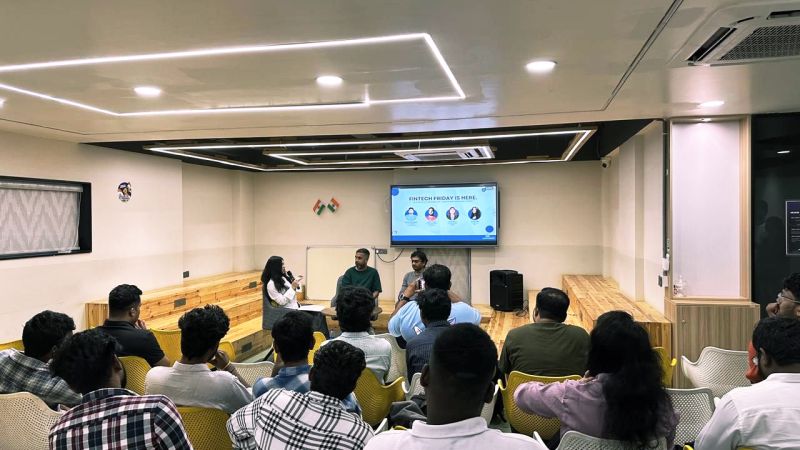
Vemuganti has lately carried those lessons into founder rooms. In 2025 he spoke with aspiring entrepreneurs at Draper Startup House India’s Fintech Friday and joined a small Hyderabad workshop on shaping a fundraising story. The useful story he can offer is not a tale of discovering an exotic frontier. It is about looking harder at ordinary work.
The invoice was the entry point. The ambition is the shop itself: sales, customers, cash, stock and compliance moving as one system.
That ambition is demanding because small business is not small in complexity. A neighbourhood retailer can face tax rules, fluctuating inventory, partial payments, several price lists and customers who prefer different channels. The owner does not experience these as separate software categories. They arrive together, usually while somebody is waiting.
Swipe’s wager is that the software should arrive together too, but with less fuss. Vemuganti started with the plainest proof of value: make the bill fast and help the merchant get paid. Five years of product expansion have not altered the underlying observation. The dullest document on the counter may still be the liveliest place to build.