Zayd Syed Ali had done the difficult part. A cold email had become a conversation, the conversation had become a series of introductions, and a venture fund was finally inviting him to present to its partners. Then, thirty minutes before the meeting, he rewrote his pitch. The new version, he would later admit, made no sense. After all that selling, he had talked himself out of a sale.
The story is a useful place to meet Valley’s founder and CEO. His business is helping other people start conversations with prospective customers. His own career contains plenty of conversations that went sideways. It also contains two agency exits, an abandoned social network, a return to appointment setting, and a growing suspicion that speed can become a rather expensive habit.
The pitch he rewrote thirty minutes too late
The introduction began with surfing. Ali noticed that a venture-fund partner had started a surf school he used to attend. He sent an email. That shared detail carried him through several people at the fund, eventually to an in-person meeting. Asked to demonstrate how he sold Valley to a portfolio company, he says he closed the customer in twenty minutes.
Then came a rejection, delivered while he was at a family barbecue. The fund had concerns about interoperability. Ali went home and recorded a Loom video addressing the objections. The next morning brought another call and the invitation to a partner meeting.
That was the presentation he changed at the last minute. The fund declined. He has described the episode without supplying a convenient rescue scene. The money came from elsewhere later. The promising introduction, the customer demonstration and the carefully argued video had earned an opportunity; none could protect the presentation from its presenter.
“My new pitch made no sense.”
Zayd Syed Ali, on the last-minute rewrite
Before software, there were appointments
Ali’s first outbound agency began when he was seventeen, with a friend he remembers meeting through Snapchat. They helped financial advisors find prospective clients. He dates that exit to 2021. A second agency applied the approach to emerging fund managers looking for limited partners, beginning in 2022 and exiting in 2023.
Getting an appointment sounds tidy on an invoice. Behind it sit account lists, research, messages, unanswered messages and the continual question of whether the person contacted was ever likely to buy. His agencies added human services around existing LinkedIn automation tools. The research and judgment mattered as much as the sending.
At nineteen, reflecting on his first sale, Ali had mixed feelings about the experience. Advisor Appointments had taught him a great deal and made money, yet he found parts of the work joyless. He traced his enthusiasm for entrepreneurship to OnSide, a nonprofit where he could exercise creativity and build a community. The exit gave him room to ask what he actually enjoyed building.
Those reflections already favored inviting an audience into the process. He wanted people to see the work while it was happening. Community, in his account, could make a company more adaptable and give it ways to reach people beyond a single product. The public writing that now accompanies Valley has roots in those early questions.

Fish needed a different pond
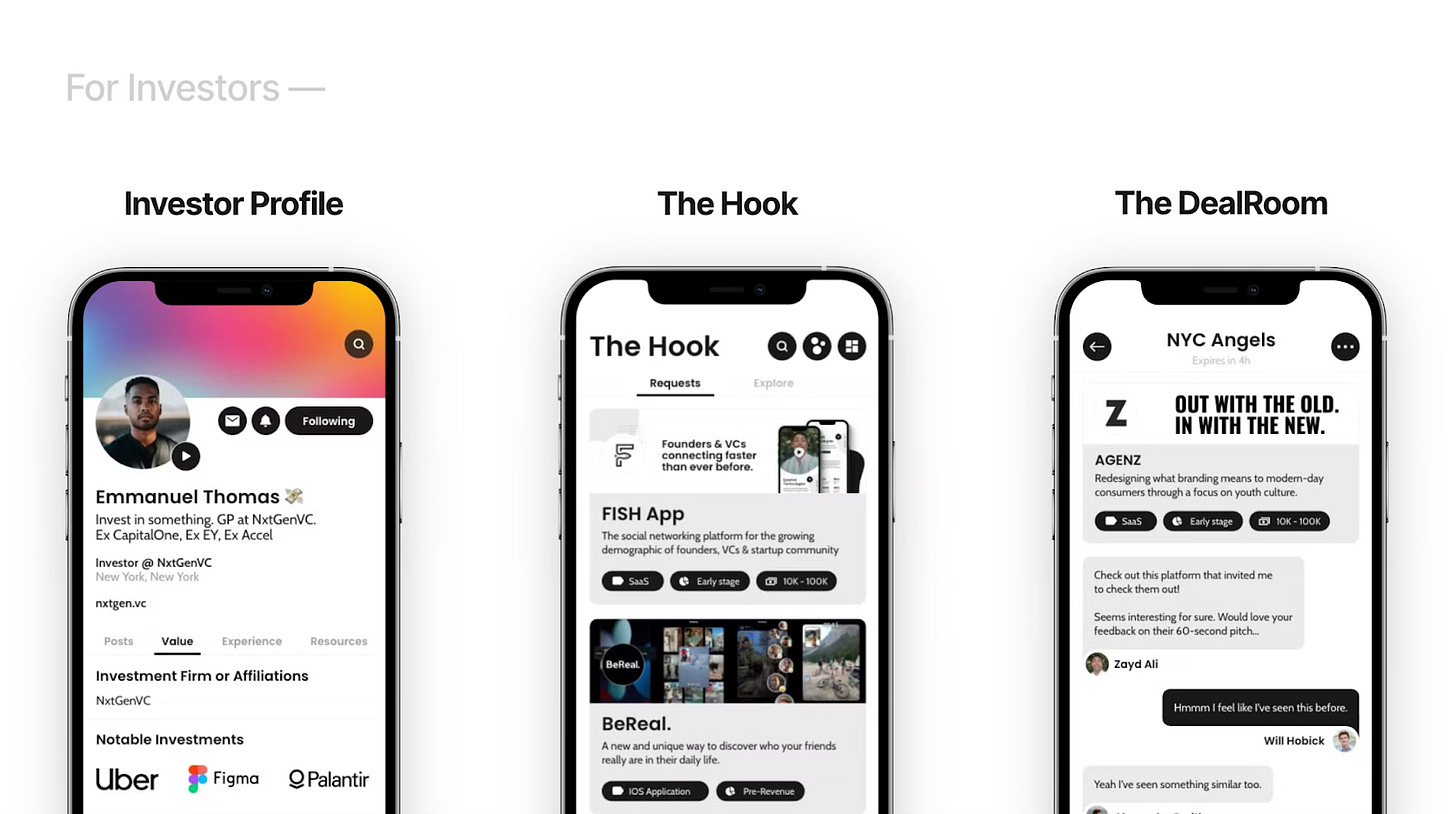
At Antler, the idea was Fish: a social network where founders and venture investors could find one another. Jeff Becker disliked the business. He liked Ali. That distinction survived the investment committee, where only one of seven people liked the idea, but all seven liked the founder enough to back him.
Ali kept working on it. In his account, six months went into new features, repositioning and changes to the algorithm. Engagement fell 60% from its peak. Advertising required a larger audience, and subscriptions for access to investors were a difficult sell. More work was producing less reason to continue.
He returned to appointment setting and called twenty founders about their outbound challenges. Then he made a Figma mockup and held fifteen feedback calls. Twelve prospects said yes. These were early responses to a proposed product, rather than a mature company’s conversion statistics, but they gave him a concrete reason to build.
Closing Fish still meant telling users that their communities would disappear. A pivot can sound clean in a retrospective. Someone has to send the awkward message. Ali had to accept that protecting the existing idea could consume the time and money needed for the next one.
about outbound
conversations
responses
A spreadsheet is an honest beginning
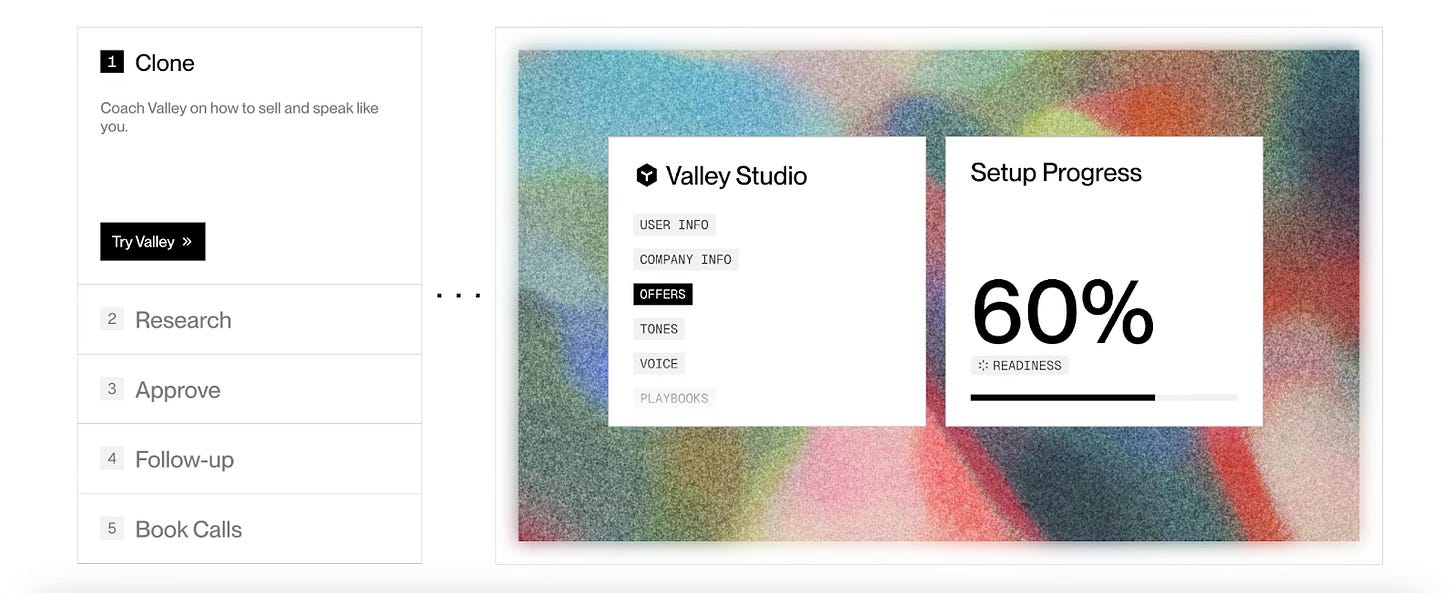
Valley’s early machinery was less glamorous than its ambition: Google Sheets, a single AI prompt and people reviewing the outputs. Ali’s verdict on that version was blunt: “It was very bad.” The team knew the model needed supervision and kept iterating.
The work started with questions his agencies had already confronted. Who should receive a message? What made the approach timely? How could it sound like the person sending it? A message that arrives carrying the wrong tone can waste the research behind it. Users supplied examples of their own writing and instructions about what to include or avoid.
By November 2023, Valley had begun its pilot and announced a $2 million pre-seed round. Backers included Antler, Jason Calacanis, Rough Draft Ventures and Transform VC. The proposed economics were straightforward: move some of the work performed by a salaried sales development representative or an appointment-setting agency into a software subscription.
Ali brought experience of the manual job to that experiment. Building software required turning the judgment into a repeatable workflow. The spreadsheet stage makes that process visible: outputs arrived, people examined them, and the system was revised. It is a more useful beginning than pretending the first prompt came with manners.
The arithmetic of a smaller inbox
Ali’s argument for Valley rests on relevance. A prospective buyer should be able to understand why this person approached them, and feel that someone invested effort in learning about them. An interchangeable opening makes the opposite impression. A detail from a recent podcast or company announcement gives the sender something specific to work with.
His product demonstrations describe a connected sequence: find leads, research them, assess whether they fit, draft messages and send them. The important decisions happen before the final click. LinkedIn’s constraints make those decisions consequential. When messages are limited, an irrelevant recipient takes up room that could have gone to someone more suitable.
Valley now presents that work across LinkedIn and email, with drafts that users can review and edit. Ali’s ambition is to free founders and sales teams to spend more time in the conversations that follow. The software still needs a clear account of what the company sells and whom it can help. Automating an introduction does not supply a business with a reason to be wanted.
- 01Find a reasonA signal that makes contact timely.
- 02Check the fitResearch the person and the company.
- 03Write, then reviewUse the sender’s voice and judgment.
- 04Start a conversationGive the recipient something relevant.
The public version, with the rough edges left in
Fundraising took persistence. Becker recounts 136 meetings before the first yes, followed by a few more to complete an initial $2 million raise. Later, an email to existing investors brought another $1.2 million in commitments between Wednesday and Friday. The two stretches belong beside each other: a slow beginning and a quicker return to people who already knew the company.
Ali’s operating reflections are similarly uneven. In one account of his earlier businesses, he describes almost shutting a company at $5,000 in monthly recurring revenue and 10% margins. A year later, he says, it reached $50,000 a month with margins above 50%. He warns against treating office decor, publicity and elaborate plans as evidence of progress. Exposed brick cannot pay an invoice, however photogenic the invoice may be.
He has also described Valley losing 30% of its users in a month because the product was unreliable. The response, he says, involved fixing it, reducing the team and discarding work that did not move the business forward. His retrospective places those decisions beside reported growth, rather than concealing them behind the result.
Enabled, his newsletter, carries that habit into sales advice. In July 2026 he argued that outbound software sellers should pay more attention to marketing and demand-generation teams, which want to deliver qualified meetings directly to sales. He is still revising his account of who needs the product and how they use it.
Lightning McQueen acquires a management problem
Then there is Cars. Ali grew up devoted to Lightning McQueen, with the lunchbox and Halloween costume to prove it. Rewatching the film for its twentieth anniversary gave him a less flattering view of his childhood favorite. The confidence remained. The treatment of teammates looked rather worse.
In August 2026, he connected that realization to Valley’s first year. He had prioritized speed and often fixed problems himself because explaining them to someone else felt slower. Hearing from founders further along helped him recognize where that approach could lead. His own willingness to work had become a reason to avoid handing work over.
It is a fitting complication for someone selling software that takes tasks off other people’s desks. Delegation requires accepting the interval in which another person learns. A founder can make a fast repair and still leave the company dependent on the same pair of hands tomorrow.
Ali’s career has already required several kinds of revision: leaving Fish, recovering from a pitch, changing the product and reconsidering the buyer. The latest is personal and ordinary. He is learning to bring other people up to speed. Lightning McQueen, it turns out, has something to contribute after the lunchbox years.
Continue the conversation
Find Zayd’s writing, Valley’s work and the longer conversations behind the career.