BREAKING ● DoseOptics films radiation as it lands on patients● Cherenkov light: the reactor glow, repurposed for cancer care● 20+ patented products shipped by CEO William Ware● $3.4M NIH funding raised in a single year● Vision RT partnership: making the invisible beam visibleBREAKING ● DoseOptics films radiation as it lands on patients● Cherenkov light: the reactor glow, repurposed for cancer care● 20+ patented products shipped by CEO William Ware● $3.4M NIH funding raised in a single year● Vision RT partnership: making the invisible beam visible
Profile / Medtech
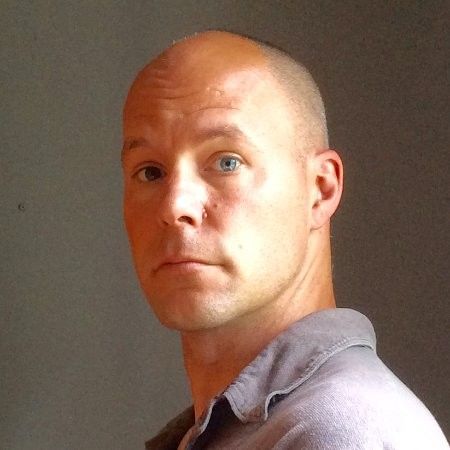
William Ware.
He builds cameras that see a glow too faint for the human eye - and uses it to prove a radiation beam went exactly where it should.
CEO & Co-Founder, DoseOptics LLC // Lebanon, New Hampshire
William Ware. The chemistry is in the glow, the business is in the proof.
The Pitch
A faint blue glow, turned into a safety check.
Inside every patient under a radiation beam, there is light. It is called Cherenkov radiation - the same eerie blue that haloes the core of a submerged nuclear reactor. It is real, it is physics, and until recently nobody could do much with it. William Ware can. As co-founder and CEO of DoseOptics, he runs a 16-person company in Lebanon, New Hampshire that points sensitive cameras at that glow and turns it into a live picture of treatment as it happens.
Radiation therapy has always carried a strange blind spot. A linear accelerator fires an invisible beam at a tumor, the patient lies still, and the dose is delivered without anyone actually seeing it land. The math says it worked. The plan says it worked. But the eye sees nothing. DoseOptics changed the verb from "trust" to "watch." Its BeamSite system captures the Cherenkov emission, strips away the background, and renders the dose on the patient's skin in real time - a direct, optical confirmation that the beam shape and position match the plan.
Ware did not invent the science. That came out of Dartmouth's Thayer School of Engineering and the Norris Cotton Cancer Center, where researchers figured out how to coax a usable image from emissions almost too dim to register. What Ware brought is the rarer skill: taking a discovery that lives in a lab and making it into a product a hospital can buy, install, and rely on. He is the translator between the bench and the clinic.
That role suits his record. Before DoseOptics, Ware spent a career launching things - more than 20 patented products to commercial success, spread across industries that have almost nothing in common: pharmaceuticals, oil and gas, textiles, medical devices. He has worked at the proof-of-concept stage and at the global-growth-and-exit stage, and most of the messy stops in between. The through-line is not an industry. It is the act of commercialization itself.
By The Numbers
20+
Patented products launched
$3.4M
NIH funding in one year
4
Industries crossed
~16
People on the team
"We are proud to partner with Vision RT, the leader in SGRT, and believe that, together, we can make the marriage of Cherenkov imaging and SGRT the standard of care."
- William Ware, on the DoseOptics x Vision RT partnership
How The Glow Becomes A Picture
Seeing the unseeable beam.
The trick is not making light - the radiation does that on its own. The trick is catching something this faint and turning it into something a clinician can read in the moment.
01
Emit
A radiation beam interacts with tissue and produces a low-intensity Cherenkov glow - the reactor-blue effect, scaled down to a whisper.
02
Capture
Specialized cameras with precise triggering catch each pulse and strip away ambient room light and background noise.
03
Verify
Image processing renders the dose on the patient in real time, confirming the beam's shape and position against the plan.
The Arc
From the bench to the beam.
1992 - 1994
Earns an MS in Chemical Engineering at Dartmouth's Thayer School of Engineering - the school he will later spin a company out of.
The Wandering Years
Holds executive roles across pharma, oil and gas, textiles and medical devices - including Nano-Tex, Miltenyi Biotec and Soane Energy - shipping 20+ patented products.
2013
Co-founds DoseOptics with Thayer professors Brian Pogue and Scott Davis to commercialize Cherenkov imaging for radiotherapy.
2016
DoseOptics lands a $2M Phase II NIH SBIR grant, hitting $3.4M raised within a single year.
2024
Announces a long-term Vision RT partnership and launches DoseRT powered by BeamSite, pairing Cherenkov imaging with surface-guided radiation therapy.
Things Worth Knowing
The footnotes.
The core technology rides on Cherenkov radiation - the same blue light that glows around nuclear reactor cores.
A chemical engineer by training, Ware has commercialized inventions in oil and gas, textiles, pharma and now oncology imaging.
DoseOptics grew out of the Dartmouth Regional Technology Center, licensing its science straight from the university.
What's Next
Standard of care, not a curiosity.
Ware's stated ambition is plain: make Cherenkov imaging an ordinary part of radiation therapy, everywhere. Not a research toy, not a single-site experiment - a default. The 2024 partnership with Vision RT, the leader in surface-guided radiation therapy, is the clearest bet on that future. Pair a system that tracks where the patient is with one that shows where the dose goes, and you close the loop between intention and delivery.
It is a quietly radical idea dressed in unglamorous language. For decades, radiotherapy has been delivered on faith in the plan. Ware wants to replace a portion of that faith with a picture. If he succeeds, the strangest part will be that nobody remembers it was ever any other way - that there was a time when the beam was simply invisible, and everyone agreed to look away.