William R. Cruz trained for a life in which you practised before the performance. Then he took an interest in financial markets, where an unrehearsed idea can send you a bill. He and his younger brother, Ralph, pooled their savings, traded, and lost the money. The episode could have remained a youthful embarrassment. Instead, it became part of the origin of a business devoted to making trading ideas easier to examine.
In 1982, the brothers started Omega Research. William, usually called Bill, concentrated on product development; Ralph concentrated on marketing. Their company would produce TradeStation, turn itself into an online brokerage, and eventually be acquired by Japan’s Monex Group. But the useful place to begin is before the company had an office, a public listing, or a product name that outgrew its own corporate name.
A violin, then an expensive lesson
Cruz was born in Cuba. In 1966, he and his brother came to the United States with their parents and two aunts. Music occupied a substantial part of their childhood. An aunt who had been a concert pianist in Cuba supervised violin practice; the brothers put in four hours a day.
They won music awards, and William studied classical violin at the University of Miami and later at Juilliard. A performing career was a plausible destination. His interest in the markets sent him in another direction. After the early trading loss, he enlisted a music teacher who also knew computer programming to help develop software for testing strategies.
There is a pleasing family resemblance between those two pursuits. A score makes musical intentions explicit. A trading rule makes a market idea explicit. The resemblance is an observation about the work, rather than a theory about Cruz’s private thoughts. In both cases, the details eventually become audible.
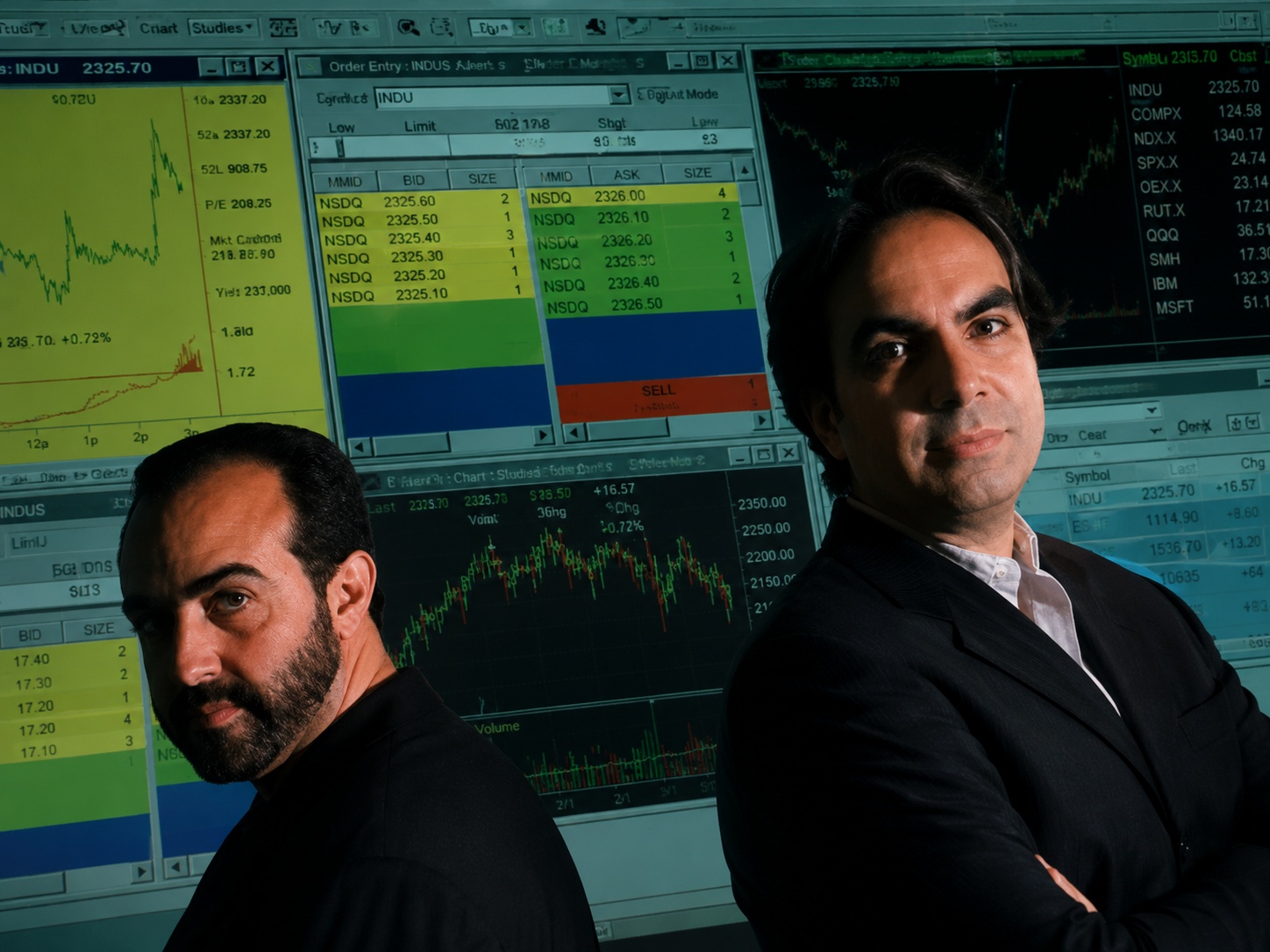
A trading idea needed a language
Omega began in a room in the brothers’ parents’ home. Its product problem was specific: let someone describe a trading system and test it against historical data without first acquiring a programmer’s education. An idea might be easy to explain over lunch and surprisingly awkward to explain to a computer.
The development took years. System Writer was demonstrated in December 1987. System Writer Plus followed in 1989, incorporating improvements and customer suggestions. TradeStation arrived in 1991. The sequence matters because it gives the early business a working pace: build, discover the limitations, revise, and make the next release useful enough to earn its place.
is founded
is demonstrated
Plus follows
is launched
The English-like language associated with the software, EasyLanguage, addressed that gap between an idea and its instructions. A trader could express conditions, inspect historical results, and have the computer watch for the conditions in real time. The premise gave the customer a more active role: specify the method, then examine what it actually does.
The customer became the teacher
Cruz’s connections in trading also ran back to his days as a learner. Larry Williams later said that Bill became his student in 1980. In November 2013, Williams announced that his indicators were available through TradeStation’s software, describing a relationship with the company stretching back decades.
It is a satisfying reversal of roles. The student helped build a platform on which the teacher’s work could be used. It also places Cruz inside a working community of traders, educators and developers, rather than alone on the obligatory founder’s pedestal. Pedestals offer a poor view of the keyboard.
Another connection was Sunny J. Harris, whose book TradeStation Made Easy! carried a foreword by Cruz in 2011. He described having watched her development from the days of DOS-based SystemWriter. Harris, in turn, acknowledged his help as she learned EasyLanguage. Software had produced an ongoing conversation between its maker and a demanding user.
“Successful traders have one thing in common: they approach trading by developing an objective strategy and then use it consistently.”
Bill Cruz, foreword to TradeStation Made Easy!, 2011
The emphasis in that passage is on a method someone can state and repeat. It fits the product he helped develop: a place to turn a trading opinion into instructions precise enough for a machine to follow.
The box could no longer hold the business
By September 2000, TradeStation had sold about 45,000 copies, accounting for roughly $100 million in product revenue. Those were substantial reasons to like the existing business. Meanwhile, the company was moving toward internet subscriptions and direct-access brokerage. Customers were being offered a service that could stay with them through the working day.
The transition had an awkward financial middle. A contemporary snapshot put quarterly revenue at $5.4 million, compared with $11.6 million a year earlier, and recorded a $3.9 million net loss. Subscription revenue, however, had risen 122 percent from the preceding quarter to $2 million. Different parts of the business were travelling in different directions.
The business was acquiring the ability to execute trades as well as analyse them. Monex’s later corporate chronology records the acquisition of OnlineTrading.com in 2000; the TradeStation corporate name followed in 2001. An analytical tool was becoming part of a brokerage relationship. That changed the responsibilities of the company as much as the packaging of its product.
The unglamorous work between idea and order
Cruz’s product involvement also has a more technical footprint. He is named with Ralph Cruz and Peter A. Parandjuk as an inventor on US patent 7,379,909, granted on May 27, 2008 and assigned to TradeStation Technologies. Its subject is the monitoring and execution of entry and exit orders.
The design links strategy writing, historical testing and automated order handling. It also attends to the awkward details that appear when an instruction reaches a live market: orders may be only partly filled, restrictions may apply, and a strategy may change while an order is still active.
DescribeState the rules02
TestUse past data03
MonitorWatch conditions04
HandleTrack the orders
These are useful details for understanding what product work meant here. A chart can suggest an opportunity. A trading platform must account for what happened to the instruction sent to act on it. The patent’s machinery lives in that less photogenic territory, where a sensible idea has to survive the particulars of implementation.
Knowing when to leave the podium
The company had listed on Nasdaq in 1997. Public ownership added another audience to the people judging the product: shareholders. Cruz occupied both sides of that relationship, as an executive responsible for the business and a founder with a substantial ownership stake. By April 2007, his reported beneficial ownership was 17.1 percent.
The compensation arrangements add a less familiar detail. From 1997 through 2002, the brothers each received a $150,000 annual base salary and no annual cash bonuses. Neither had received equity-based compensation awards. Their existing shares were already an important part of their financial connection to the company. The distinction gives some shape to the phrase “founder ownership”: a salary paid for the executive job, while an established stake linked them to the value of the business. By the time Cruz left daily management, the company had spent roughly a decade on the public market.
In 2005, William and Ralph Cruz shared Florida’s Ernst & Young Entrepreneur of the Year recognition with Salomon Sredni. Sredni had joined the business in 1996 and had been president and chief operating officer since 1999. By February 15, 2007, he was taking over as chief executive.
The brothers retired from their daily executive duties, remaining non-executive co-chairmen and available to advise on key projects. Bill’s public announcement credited Sredni generously, assigning him an equal share of credit for the company’s achievements over the preceding decade. It was a handoff to an experienced colleague who had already helped run the business.
In March 2009, Cruz informed the company that he would not stand for board re-election. The dates separate his operating career from the acquisition that followed. Monex announced its agreement to buy TradeStation in April 2011, at $9.75 a share and an announced transaction value of about $411 million.
The approximate completed purchase price paid by Monex Group for TradeStation.
The June completion announcement reported approximately $402 million. TradeStation became a wholly owned Monex subsidiary. For a business that began in a family home, the change in scale is plain. The intervening work deserves its own room in the story: successive products, a public company, a business-model transition, and leadership passed on before the sale.
Quality, remembered years later
In October 2025, TradeStation CEO John Bartleman recalled the founders’ different influences. He remembered Bill as the product mind who taught him to pay attention to quality and detail, and Ralph as the marketing influence who stressed the mission. It is a more particular legacy than a founder’s name in a corporate history.
Bartleman had joined in 1999, when the company still shipped software on CDs. He experienced the move into brokerage from inside the business. His recollection connects Cruz’s product decisions with the people who continued making decisions after him. An operating habit can remain in circulation after its author has left the daily meeting.
In June 2026, Bartleman returned to the brothers’ founding story while writing about independent traders. The tools and interfaces had continued changing. The original question remained recognisable: how much of the analytical work could an individual trader do with the right software?
Cruz’s career gives that question a human beginning. A violin student became interested in markets. A loss prompted an attempt to test ideas. A family partnership turned the attempt into products other people could use. The rehearsal acquired a keyboard, and a rather different audience.