Before there was a therapy platform, there were people trying to manage diabetes. In 2018, Paulo González was working with people living with type 2 diabetes when their conversations kept returning to something else: depression, anxiety, stress. The problem they described refused to stay inside the category his business had chosen. In the founder account published by Whereby, that discovery helped steer González and Elisa Swan toward behavioral healthcare. The lesson arrived through patients, rather than a product roadmap.
- Patients get access to licensed care and tools for the days between appointments.
- Clinicians get a digital office, including help with insurance administration.
- The business depends on making those two experiences work together.
That beginning explains something useful about Wellnite today. Its subject is mental health. Its recurring preoccupation is the difficulty of arranging help. A person can be ready to talk and still face a formidable little obstacle course: finding someone suitable, checking coverage, choosing a time, completing forms. Every step asks for energy from somebody who may already be running short of it.
The appointment has a backstage
For patients, Wellnite’s website offers a directory of professionals, an opportunity to describe their concerns, and tools for following progress. The advertised areas of support include anxiety, depression, relationship difficulties, and personal growth. Mood Flow adds daily emotional tracking and AI-generated insights. The proposition reaches beyond the scheduled conversation: notice what happens during the week, then bring something more concrete than a vague recollection to the next appointment.
For clinicians, the same appointment looks like a small business operation. Wellnite’s Digital Practice brings together bookings, forms, notes, messaging, payments, and video sessions. It also advertises marketing, credentialing, billing, and virtual staff support. Those services address an unromantic constraint. Time spent chasing administrative work is time unavailable for something else. Putting several tasks inside one workspace can make the working day easier to navigate, even though software cannot supply the clinician’s judgment.
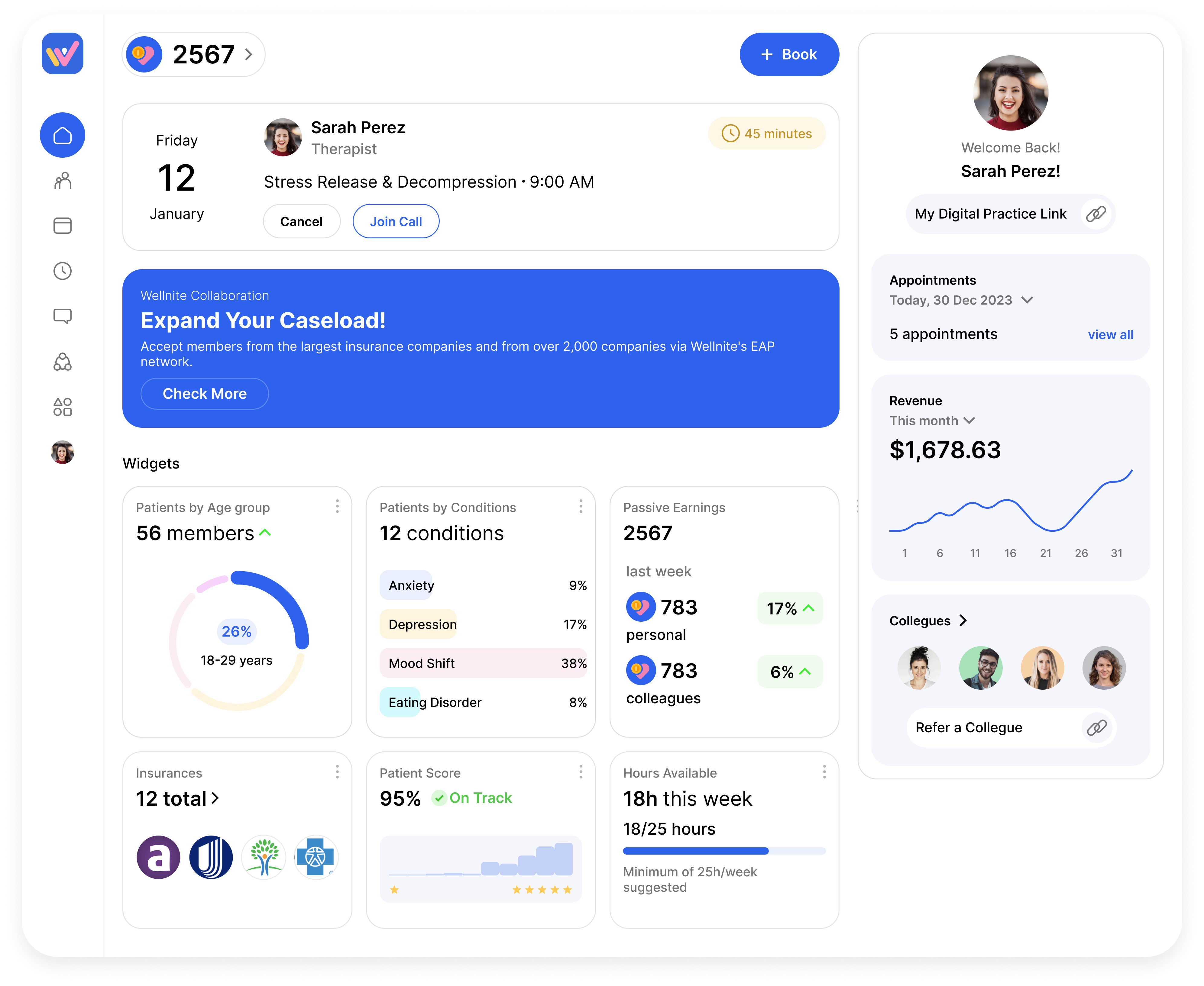
The two sides reinforce each other in principle. A patient wants an available professional. A professional wants a manageable practice. The interesting business question is whether helping the second person creates more usable access for the first. That is a more demanding proposition than simply collecting a large directory of names.
Build the office. Buy the plumbing.
By 2019, the founders were envisioning care delivered through video. They assembled the workspace using specialist services, including Whereby for embedded calls. A January 2023 customer story described hundreds of daily sessions across 47 states. Those are historical operating claims from a vendor account, not present-day patient totals.
The architecture offers a practical idea for other founders: identify which part of the experience requires your own attention. Buying a component can leave more room to design how the parts meet. In healthcare, however, a working connection is only one requirement. Privacy settings, clinical procedures, and the handling of records still belong in the design. The useful unit of progress is an appointment that people can actually complete.
“Free to join” needs a second sentence
Wellnite’s provider help center says clinicians face no subscription or registration fees to join. That removes one decision from onboarding. It does not make the consultation free for the patient. Patient payments and professional participation are different parts of the transaction; confusing them makes almost any healthcare offer sound simpler than it is.
The company lists payer relationships including Aetna, Cigna, Blue Cross Blue Shield, Humana, Optum, United, and Oscar. For a prospective patient, the useful question remains specific: does this clinician accept this plan for this service? A familiar insurer’s logo cannot answer all three. Self-pay options offer another route, but the amount and included services need to be established before booking.
There is a concrete cost in the published terms: a $65 charge for a no-show or cancellation within three hours. The terms also distinguish Wellnite’s administrative platform from the independent practices delivering clinical care. Its business sits across that boundary, coordinating a service whose medical decisions remain with clinicians.
The interesting business question is whether a more manageable practice creates more usable care.Our reading of Wellnite’s model
The week between visits
The mobile app listing extends the offer into journaling, guided exercises, audio, AI coaching, and creative reflection through Wellnite Art. These features give users things to do between visits. Their presence should not collapse the distinction between an automated response and a consultation with a licensed professional. A mood log can help organize a conversation; it does not become that conversation.

That app also makes reliability part of the proposition. Its October 7, 2026 Android update describes refinements to video calls, audio, booking, and bug fixes. These are modest changes with practical consequences. A feature that is awkward to reach or a session that is difficult to join can put friction back into the very service meant to remove it.
Access is an operational problem, too
Wellnite occupies overlapping markets. Patients can consider services such as Talkspace; clinicians can compare practice support from Headway and Alma. Its combination of care access, practice operations, and between-visit tools is the relevant comparison. No single feature establishes an advantage by itself.
The conditions matter. A directory helps only when a suitable clinician has availability. Insurance support helps only when the particular coverage works. Virtual visits depend on a usable connection and a private place to talk. For someone needing emergency intervention, the platform’s own terms direct them toward emergency services. The model has boundaries, even when the interface looks inviting.
The idea worth copying is the attention paid to what surrounds the central service. Ask what stops a willing customer and a qualified professional from meeting. Then examine each handoff. Wellnite’s origin began with listening beyond the original diagnosis. Its continuing task is equally concrete: help the next conversation happen.