Forty thousand young salmon arrived in Kenosha in April 2024. Their immediate destination was a rearing pond, where volunteers would feed them twice a day before releasing them into Lake Michigan. Walter Kreuser, the president of the Kenosha Sportfishing and Conservation Association, was there to explain the arrangement. The lake would come later. First came three weeks of looking after the fish.
There is something pleasantly demanding about that timetable. A delivery makes a fine occasion for photographs; feeding makes a schedule. The fish have little interest in whether the people caring for them have finished their paid work, found enough volunteers or balanced the electricity bill. A pond puts a practical question to a community: who will keep it running?
Kreuser’s working life gives that question a particular texture. He is an electrician in Kenosha, with a business that handles generators, electrical services and solar installations. At the pond, he belongs to a group whose members bring other working lives with them. The connection between the two is visible in the equipment and in the attention that equipment requires.
“This is just a passion of all of ours.”
Walter Kreuser, April 2024
The lake has a waiting room
The rearing pond occupies a small but consequential interval between hatchery and lake. In the spring of 2024, the Wisconsin Department of Natural Resources delivered Chinook salmon to the association. The volunteers cared for them until release. A fishery that people encounter from a pier or a boat has an earlier life in this much more manageable body of water.
During the association’s fiftieth-anniversary year in 2023, Kreuser described the waterfront’s economic importance. His fellow volunteer Jim Zondlak described the daily monitoring that kept the rearing operation going, including checking dissolved oxygen. Their accounts placed the pond inside a larger civic picture: fishing, visitors, education and the local businesses that serve people coming to the lake.
The organization has a long history, and Kreuser’s involvement predates his presidency. In June 2011, an association newsletter recorded that he would investigate grants for a permanent roof over the rearing pond. It is a modest entry. It also puts him in the story years before the interviews that would introduce him to a wider local audience.
A roof proposal is a wonderfully unglamorous piece of history. It concerns the place where the work happens. Somebody has to consider shelter, cost and a possible way to pay. The newsletter captures a prospective task, rather than a completed triumph. Keeping that distinction makes the detail more useful: this was work being considered by an active member.
A harbor needs enough water beneath it
By early 2012, Kreuser was also involved in a conversation about the harbor. The association’s February newsletter described his presentation at a January meeting about harbor finances and dredging. It connected him with Kenosha Harbor Associates, an organization newly created to address waterfront concerns. The same account identified him as working at the Kenosha Yacht Club.
The problem was easy to understand without a boating vocabulary. Shallow water could limit access for boats. The newsletter discussed concerns about depths of less than five feet in places and the consequences for local businesses. A harbor may look like an open invitation. Whether a vessel can use it depends on details below the surface.
That earlier episode broadens the picture of Kreuser’s public involvement. Before his current conservation leadership, there was already a concern with whether Kenosha’s waterfront could continue to do its job. The people around that discussion included businesses and fishing interests. Their shared place supplied a reason to assemble, even when their everyday occupations differed.
It is tempting to write community histories entirely around appointments and anniversaries. This one has a useful intermediate chapter: a member bringing a practical concern to a meeting. The harbor discussion makes the later pond work easier to place. Both belong to the upkeep of a waterfront people use, rather than admire only from a distance.
On a roof above the pumpkins
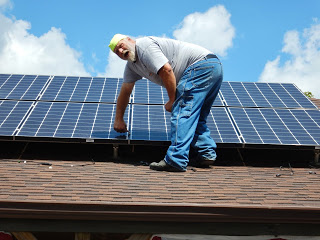
In August 2016, another photograph put Kreuser above the ground, adding a final solar panel to the roof of Jerry Smith Country Store and Pumpkin Farm. He had designed and installed the farm’s 18-kilowatt system. The installation included rooftop panels and tracking arrays. A country store offered a rather cheerful setting for an electrical project.
The account of that project identified him as a NABCEP-certified installer and noted previous solar work at the University of Wisconsin-Parkside and Gateway Technical College. Those are specific entries in his working record. They describe a technician whose projects extended beyond one kind of customer, from educational institutions to a family attraction outside Kenosha.
His business website places solar alongside more familiar electrical jobs: service upgrades, generators, repairs and rental equipment. It identifies him as a master electrician, electrical inspector and master generator technician. The business presents itself as a two-generation operation. These details locate his conservation work beside an established trade, with its own customers and responsibilities.
He was explaining that trade publicly by 2013. In a first-person post about emergency generators, Kreuser described installation, maintenance, warranty work and rebuilding used equipment. The post also discussed rental power for outages and events. His subject was the whole working life of a machine, including the attention it needs after somebody first buys it.
That is a useful occupational background for a story involving pumps and water. It does not tell us what he thinks in private. It does show why electrical equipment belongs naturally in an account of his public work. The solar roof and the rearing pond contain different projects, with very concrete things that must function.
Four ponds and an electricity bill
In April 2024, Kreuser explained changes to the rearing operation. Each of its four ponds had an oxygen line. Well-water flow was being controlled separately instead of passing freely between the ponds. He described the intended benefits: keeping the water cooler, improving aeration and reducing the amount of electricity the operation needed.
One aim was to avoid running a third large air pump. That detail gives the renovation a human scale. Electricity costs money; equipment requires operation. Kreuser was discussing the choices that sat between caring for fish and maintaining a workable budget. The changes were intended to improve conditions, with savings as another practical objective.
to each pond
well-water flow
on another pump
The distinction between an objective and a measured result matters here. The story is about the changes he described and what the group hoped they would do. An association must make decisions before every outcome is known. The pond offers a close view of that ordinary responsibility: understand the problem, alter the equipment and keep observing.
The visitors belong in the picture
A photograph from that spring visit shows children beside the pond with adults nearby. An orange bucket and the pond’s edge give the scene the look of a working place opened to visitors. The children can look down into the water. The scale makes the fish visible in a way that Lake Michigan itself rarely permits.

Kreuser’s current association responsibilities also include chairing Kids Fish-N-Fun. The listing puts youth participation beside his presidency, giving his role another specific dimension. The association is concerned with people learning to fish as well as with the fish themselves. That creates opportunities for children to enter a world whose practical details are otherwise easy to miss.
His public account of volunteer leadership includes another organization, the Kenosha Fisheries Restoration Foundation. On LinkedIn, he dates the start of that presidency to January 2022 and describes fundraising for fisheries, conservation and education. He dates his association presidency to December 2021. These are his own descriptions of the roles, linking organizational work with the pond’s recurring needs.
A small detail elsewhere in the civic record adds a different sort of contribution. A March 2022 school-board agenda records a donation from Kreuser to Bradford High School’s theatre program: twelve scenic flats and a pallet of corrugated cardboard. It is a concrete gift for another working space, where materials become useful in somebody else’s hands.
Theatre scenery, harbor depth, a solar panel and a pond’s oxygen line make an unusual set of objects for a personal profile. Their usefulness is the point of contact. Each belongs to a place where people are trying to get something done. Together they give Kreuser’s local story its shape without requiring an invented origin tale.
At the rearing pond, the calendar keeps that story moving. The arrival draws attention. The care occupies the following days. Release sends the fish into a much larger environment. Kreuser and the other volunteers take responsibility for the interval they can attend to, close to home, with equipment to maintain and young fish to feed.