A delivery driver gave Eric Martell and his friends a peculiar piece of business advice: stop using the website. They had ordered takeout online, and the driver explained that the service charged them extra. Calling the restaurant would be cheaper. It was an excellent recommendation for saving seventy-five cents. It was a less flattering review of the internet.
Martell, Matt Howard and Alex Wyler were students at the University of Wisconsin-Madison. They thought ordering dinner ought to work better than that. Howard would recruit restaurants; Martell and Wyler would build the website. Work began in the summer of 2009. On February 1, 2010, their service launched as BadgerBites.
There is something pleasingly modest about this origin. Nobody needed to invent hunger. Restaurants already wanted orders; students already wanted dinner. The troublesome part was getting the two sides together without making everyone regret the introduction. Martell has spent much of his working life in that troublesome part.
The restaurant at the other end of the screen
BadgerBites became EatStreet, expanding beyond Madison and adopting its national name in 2013. Martell's work changed along with it. He initially built product and engineering with Wyler, then moved into business intelligence, analytics and metrics. The developer was learning to ask what happened after someone clicked.
EatStreet gave small restaurants more than a listing in an online directory. It supplied ordering technology, restaurant websites and other ways for customers to place orders. Its Yelp partnership put ordering into restaurant review pages. A person could discover somewhere to eat and act on the discovery while dinner still seemed like a good idea.
By 2015, Martell and his co-founders were finalists for the EY Entrepreneur Of The Year award in the Midwest. Their company described a business connecting more than 15,000 restaurants with diners in over 150 cities. Those figures belong to that period, when mobile ordering was becoming a larger part of the operation.
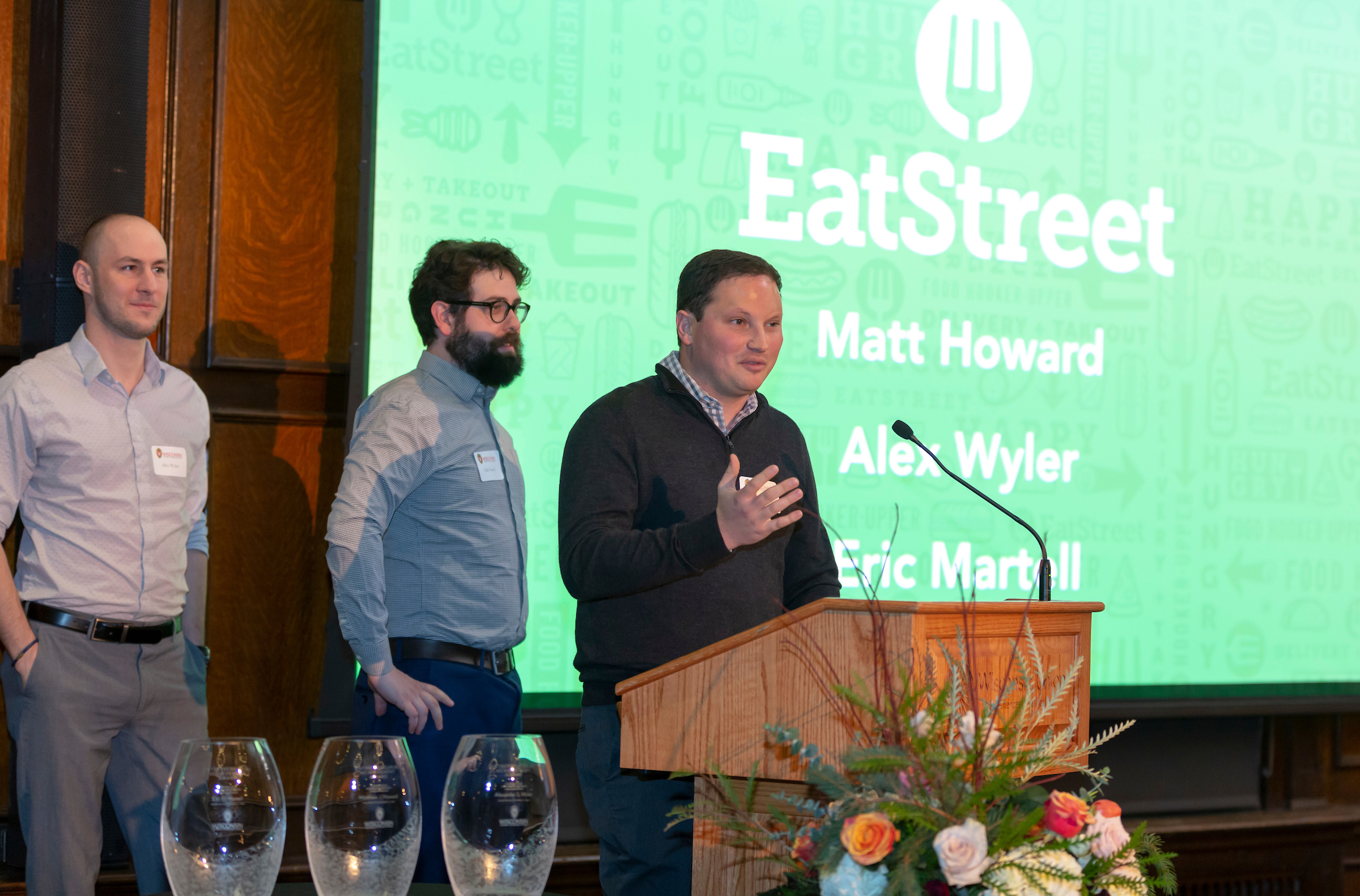
The university honored all three founders with its Entrepreneurial Achievement Award in November 2018. By then, EatStreet served more than 275 cities. The photograph from the ceremony shows Martell standing beside Wyler while Howard speaks at the lectern. Their student complaint had acquired employees, drivers and an awards evening. Seventy-five cents had proved unusually productive.
A second company, with the same accomplice
Between the two startups, Martell worked on the investor's side of the table. He led gener8tor Minnesota as managing director and subsequently served as a venture partner. He had been the person trying to build a company; now he was helping other people get theirs started. That experience gave him another view of the distance between an appealing pitch and a functioning business.
His geography remained distinctly Midwestern. In a 2022 conversation, he recalled moving from Madison to Minnesota in 2016, then promptly qualified his local allegiance: he was still a Packers fan. Some integrations apparently require more engineering than others. His public LinkedIn profile now lists Madison as his base.
For his next company, he returned to Wyler. Pear Commerce was founded in 2018. In 2019, Martell went through The Brandery, the Cincinnati accelerator powered by gener8tor, incorporating Pear on the program's first day. The program opened conversations with executives at Procter & Gamble and Kroger. A pre-seed round followed its Premiere Night.
The choice of customers mattered. Martell and Wyler were taking software into the world of consumer packaged goods: the food, drinks and household products bought through retailers. These brands could make people want a product without owning the place where those people eventually bought it. The gap between those activities became Pear's working territory.
The ice cream problem
Martell's early explanation of Pear used an ice cream advertisement. A shopper sees the ad, clicks, and arrives at the manufacturer's website. There is plenty to learn about the ice cream. Buying it immediately is another matter. The brand has successfully introduced dessert and left the shopper to arrange the rest.
Pear's proposed connection was straightforward to describe: show the shopper retailers that sell the product and provide a route into their online carts. Retailers receive interested shoppers. Brands get a better connection between their advertising and the shopping activity that follows. Each party already has something the other needs.
The product has since spread across store locators, product pages, direct-to-cart links, recipes and advertising. Its current website describes daily checks of store-level availability and reporting that distinguishes products, retailers and locations. These details are the unromantic machinery behind a very ordinary request: please send me somewhere that actually has the thing.
For Martell, the attraction is familiar. At EatStreet, a customer action could produce a meal at a front door. At Pear, an encounter with a brand should lead to a workable retail purchase. Software sits between the desire and the delivery. The physical object still has to exist, somewhere reachable, when the shopper arrives.
The customer preferred the other idea
Pear did not arrive at its present model by faithfully executing every detail of its first plan. Martell has described an early concept involving much deeper relationships with individual retailers. Wyler suggested testing an adjacent approach with a small initial product. Prospective customers preferred the alternative.
That changed the business. Loosening those retailer relationships allowed a broader model. The useful detail is the scale of the experiment: the founders could show customers another option before committing the company to it. Martell describes the process as adding a second item to a menu and discovering that people wanted that one.
His wider argument about decisions is equally practical. EatStreet first struggled with the temptation to accept everything, then became too inclined to refuse opportunities. At Pear, he has tried to define in advance the kinds of work the company will pursue. A founder can exhaust a day debating an attractive distraction. A previously agreed boundary makes for a shorter meeting.
There is continuity here with his earlier discussions of startup growth: keep attention on the customer's problem, and allow the proposed solution to change. A long partnership with another founder can help make that possible. In this case, the person challenging the original idea had already spent years building alongside him.
What the money was meant to buy
In June 2024, Pear announced a $10 million Series A led by Stage 2 Capital, with investors including Heartland Ventures, Dundee Venture Capital and M25. At that point, the company reported fivefold year-over-year growth and work with five of the top 20 CPG companies. Its stated retail coverage exceeded 3,000 retailers and reached 165,000 store locations.
Pear's announced Series A, led by Stage 2 Capital.
Company financing, not personal wealth.The spending plan was concrete: product development, expansion and senior hires in sales, engineering and customer success. Martell framed the ambition around giving brands that sell through retailers the visibility enjoyed by businesses selling directly to customers. The desire is understandable. Paying for attention becomes an uncomfortable exercise when the next steps disappear from view.
By February 2026, Pear described a fully remote team of about 30 people across more than 20 states. It was working with seven of the top 20 CPG companies, had raised approximately $17 million in total and was approaching profitability. That was a snapshot of a business still growing, with an explicit interest in paying its own way.
Software gets an undo button. Cereal does not.
Martell's account of his work has room for the absurd. He writes about long showers, software experiments and the good fortune of being able to reverse a coding mistake. His comparison with physical products is affectionate and pointed: a software team can roll back an update; a manufacturer cannot recall a truckload into a laptop.
That difference has given him respect for the brands Pear serves. Product decisions carry different consequences when an experiment occupies actual shelf space. In his own world, the ability to change course quickly is a privilege. The people making the goods at the far end of the software have fewer convenient do-overs.
“Make decisions quickly. Do something dumb, learn from it, then do something smart.”
Eric Martell · February 2026
There are other glimpses of the person beneath the spreadsheets. An early interview lists guitar among his interests. His professional conversations wander happily into database technology. The Packers qualification arrives without much prompting. He can explain an advertising system through ice cream and a product pivot through a menu. Food has remained useful even when he is talking about management.
Back to dinner, by a different route
In July 2026, Ahold Delhaize USA announced a Pear collaboration across Food Lion, The GIANT Company, Giant Food, Hannaford and Stop & Shop. Shoppers could move from recipes and product discovery into grocery carts. The ingredients on a screen were being connected to the stores that could supply them.
Pear's later updates show the geography expanding too: French retailer integrations in August, followed by French-language Pear Connect ads in September. The technical surface keeps changing. A recipe, an advertisement and a product page are different starting points, but each asks the same practical question about what happens next.
Martell's career keeps coming back to that next step. The student who helped build a better way to order takeout is now working on the route from noticing a product to finding it on sale. Years of code, fundraising and reconsidered plans sit behind that modest ambition. The shopper is entitled to remain gloriously uninterested in all of them. Dinner should be easy to order.