BREAKINGVisual Action Platform 8.0 ships - AI throttled by human oversight•
EST. 2015The Hive Group + Visual Action merge under one roof•
FLAREMAP®The treemap grew up and got a job in national intelligence•
CUSTOMERSNavy · CACI · Jabil · Pioneer · T-Mobile•
HQOrchard Park, New York — ~10 people, large ambitions•
BREAKINGVisual Action Platform 8.0 ships - AI throttled by human oversight•
EST. 2015The Hive Group + Visual Action merge under one roof•
FLAREMAP®The treemap grew up and got a job in national intelligence•
CUSTOMERSNavy · CACI · Jabil · Pioneer · T-Mobile•
HQOrchard Park, New York — ~10 people, large ambitions•
Who they are now
A wall of rectangles, and someone deciding
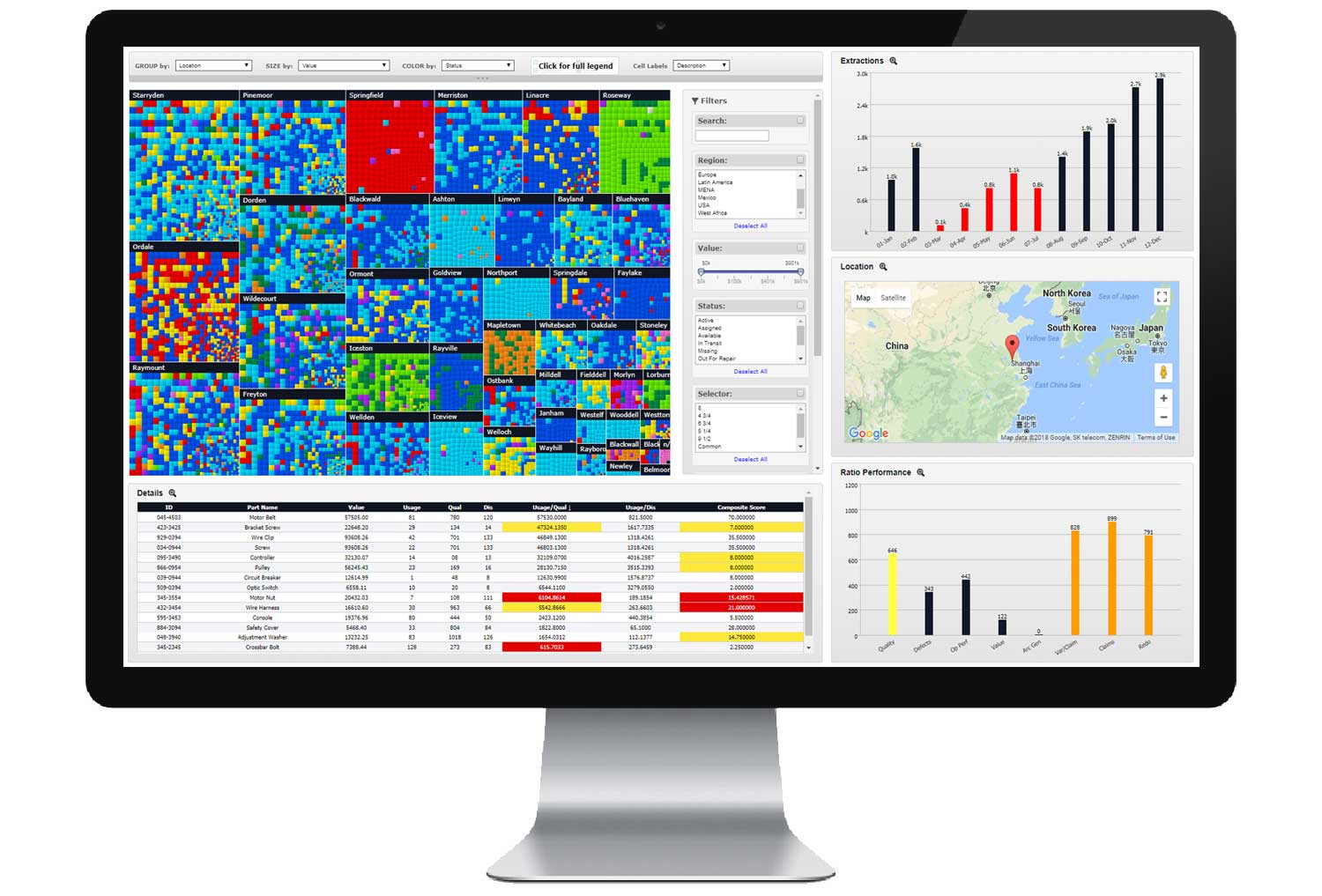
Somewhere right now a screen is full of small colored rectangles. Each one is a contract, a transaction, a sensor, a shipment. One of them just turned the wrong shade. An analyst leans in, clicks, and acts before the rest of the organization even knows there was a question. That screen, more often than the headlines suggest, was built with Visual Action Software.
Visual Action makes operational visualization tools. Not dashboards you admire and forget - interfaces people work inside, all day, when the stakes are real. Its patented Flaremap technology compresses thousands of moving data points into a single dense, readable picture, then wires that picture into the enterprise systems that have to respond. The customers are not casual. They include the U.S. Navy, CACI, Jabil, Pioneer and T-Mobile, which is a curious roster for a company you could fit in a single conference room.
The problem they saw
Everyone bought big data. Nobody could read it
The 2010s sold every enterprise on the same promise: collect everything, and insight will follow. The collecting worked. The insight, less so. Organizations ended up with warehouses of data and a handful of charts that looked impressive in a board deck and meant almost nothing on a Tuesday afternoon when a threat was forming in real time.
That gap - between data you own and data you can actually act on - is the single tension Visual Action exists to resolve. A pie chart cannot show you ten thousand things at once. A spreadsheet can, but only if you have a week and a strong constitution. What an operator needs is density and clarity at the same time: the whole field of play, with the one anomaly already glowing. Most tools pick one or the other. Visual Action's whole bet is that you can have both.
The founders' bet
Two companies, one stubborn idea
In January 2015, Visual Action Software and The Hive Group merged. The Hive Group had spent years refining the treemap - the visualization technique, invented by researcher Ben Shneiderman, that packs hierarchical data into nested rectangles sized and colored by what matters. Hive's product was called Honeycomb. Its CEO was Jim Bartoo. When the two firms combined, Bartoo took the helm of the merged company, and Honeycomb was reborn as the Flaremap Application Suite.
The bet underneath the merger was unfashionable: that the future of data was not a flashier chart or a virtual-reality control room, but a better, denser, more honest two-dimensional surface that real operators could trust. While much of the industry chased the next visual novelty, Visual Action doubled down on the treemap's descendant and made it operational. It is the kind of bet that looks boring until the moment it saves someone a very bad day.
The product
The Visual Action Platform
The Platform is a kit for building high-utility, data-dense visual applications. Flaremap is the engine; the Platform is the workshop where teams assemble it into something specific - a fraud monitor, a fleet-readiness board, a market-risk display - and then plug it straight into the enterprise processes that have to act on what it shows. The point is never decoration. The point is that someone sees, and then someone does.
The version numbers tell the story of a company that ships. Flaremap JS arrived for live, browser-based process integration. Platform 7.0 was a full reimagining of operational visualization. 7.2 carried the gloriously blunt subtitle "Built for Real-World Work, Not Metaverse Mania." 7.4 paired disciplined workflow with off-road analysis. And in November 2025, Platform 8.0 added AI-assisted decision support - then, characteristically, wrapped it in human-oversight controls so the machine advises but the analyst still decides.
CORE TECH
Flaremap®
Patented treemap-descendant visualization. Identifies and assesses threats, monitors performance, reduces risk - in real time.
PLATFORM
Visual Action Platform
Build data-dense visual apps that integrate with enterprise processes. Latest: v8.0, Nov 2025.
SERVICES
Professional Services
Custom interface design, development, technical consulting, and training to deploy visualization where it works.
The proof
Who actually uses this
A company's customer list is its real argument. Visual Action's spans the parts of the economy where a missed signal is expensive: defense and national intelligence, financial services, healthcare, energy and utilities, and the core infrastructure that keeps everything else running. The reference logos - Navy, CACI, Jabil, Pioneer, T-Mobile - sit at the serious end of that spectrum. None of them buy software to make screenshots prettier.
The keyword cloud the company has accumulated over the years reads like a threat-and-risk dictionary: anomaly detection, fraud prevention, geospatial threat assessment, financial risk visualization, healthcare fraud detection, IoT security monitoring. The chart below is a rough read of where that emphasis lands across its public positioning - directional, not audited, but telling.
Where the focus points
// relative emphasis across Visual Action's public keywords & sectors - approximate
Read it loosely: this is a company that thinks about what could go wrong for a living, then draws it.
PARTNER
MapR
Integration bringing Flaremap visualization to a major big-data platform (2015).
ORIGIN
The Hive Group
Merged in 2015; its Honeycomb treemap product became Flaremap, and its CEO became Visual Action's.
SECTORS
High-stakes only
Defense, intelligence, finance, healthcare, energy, infrastructure - where a missed signal costs the most.
The mission
Make the complicated visible
Visual Action's stated purpose is to radically advance the utility and relevance of data visualization - to make complex operational processes visible, explainable, and actionable. It is a mission with a built-in editor: anything that is not useful, not explainable, or not actionable does not make the cut.
That filter explains the company's slightly contrarian public voice. When the industry got excited about the metaverse, Visual Action shipped a release named for not being about it. When the industry got excited about AI doing everything automatically, Visual Action shipped one about keeping a human hand on the throttle. The throughline is a kind of professional skepticism: tools should earn their place by helping someone do real work, or they should get out of the way.
Why it matters tomorrow
The case for keeping a human at the screen
The next few years will pressure-test exactly the question Visual Action has been circling for a decade: when the data is overwhelming and the machine is confident, who decides? The company's answer with Platform 8.0 is "collaborative intelligence" - let AI pre-process and propose, but keep the human able to see why, override, and act. In an era racing to automate the judgment out of the loop, that is a deliberately old-fashioned position. It may also age well.
For a ten-person company, the ambition is outsized and the customers are unforgiving, which is its own kind of credibility. Visual Action does not need everyone to use its software. It needs the people watching the most consequential screens to trust the rectangles.
Back to that screen
Return to the wall of rectangles. The one that turned the wrong shade is already handled - flagged, clicked, resolved - and the analyst has moved on to the next thing before most of us would have finished loading the spreadsheet. Nothing dramatic happened. That is the point. Visual Action's whole job is to make the moment a threat surfaces feel small and manageable instead of large and late. The treemap grew up, learned a trade, and went quietly to work. Most days, no one notices. Which, for software built to catch the things that go wrong, is the highest compliment there is.