An index is an excellent hiding place for hard work. At the end of the process, a number appears on a screen. It has the composure of something inevitable. The data that arrived late, the rules that needed interpreting, the calculations that had to run again: all politely disappear. Vinit Srivastava has built a career around the part that disappears.
He is the co-founder and CEO of MerQube, a company launched in 2019 to design and calculate rules-based investment indices. Before that came Oracle, S&P Global and S&P Dow Jones Indices. Before those came two degrees in mechanical engineering. His route into finance took a useful detour through the business of making things work.
The thread connecting those jobs is a practical problem. An investment idea can sound perfectly reasonable in a meeting. Making it run, repeatedly, with changing prices and explicit rules is another occupation altogether. Srivastava’s working life sits in the distance between the proposal and the operating system.
An engineer learns a second language
His undergraduate studies took him to the Indian Institute of Technology Kharagpur, where he studied mechanical engineering from 1994 to 1998. He followed that with a master’s in the same discipline at Carnegie Mellon, from 1999 to 2001. The early academic record belongs to an engineer, before the vocabulary of ETFs and volatility indices enters the picture.
Oracle supplied the software chapter. He worked there in engineering and product management; an earlier speaker biography records seven years with the company. His subsequent business education took him to the University of Virginia’s Darden School of Business, where he completed his MBA in 2010. The sequence gave him experience of both building a product and considering the business around it.
There is a small human detail from those Darden years. A classmate, Adriano Maesano, later recalled Srivastava helping fellow students across subjects, describing generosity alongside academic ability. It is one person’s recollection, but an appealing addition to a résumé otherwise populated by large institutions. Someone had to get through the coursework; apparently he helped other people get through theirs, too.
At S&P Global, Srivastava worked in business and corporate strategy. At S&P Dow Jones Indices, he became managing director and head of strategy and volatility indices. His responsibilities covered systematic investment approaches and also included leadership of ESG product management. The job put him close to clients trying to turn particular investment objectives into products.
- EngineeringIIT Kharagpur + Carnegie Mellon
- OracleEngineering + product management
- DardenMBA, 2010
- S&PStrategy + volatility indices
- MerQubeCo-founded, 2019
By December 2017, he was explaining the evolution of factor investing in an interview about smart beta. He traced it from familiar dividend, value and equal-weight approaches to indices combining multiple factors. The emphasis was on investment objectives, implementation and cost. This was someone describing how the parts fitted together, with a view of the machinery behind the label.
The shift also changed the kind of conversation he could have with a client. His engineering experience supplied familiarity with implementation; his product roles required attention to what someone wanted to accomplish. Neither side could answer every question alone. A financial methodology had to survive its translation into instructions, and the instructions had to preserve the purpose of the methodology. His career had brought him into both rooms.
That earlier discussion helps explain the later company. Indices could embody choices about risk and portfolio construction, rather than simply list the largest stocks. Each additional choice created work for the systems underneath. A methodology could be printed neatly on a page while asking quite a lot of the people and software expected to execute it.
A company begins at the kitchen table
MerQube’s fifth-anniversary message supplied a pleasantly domestic founding image: its founders had begun working at their kitchen tables. The company launched in 2019 with Srivastava, Keith Loggie and Praveen Yalagandula. Finance has many impressive addresses. This particular beginning had room for a laptop and, one hopes, somewhere to put a cup.
The combination of colleagues mattered. Loggie brought index-industry experience, including service as chair of the S&P 500 Index Committee. Yalagandula brought the technology expertise associated with the company’s founding CTO role. Srivastava brought experience on both sides of the conversation, from enterprise software to financial product management. Their business would require the disciplines to cooperate.
MerQube used cloud-based, API-centric architecture for customized index strategies. Put more plainly, it built software for receiving data, applying instructions and delivering calculations in forms other systems could use. The founding opportunity came from client needs the team had encountered in the index business: investment designs were becoming more varied, and the infrastructure had to keep up.
In his 2024 account of the industry’s evolution, Srivastava identified three developments: wider uses for indexing, greater involvement of options and derivatives, and more kinds of data available for investment strategies. Each widened the possible product set. Together they also increased the demands on whatever sat behind the finished index.
The clock inside the index
A conventional mental picture of an index is a basket of securities observed at the close. Srivastava’s work extends into strategies whose rules may require attention during the trading day. Intel Capital’s 2023 investment explanation highlighted MerQube’s ability to support intraday adjustments and rules-based rebalancing. In that setting, the clock becomes part of the design.
That is a useful way to understand the technical challenge without getting lost in abbreviations. Instructions need data at the appropriate time. They need calculations at the appropriate time. A system that handles a daily observation has a different workload from one supporting changes within the day. The investment concept and its operating requirements have to agree.
Srivastava has described an approach that begins with systems when something needs improving. His 2022 discussion included checking incoming data and the information going out. It is an engineer’s preference for a repeatable fix, applied to an industry where a small operational detail can travel a long way.
“we will always look to enhance our systems first”
Vinit Srivastava · 2022
That focus also gives his company’s proposition a particular shape. Clients can bring a strategy, but the work includes making the strategy calculable and maintainable. The public language of investing tends to reward the idea. Srivastava’s work asks readers to notice the execution as well. Even an elegant rule needs somewhere dependable to live.
When the market becomes your backer
Support arrived from institutions already familiar with the products such infrastructure could enable. In July 2023, MerQube announced a $22 million Series B led by Intel Capital. Allianz Life Ventures joined as a new investor, alongside existing backers Citi, J.P. Morgan, Laurion Capital Management and UBS. The investor list connected software funding with financial-market experience.
That year’s announcement also recorded operational milestones. MerQube had received FCA authorization under the UK Benchmarks Regulation in May 2023 and had taken on calculation and administration for the UBS CMCI family of more than 1,100 commodity indices. These were concrete assignments for the infrastructure Srivastava and his colleagues had been building.
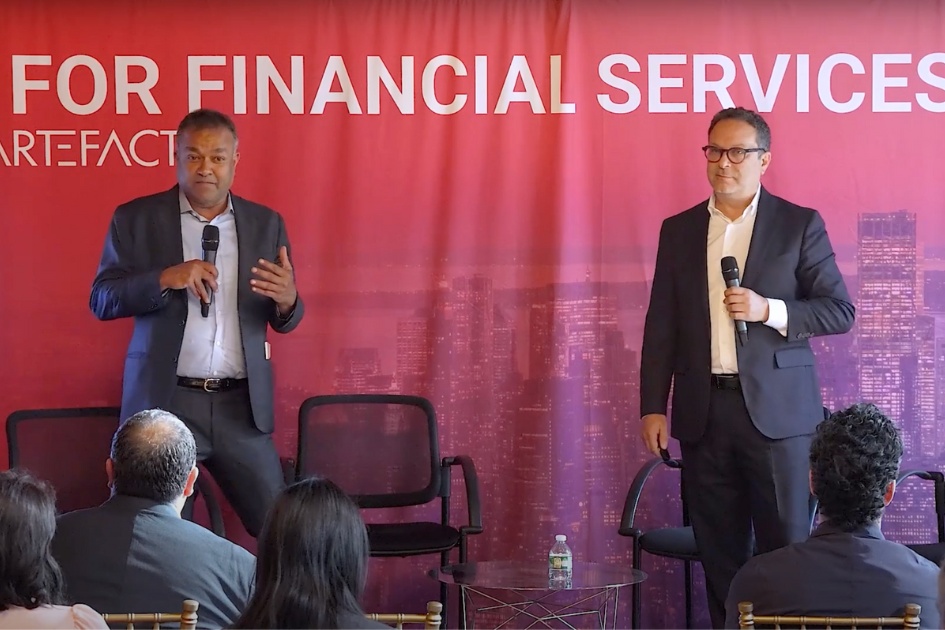
His public activity continued beyond funding announcements. He appeared on the speaker list for the May 2024 Index Linked Solutions Forum in New York. He also joined Libertify founder Steve Rosenblum at Artefact’s AI for Financial Services NYC event. These appearances placed the index builder in conversations about the investment products and communication tools developing around financial services.
In April 2026, MerQube announced its Series C, welcoming 7RIDGE and Deutsche Börse Group. Its announcement reported approximately $27 billion in assets tracking MerQube indices. That figure describes the assets using those reference points, rather than money personally managed by Srivastava. It gives the previously invisible calculation work a measure of its reach.
Assets tracking MerQube indices, as reported in the company’s Series C announcement.
The stated next steps included expanding the Garage platform, developing technology for options-based structured ETFs, and broadening adoption among wealth and asset management clients in the US, Europe and Asia-Pacific. The company also planned further work in quantitative investment strategies. Srivastava described the ambition as helping “close the fintech gap in passive investment.”
The simplicity test
The geographic ambitions fit the way his career had developed. At S&P, his work involved clients and product ideas across markets. MerQube’s plans similarly depend on understanding institutions with different requirements while maintaining a common technological foundation. For Srivastava, expansion brings the familiar task of connecting a financial use case to the machinery capable of supporting it. The locations multiply; the need to get the instructions right travels with them.
For a revealing clue to how he thinks about that ambition, return to his admiration for Apple. In his 2022 discussion of indexing, Srivastava pointed to the way a complicated product could feel simple to its user. He connected that observation to investors’ straightforward objectives and the increasingly complicated mechanics involved in addressing them.
It is a fitting comparison for his own career. The mechanical engineering student became a software professional, then an index executive, then a founder. Each chapter required understanding what happens beneath a surface that someone else would eventually encounter. The résumé crosses industries; the recurring concern is how a system carries out its promise.
At MerQube, that concern has become a business involving researchers, engineers, financial institutions and clients with differing requirements. The number on the screen remains tidy. Behind it are the choices about data, timing and rules that have occupied Srivastava for years. Simple investing, it turns out, can keep an engineer very busy.