In September 2013, Value Consulting offered an appealing proposition for anyone who had ever approved a consultant’s invoice. Its specialists, an executive explained, were employees. Remove the intermediaries and the customer could keep the hourly savings. Here was enterprise technology presented as a problem of unnecessary distance: too many people between the person doing the work and the person paying for it.
- The work: SAP implementation, application integration, custom development, and support.
- The pitch: business-process expertise paired with people who could execute the project.
- The complication: a federal guilty plea involving a director and the staffing operations of related companies.
The useful thing about that proposition is how little it depends on a particular software brand. A business buys a system, then needs somebody to make it fit. Value Consulting occupied that space. Its history also exposes something easy to overlook while comparing technical proposals: the delivery organization itself is part of what the customer is buying.
The work between the boxes
Value Consulting’s published identity is an enterprise IT services firm. Its company profile lists SAP Business One, ECC, and a range of associated applications, alongside Oracle, Microsoft, bespoke software, and offshore support. The customers it describes operate across the United States, Canada, Europe, and India. This is a business aimed at organizations with existing systems and operational complexity.
Consider an illustrative problem. Sales records an order, the warehouse allocates stock, and finance expects an invoice. Each department may have perfectly serviceable software. The trouble lives in the handoffs: a field that means something different, an approval that never arrives, a transaction somebody types twice. An integration assignment begins with those connections. Buying another application does not automatically repair them.
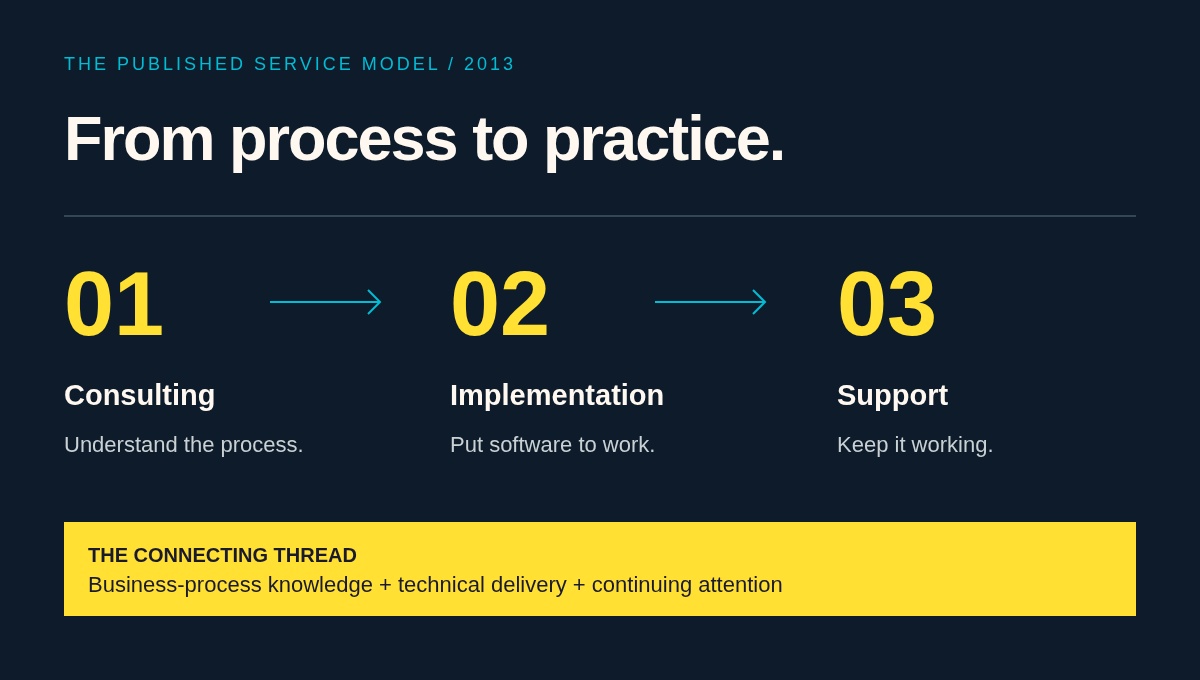
A 2017 company contribution described developers finding gaps while maintaining applications, then building add-ons around them. That is a revealing detail. Custom development can begin with the small inconvenience that a standard package leaves behind. The proposed service combines knowledge of the business process with the ability to change how the software handles it.
The same historical account described HR outsourcing and recruitment services. Technology and staffing sat alongside each other in the offering. For a buyer, that breadth creates several possible engagements: advice about a process, implementation of a package, development of an extension, or people to support the work afterward.
Five measures, one missing question
The 2013 conference announcement organized the company’s pitch around five measures: ownership cost, delivery quality, deployment speed, scalability, and timeliness. This was a practical way to speak to a CIO. An application can meet a specification and still become an expensive nuisance if it arrives late or proves difficult to operate.
- 01 Ownership cost
- 02 Delivery quality
- 03 Deployment speed
- 04 Scalability
- 05 Timeliness
The direct-employment argument addressed the first measure. Value Consulting said its own specialists reduced the need for intermediaries. That is a claim about the structure of a services business. It invites a buyer to examine how an hourly charge becomes payroll, supervision, and delivery. A low number on a proposal reveals only part of that arrangement. The reasonable inference for procurement is to compare the complete assignment: hours, responsibilities, handover, and continuing support. A quoted rate becomes meaningful when the buyer understands what work it covers and who remains accountable after the initial implementation ends.
“Our subject matter experts are our employees”
Ashish Sawhney, identified as Director of Information Technology, 2013 announcement
The commercial alternatives are familiar: another implementation partner, a larger systems integrator, or an internal team. The choice turns on the assignment. A narrowly defined application gap and a company-wide replacement demand different resources. Value Consulting’s published combination of implementation and ongoing support placed it in the market for hands-on enterprise services.
When a job existed only on paper
In August 2020, federal prosecutors announced charges against Ashish Sawhney. Their announcement named Value Consulting, LLC, Value Software Products, Inc., Business Pointers, Inc., and E-Train ERP, Inc. It alleged that visa applications described jobs that did not exist when the applications were filed. The approximately $21 million in gross profits cited there was an allegation concerning the scheme across those companies, covering 2011 to 2016.
The subsequent development matters. The Labor Department’s inspector general reported that Sawhney pleaded guilty on September 16, 2021, to conspiring to make false statements. Its account described more than 100 H-1B visas obtained through the scheme, and workers waiting while employment was sought. Some recruits were made to pay visa fees in violation of federal regulations.
Charges announced against Sawhney
Guilty plea reported by the Labor Department
The distinction between an accusation and a guilty plea is essential. So is the distinction between a brand and several legal entities. This record concerns named operations and an individual’s conduct. It changes how the staffing proposition should be read without establishing a verdict on every software project associated with the name.
Read the contract behind the code
The lesson for a prospective customer is concrete. Treat the delivery team as something to understand before procurement ends. Which entity signs? Who employs the specialists? Who supervises their work? Those questions follow directly from the gap between an attractive employment claim and the documented staffing conduct.
There is also a useful idea in the application-gap approach: describe the awkward handoff before specifying the customization. A buyer can borrow that discipline without adopting any particular supplier. Write down the transaction, the exception, and the person responsible. Then ask a proposed team to demonstrate how the work moves through the system.
As an editorial assessment, the published service model fits organizations prepared to define processes and manage an external delivery relationship. It offers less help when nobody inside the customer owns the decisions. Value Consulting’s story leaves the buyer with a demanding definition of value: software that works, delivered through arrangements that can withstand examination.