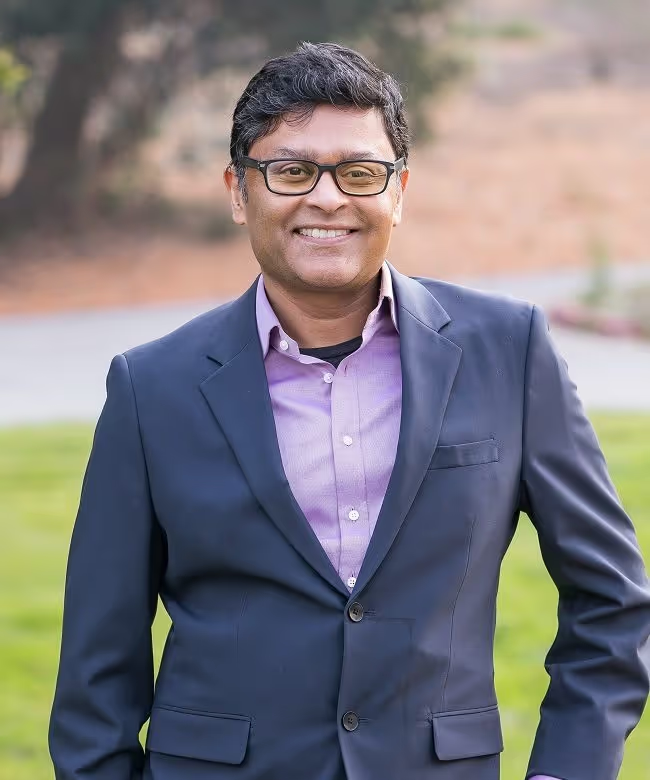
In 1995, before most of Silicon Valley knew what to do with it, Upal Basu signed up for a Yahoo! email account. He was among the first. That instinct - to grab the new thing early, understand it structurally, and then build something on top of it - has defined every chapter of a career that spans structural engineering, McKinsey consulting, startup founding, and two decades of venture capital at the highest level.
Today Basu is a General Partner and Managing Member at NGP Capital, the Nokia-backed venture firm based in Palo Alto that writes checks across the connected technology ecosystem. He leads the US investment team and runs NGP's India portfolio - a geographic spread that reflects a firm belief that the most interesting infrastructure plays are happening simultaneously in Silicon Valley, Bangalore, and everywhere in between. His current portfolio is a map of where digital infrastructure is heading: satellite navigation (Xona), network automation (NetBox Labs), AI-powered application security (ArmorCode), autonomous manufacturing robotics (Ati Motors), workforce intelligence (Observe.AI), and cybersecurity ratings (SecurityScorecard).
What sets Basu apart from most GPs isn't the name on his business card or the universities on his CV. It's the gap on his resume between McKinsey and NGP Capital - eight years when he wasn't advising companies or investing in them, but actually running one through the hardest years of its life.
I experienced three waves of mobile transformation: as an entrepreneur during 3G to 4G, and as an investor during 4G to 5G.
- Upal Basu, NGP CapitalBasu founded Mformation Technologies in 1999, right as the mobile internet was beginning its long awkward adolescence. The idea was straightforward and extraordinarily hard to execute: give telecommunications companies a unified way to manage the devices on their networks. He spent the next eight years building it into the world's largest mobile device management company, eventually managing over 500 million devices for more than 20 service providers globally. The scale was unprecedented. The operational complexity was the kind that either breaks founders or shapes them into serious operators.
Alcatel-Lucent acquired Mformation in 2015 for its IoT security and device management capabilities - validation, a decade in the making, that Basu had correctly read where mobile infrastructure was heading long before IoT became a buzzword in every pitch deck. By then, he had already been at NGP Capital for seven years, putting his operator experience to work on the investor side of the table.
The Edge Thesis
Ask Basu what edge computing actually is, and he'll give you an answer that sounds like it came from someone who built the infrastructure, not just studied it. He describes it as a system construct with three distinct components: the vertical solution deployed at the edge itself, the central cloud processing layer, and the horizontal enabling technologies that tie them together. Most investors treat these as synonymous. Basu treats the distinctions as the investment thesis.
His view on IoT deployments is similarly grounded in operational reality. The conventional consulting playbook assumes IoT rollouts with tight ROI windows and centralized architectures. Basu pushes back: real IoT projects require longer time horizons and fundamentally decentralized thinking. The sensors are not in the corporate office. The value is not in the dashboard. The value is in what happens when the data reaches the right computation layer at the right moment - in a factory floor, on a shipping route, inside a satellite constellation navigating commercial aircraft.
That last example is not hypothetical. Xona, one of NGP Capital's most ambitious bets, is building the next-generation satellite navigation and positioning infrastructure - a fundamental rethink of how GPS works, designed for the precision requirements of autonomous vehicles, drones, and critical infrastructure. NGP participated in every funding round from Series A, and when Xona closed a $170M Series C in late 2024, it validated a thesis Basu had been building for years: the physical infrastructure layer of the connected world needs as much reinvention as the software layer above it.
An Operator Reading the Room
The NGP Capital portfolio under Basu's stewardship reflects a specific and consistent pattern. He tends toward companies building the plumbing, not the applications - infrastructure that other software depends on, in sectors where the consequences of failure are measured in aircraft trajectories or factory shutdowns rather than engagement metrics. SecurityScorecard, where he has served as a Board Director since 2017, turns cybersecurity posture into quantifiable ratings - the credit score of enterprise security. NetBox Labs automates network infrastructure management at scale. ArmorCode applies AI across the full application security workflow. The common thread is companies that make large, complex systems legible, manageable, and defensible.
Basu manages over ten board and advisor roles simultaneously, a portfolio that would overwhelm most investors but fits naturally with someone who spent eight years as an operating CEO. He knows what a board needs to do and what it shouldn't do. He understands the difference between strategic guidance and operational interference. Founders in his portfolio tend to describe him as genuinely engaged - not in the performative way of a GP curating their LinkedIn presence, but in the way of someone who has sat in their chair and remembers what it felt like.
India, Emerging Markets, and the Global Bet
Basu also leads NGP Capital's India investment strategy, a portfolio that includes Shadowfax - the last-mile logistics company that IPO'd on Indian public markets, with NGP having led its Series C back in 2018. His India work reflects the same thesis as his US investments: infrastructure plays in sectors where mobile and connectivity are still reshaping fundamental industries. Indian logistics, Indian enterprise software, Indian fintech - all of these are going through transformations that 5G and edge computing will accelerate in ways that parallel what happened in US enterprise between 2008 and 2015.
The geographic breadth is intentional. Nokia's position as the world leader in 5G and networking means NGP Capital has natural deal flow and credibility in any market where 5G infrastructure is being deployed. Basu uses that vantage point to find companies that will benefit from the 5G transition before the transition becomes obvious - the defining skill of any GP worth their management fee.
Before the VC Era
Start further back and the arc becomes even more interesting. Basu began his career as a structural engineer at Degenkolb Engineers - the kind of foundation work (literally) that teaches you to think about load-bearing systems and failure modes before thinking about aesthetics. He moved to Risk Management Solutions in the early 1990s, where he led product management for mapping software used by insurance underwriters to visualize risk around the world. Data visualization as a product, before "data product" meant anything in particular.
Then McKinsey, in New York and London. Then Mformation. Then NGP. The through line is not industries or geographies but a specific way of interrogating a problem: structurally, from first principles, with attention to what happens when the system is under load. The same instinct that made him a good structural engineer made him a good device management CEO, and makes him a formidable investor in companies that have to work at scale, under pressure, in environments where failure has real consequences.
He walks an hour every day. Reads constantly. Cooks when the ingredients are interesting. Deliberately puts down his phone to experience cities and nature the way they were meant to be experienced. The discipline is the same whether it's an investment committee meeting or a morning walk - present, attentive, and thinking about what comes next.