The curious thing about Ubiquiti is the person missing from the room. There is a network to build, a cupboard to fill with equipment, perhaps a school or a hotel waiting for WiFi. But the vendor's salesperson need not be there. The installer may already know what to buy. Someone on a forum has tried it. Someone else has posted the settings. The sale begins with people doing the work.
- Ubiquiti sells networking hardware, with software that makes the pieces work together.
- Its community and distribution model replace much of the traditional enterprise sales apparatus.
- Core UniFi management is license free; installation, hardware and optional services still cost money.
This is a useful way into a company whose name is less familiar than the little white discs on its customers' ceilings. Ubiquiti makes access points, switches, gateways and cameras. Its UniFi platform brings much of that equipment under one management system. UISP serves internet providers. The ambition is broad; the transaction is wonderfully concrete. Buy a box. Connect it. Make a place work better.
A $650 office, with sleeping arrangements
Robert Pera left Apple's wireless engineering group in 2005. He liked the company's approach to integrated products, but wanted more room to design his own. As he later told Fast Company, he exchanged a $600 monthly studio apartment for a $650 office near the San Jose courthouse. For several months, the office was also home. His remembered assessment was economical: “If this doesn't work out, I am screwed.”
That beginning helps explain the appeal of Ubiquiti's proposition. Networking had jobs to do outside the headquarters of companies with generous IT budgets. A small operator needed to connect customers. An installer needed equipment that could earn its keep. A company that could make the hardware affordable, then let experienced buyers explain it to one another, had an opening.
Outside money did arrive. Summit Partners made a minority investment in 2010 and helped prepare the business for a public listing. The 2011 IPO offered about seven million shares at $15 each. Most were sold by existing shareholders; roughly 2.4 million were company shares. That distinction matters. The offering's approximately $105.6 million gross value was not all fresh cash for Ubiquiti.
The software sells the next box
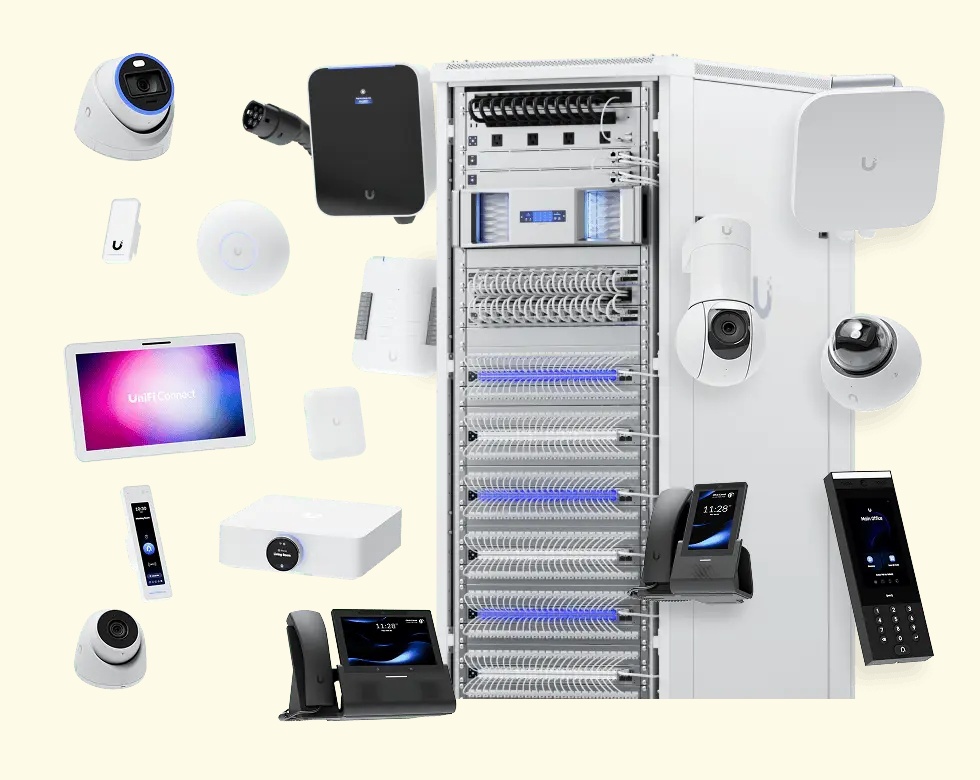
Consider a small business extending a network into another room. An access point provides wireless coverage. A switch connects equipment and, on suitable models, supplies power over Ethernet. A gateway handles the internet connection, routing and firewall. UniFi's attraction is that an administrator can manage these functions together, rather than relearn a different control panel for every purchase.
The product family stretches further. Protect handles video surveillance; Access manages doors; Talk covers telephony. Site Manager brings multiple locations into one interface. For a shop, school, hospitality operator or managed service provider, the practical benefit is fewer separate systems to learn. It also gives Ubiquiti a natural route to the next order: the customer already understands the controls.
There is history behind this arrangement. An older UniFi access-point datasheet bundled controller software that could run on a PC, Mac or Linux machine. Customers could expand their installation without buying a dedicated hardware controller. The company's current homepage condenses that philosophy into “Building the Future of IT. License Free.” The appeal survives even as the catalogue grows more elaborate.
The next product arrives with something valuable already installed: the customer's familiarity.
$379 gets you a gateway. Then comes the building.
At the time of research, the US store listed the Dream Machine Pro at $379. That buys a rack-mounted gateway, not a finished network. Access points, appropriate switching, cabling, installation and any recording drives add to the bill. Tax and regional pricing matter too. A clear equipment price is useful precisely because it lets a buyer begin a real budget.
License free also needs a boundary. Ubiquiti offers paid services, including enhanced cybersecurity and professional support. Its support guidance describes free chat and email alongside paid, mission-critical phone support for eligible deployments in specified regions. A buyer comparing UniFi with Cisco Meraki, HPE Aruba Networking or TP-Link Omada should compare the required features, support terms and operating costs over several years.
The ceiling discs grew into a $3.27 billion business
The financial mix shows where the company has travelled. In fiscal 2026, Ubiquiti recorded $3.274 billion in revenue, up from $2.574 billion a year earlier. Enterprise technology supplied about 91% of the total. Service-provider technology, including equipment for wireless internet infrastructure, supplied the balance. The company still serves the operator connecting distant customers, but enterprise products now carry most of the business.
The unusual sales model remains. Ubiquiti's annual report says it has no traditional direct sales force. It describes small development teams and a community through which customers can reach engineering, marketing and support. This suggests a lesson other businesses can copy: make customer knowledge useful to the next customer. Good documentation, visible answers and repeatable installations can do commercial work.
Trust needs engineering, too
The model has encountered trouble beyond product design. Ubiquiti introduced hardware and software authenticity indicators beginning in 2012 to help customers identify counterfeits. In 2015, employee impersonation and fraudulent payment requests led to $46.7 million in transfers; the annual report then recorded $8.1 million recovered. Distribution needs verification. Finance needs controls. A community cannot substitute for either.
The product direction keeps moving toward larger installations. September 2026 brought enterprise switching enhancements focused on resilience. In October, Ubiquiti announced Network 11, including live traffic flows, historical topology and expanded connectivity features. These announcements show a wider enterprise ambition; feature availability still depends on supported hardware and software rollout.
For a buyer, the sensible first step is a representative pilot. Check coverage, routing, recovery and the support arrangement before expanding. For another founder, the useful insight is narrower than “skip salespeople.” Ubiquiti gives technically capable customers something they can evaluate and teach. That approach becomes harder when every installation is bespoke, every purchase needs prolonged negotiation, or downtime demands contractual guarantees the chosen offering cannot provide.
Keep following the signal
Explore UniFi · Explore UISP · Product news · Community