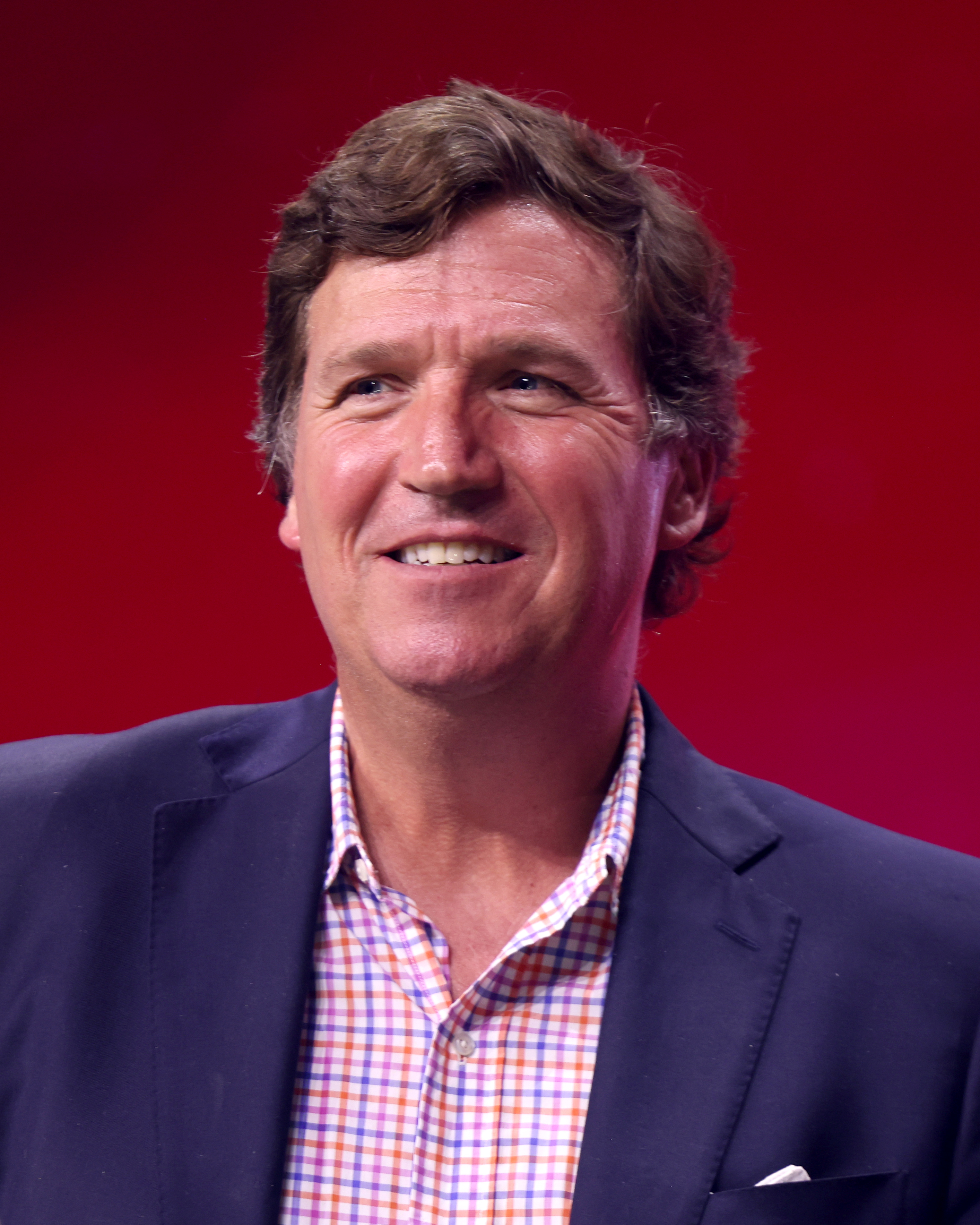
The standing desk is in Maine. The bookshelves behind it are real. The lighting is a little uneven, the audio is fine, and the guest list - in any given month - might include a former CIA officer, a UFC fighter, a Russian president, a Tennessee mechanic, and someone who claims to have seen a Bigfoot. Tucker Carlson, at 56, has built the strangest broadcast operation in American media, and he runs most of it from a property in Woodstock that has been in his family for decades.
This is the part of the story people forget. Before the Fox primetime years, before the bow tie, before Crossfire, there was a kid in La Jolla whose father ran Voice of America. Dick Carlson sent his son east to St. George's, a small boarding school in Rhode Island, where the chapel doubled as the room where Tucker met Susan Andrews. Susan's father was the headmaster. The two married in 1991, the same year Tucker graduated from Trinity College in Hartford with a history degree, applied to the CIA, and was politely turned down. His father suggested journalism. Tucker filed for The Weekly Standard.
The 1990s were spent on assignment. Long features for Esquire, The New Republic, New York. He liked the work that required a plane ticket and a hotel and a long argument with an editor. By 2000 he was on CNN, and by 2001 he was co-hosting Crossfire, the half-hour shouting match that became, briefly, a kind of cultural fixture. Jon Stewart famously came on the show in 2004 and told the hosts they were hurting America. The bow tie did not survive the decade.
"We are not here because we love Vladimir Putin. We are here because we love the United States, and we want it to remain prosperous and free."
- Carlson, on his Moscow interview, February 2024
MSNBC came next. Then a stretch as a Fox contributor. Then The Daily Caller, which he co-founded in 2010 - a brash, fast, often-controversial conservative news site that grew into a serious traffic player before he sold his stake years later. By 2016 he was filling in for various Fox hosts and, by November of that year, taking over the 8 p.m. slot. Tucker Carlson Tonight ran for almost seven years. By 2020 it was, depending on the week, the most-watched program on American cable news. The format was tight. A monologue, a sneer, a guest, a punchline. Critics hated it. Five million people watched it most nights.
And then, on April 24, 2023, Fox News announced he was out. No press release, no farewell show, no monologue about why. Within forty-eight hours he had taped a video from a wood-paneled room and uploaded it to X. The video drew tens of millions of views before the week was over. By June he was posting twice-weekly episodes of "Tucker on X." By December he had a website, a subscription product, a staff led by Justin Wells (his old Fox executive producer), and a name for the whole operation: Tucker Carlson Network.
The Network's economics are not entirely public, but the contours are. A subscription tier offers exclusive long-form interviews, books, member events. An ad-supported free tier draws the casual visitor. The show itself - The Tucker Carlson Show - drops on YouTube, on X, on Spotify, on Apple Podcasts, on the TCN site. He has, in effect, built a one-man competitor to the cable network that fired him, with a staff a fraction of the size and no quarterly meeting with a board.
The Putin interview - filmed in Moscow in February 2024 - was the moment most people who had stopped paying attention started again. Two hours, mostly Putin lecturing on Russian history, a few questions Carlson later admitted he wished he had pressed harder on. The State Department was unhappy. The European Commission considered sanctions. The interview was viewed, by some counts, more than two hundred million times in its first week. Carlson's case for the interview was straightforward: Americans were about to spend tens of billions of dollars on a war. They deserved to hear from the other side. Reasonable people disagreed.
What followed was, of all things, a tour. The Tucker Carlson Live Tour, 2024. Arena dates across the country, sold-out rooms, interviews with politicians and provocateurs on stage. It was unusual. American journalists do not normally do arena tours. Carlson seemed to enjoy it.
"Most Americans have no idea why Putin invaded Ukraine. Americans have a right to know all they can about a war they're implicated in."
- Carlson, X video, February 6, 2024
The author resume is its own thing. "Politicians, Partisans, and Parasites" in 2003. "Ship of Fools" in 2018, which debuted at number one on the New York Times bestseller list and stayed there. "The Long Slide" in 2021, a collection of magazine pieces from the 1990s and 2000s that reminds you, if you let it, that the guy used to write long magazine prose for a living. The books have sold well enough that, between them and the streaming network and the speaking fees, the public estimates of his net worth have crept into the tens of millions. Susan, his wife, comes from her own family money. They own a four-bedroom house in Boca Grande, Florida, bought in 2020 for $2.9 million, and the neighboring three-bedroom they picked up two years later. The Maine compound has been in the family longer than he has.
The Maine studio is the most Tucker detail of all. It is a small, standalone outbuilding - rumored to have cost around thirty thousand dollars to build - originally intended to be a clean room from which he could file his old Fox segments without driving to a station. After he left Fox, it became the room he films in. There is a stuffed swan in the background of some episodes. He fishes for trout in the afternoons. He reads compulsively. He keeps four kids - Dorothy, Lillie, Hopie, and Buckley - mostly out of view.
The latest chapter, as of mid-2026, has been a political reorientation that startled almost everyone. In a series of long interviews and monologues this spring, Carlson publicly distanced himself from earlier political endorsements he had been associated with, including some that defined his Fox-era brand. Whether the shift is a recalibration, a market-driven repositioning, or a sincere change of mind, it is difficult, this close to the event, to know. Poynter ran a long Q&A about it. The Times wrote about it twice. The audience seems to have followed him through the turn the way it followed him out of Fox. He is now, by any reasonable measure, one of the most-listened-to political journalists in the world without the institutional support of a single major network. He picked a room with no executives in it, and a chair facing whoever walked in.
What is striking, looking at the whole arc, is how little of it was inevitable. The bow tie could have stuck. The Crossfire format could have buried him. MSNBC could have kept him through the Obama years. The Daily Caller could have absorbed his attention permanently. Fox could have kept him for another decade. Any of those forks would have made him a different person and probably a smaller one. Instead, he kept moving. The current version - the long-form interviewer, the streaming entrepreneur, the man with the standing desk and the river view - is not the version anyone predicted in 1991. It is just the version that, for now, fits.
He still files. Several times a week. The format remains punishingly simple. Two chairs, two cameras, one question, then twenty more. The guests are not always interesting. Sometimes they are extraordinary. The audience numbers, every week, suggest that something about that simplicity is working at scale. There are very few American journalists his age who can credibly say they are building the next chapter of their career rather than narrating the last one. Carlson is one of them. The barn is open. The trout are biting. The questions, as ever, are long.