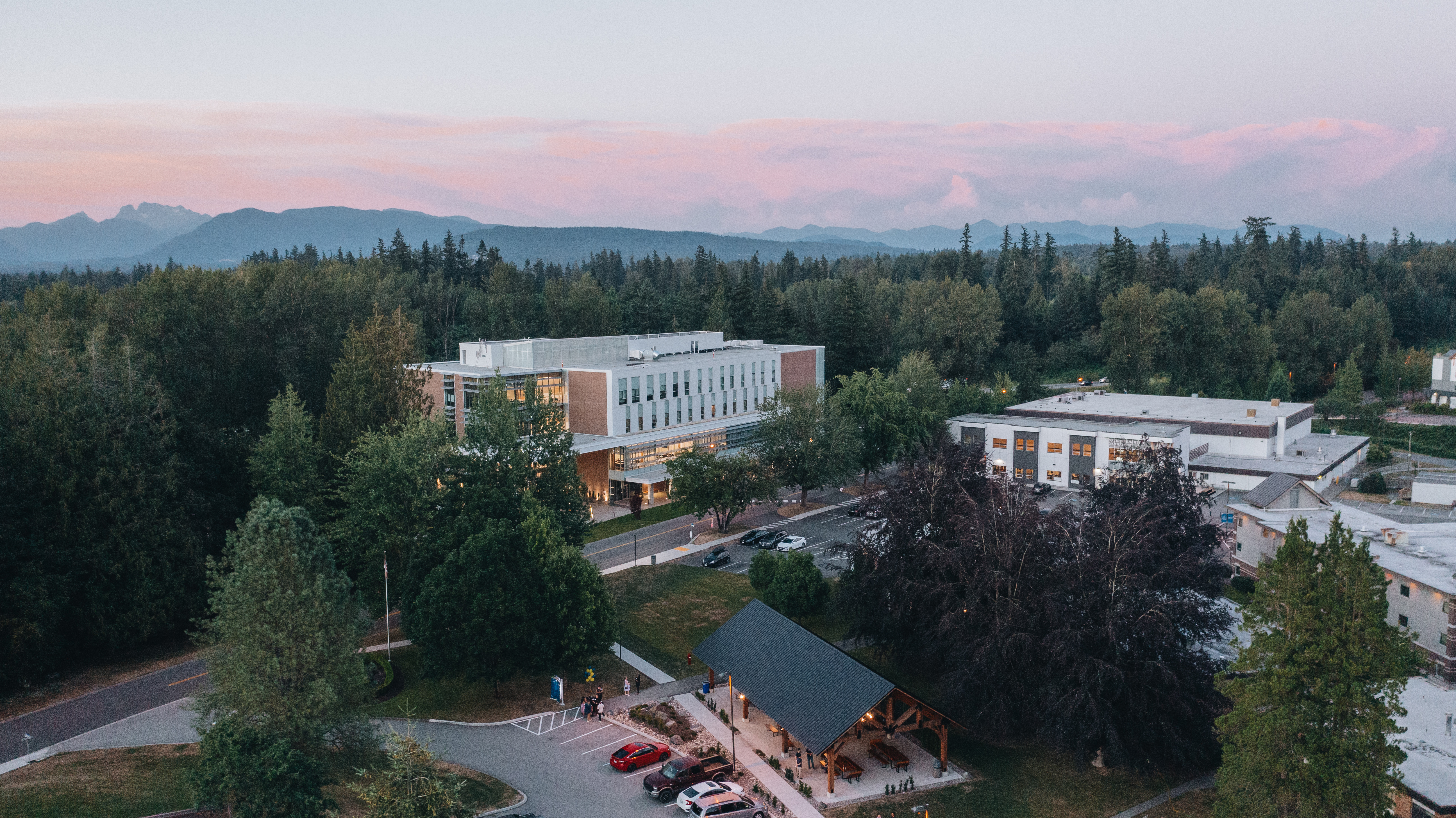
The most revealing thing about Trinity Western University is not that it is Christian. It is that the school has spent nearly seven decades learning where a belief belongs: in the product, in the culture, and sometimes, perilously, at the gate. What began in 1962 as Trinity Junior College on a former dairy farm in British Columbia’s Fraser Valley is now a private nonprofit university with C$125.4 million in annual revenue, campuses and sites in Langley, Richmond and Ottawa, and a global alumni network north of 30,000.
Its offer is unusually legible. A student can study nursing, business, psychology, education, the humanities, science or theology while being immersed in an evangelical Christian community. The university combines the ordinary furniture of higher education - classes, labs, residence halls, career support, athletics and financial aid - with worship, discipleship and an explicit promise to integrate faith and reason. Public universities sell education in a pluralistic marketplace. Trinity Western sells education plus a point of view.
The product is formation
A credential is the obvious output. Formation is the actual product. Trinity Western’s vision says every graduate should be equipped to “think truthfully, act justly, and live faithfully.” That phrasing reaches beyond employment without pretending employment is optional. The 2030 strategy calls for more internships, co-ops, practica, clinical placements and mentorship. It also proposes a “Design my Work Life” program and an entrepreneurship lab. In other words: purpose, meet payroll.
The customers are students and families who see value in that bundle. Traditional undergraduates get the fullest version - campus, chapel, clubs, residence and sport. Graduate students buy professional advancement in areas such as counselling, leadership, nursing, business and education. Adults can finish degrees flexibly. International learners can enter through online programs and partner-supported pathways. Beginning in September 2026, ministry leaders and scholars can study through Trinity Evangelical Divinity School at TWU in person, online or in hybrid formats, with offerings in English, Mandarin and Korean.

That range makes Trinity Western broader than the phrase “liberal arts college” suggests. It conducts research, supports undergraduate research awards and holds two Canada Research Chairs, one in people-centred health measurement and one in cardiovascular adaptation to exercise. Its Spartans have won 14 U SPORTS national championships since 1999. In 2024, TWU introduced what it describes as Canada’s first formal postsecondary concussion Return-to-Learn policy. The first reported academic-year cohort included 32 students; all were retained, and none landed on academic probation.
What it costs - and who pays
For 2026-27, the standard domestic undergraduate rate is C$795 per credit. A conventional 30-credit year therefore starts at C$23,850 in tuition. Add the university’s published example of housing, meals and fees, and a first-year domestic student living in Douglas Hall reaches roughly C$34,700 before books and personal expenses. TWU says 95 percent of applicants received scholarships or financial aid in the prior year, with average aid of C$5,750. The net price varies, but the value question does not: why pay a private-university premium?
TWU’s answer is attention, coherence and community. A secular campus can offer excellent professors and employment outcomes. Trinity Western tries to connect those pieces to a shared account of human purpose. This is strongest when a learner actively wants that account. To everybody else, it may look like a costly constraint rather than an advantage.
The business model is tuition-first. In fiscal 2026, tuition and fees supplied about 77 percent of total revenue. Donations contributed C$9.6 million; housing, dining, conferences, bookstore activity, investments and other sources filled out the rest. This is not a venture-backed company with a funding ladder or an advertised valuation. It is a registered charity governed by a board, with C$243.1 million in fund balances at year-end. Its currency is enrolment, retention and donor confidence.
That dependence showed up in February 2026, when the university said federal policy changes had sharply reduced international student enrolment. Management announced cost-saving measures and a reallocation of resources toward its strategic priorities. Audited total revenue had fallen from C$137.9 million in 2025 to C$125.4 million in 2026. Mission did not cancel arithmetic. It told leaders what to protect while they did the arithmetic.
What failed first
The proposed law school was the clearest collision between Trinity Western’s internal culture and an external profession. The university required students to sign a Community Covenant that, among other conduct rules, prohibited sexual intimacy outside marriage between a man and a woman. Law societies in British Columbia and Ontario concluded that the effect on LGBTQ students conflicted with the public interest in equal access and diversity. Trinity Western argued that denying accreditation infringed religious freedom.
In June 2018, the Supreme Court of Canada upheld the law societies’ refusals. The proposed school did not open. This was not a minor product delay. It showed that a code designed to preserve a community could prevent the community’s credential from functioning in a regulated market.
What changed minds is visible in the sequence, even if private board deliberations are not. In August 2018, the Board of Governors reviewed the admissions policy and made the covenant non-mandatory for student admission and continuation. Its stated aim was to remain a thriving Christian community while becoming more inclusive of students who wished to learn from a Christian viewpoint. The mission stayed intact. The enforcement mechanism changed.
Professional regulators reject the proposed law school over the mandatory covenant’s effect.
Canada’s Supreme Court upholds the law societies’ decisions.
TWU makes the covenant non-mandatory for students while reaffirming its Christian mission.
The current Student Code of Conduct draws the new line carefully. Students do not have to affirm or seek to believe every theological view, but they are expected to respect the university’s evangelical beliefs and practices. Accountability language emphasizes reconciliation, forgiveness and dignity. Critics and supporters will disagree about whether the balance goes far enough. Strategically, the distinction is important: respect for an institution’s identity is not the same product as compelled personal assent.
The new distribution machine
Trinity Western now wants to serve 10,000 students annually by 2030. Langley cannot do that alone, and a high-touch residential model does not naturally scale. So TWU is building routes around the campus bottleneck: fully online degrees, asynchronous programs, microcredentials, adult completion, multilingual theology and FAR Centres where global students take online courses with local advising support. Its IPERC partnership adds international recruitment and pathways in leadership and psychology.

The TEDS deal is the sharpest example. Effective January 2026, TWU acquired specified academic materials, intellectual property, digital assets and program-related rights from Trinity International University for nominal consideration. It assumed no liabilities, debt, leases, employment obligations or regulatory obligations from the former owner. On paper, that is close to a free acquisition. In practice, integration still costs faculty time, technology, accreditation work, marketing, student support and trust. Cheap assets can be expensive organisms.
The opportunity is unusually good. TEDS brings a 128-year name, scholars, alumni and doctoral depth. TWU supplies a Canadian institutional home, a West Coast campus and a platform for hybrid delivery. Both share roots in the Evangelical Free Church of America. This is adjacency with a reason, not a random catalogue grab.
The playbook worth copying
Five moves to borrow
- Bundle a commodity with a conviction. Degrees are comparable; a coherent account of why learning matters is not.
- Separate the promise from the policy. Preserve the valuable identity while replacing mechanisms that create avoidable exclusion.
- Scale access, not sameness. Online, hybrid and local partner centres can carry one academic core in different forms.
- Buy adjacency with shared DNA. TEDS fits because mission, audience and history overlap.
- Publish the arithmetic. Tuition, financial aid and audited statements make tradeoffs discussable.
Competitively, Trinity Western sits between large public universities and smaller faith-based institutions such as Redeemer, Crandall and Ambrose. It cannot win a facilities arms race with UBC or Simon Fraser. It can win with students who want recognized academics, professional preparation and a Christian community in one package. Against other Christian schools, its advantages include program breadth, research chairs, graduate depth, British Columbia location and an athletics brand with real hardware.
When this does not work
The model fails when the audience does not value the worldview, when tuition overwhelms the perceived benefit, when online scale thins out mentorship, or when a community rule blocks access to a regulated profession. It also fails if “global” means exporting a Canadian format without local cultural intelligence. Distinctiveness only earns a premium when the customer wants the distinction.
The university’s next test is not whether it can become less Christian to grow. That would erase its reason for being. The test is whether it can make Christian formation portable, welcoming and professionally credible across a residential campus, an online course, a partner centre and a multilingual divinity school. Trinity Western’s best idea is also its hardest one: a strong identity should act like a magnet. The moment it acts like a wall, the market - or a court - may answer back.