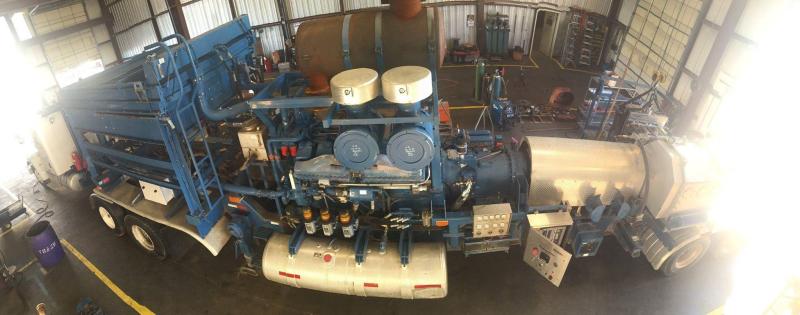
An auction is a fine place to buy a machine that does not yet work. A used frac unit can arrive with the outline of a bargain and the innards of a problem: worn pump parts, obsolete controls, and no immediate way to earn its keep. In 2015, Total Equipment And Service showed what its shop could do with one such unit. For Southwest Semi Trailers, it replaced pump parts and added Mobile Data Technologies controls. The company posted a photograph of the result with a wonderfully direct question: “Just got an auction unit? Let us get it running!”
- Built: Custom frac, coiled tubing and pressure pumping equipment for well-service companies.
- Fixed: Parts, maintenance and full refurbishments, including equipment made by others.
- Changed hands: Propell bought the assets from C&J Energy Services in March 2017.
That little repair tells more about the Granbury, Texas, manufacturer than a grand mission statement would. Total Equipment And Service, or T.E.A.S., occupied two points in the life of a costly oilfield machine. It could design and fabricate the new one. It could also bring an old one back from the edge of a yard. Both jobs required an intimate understanding of how oilfield crews actually use equipment, and both gave customers a reason to call the same shop again.
From a drawing to a dusty well pad
Barry Beadle founded Total Equipment And Service in Granbury in February 2004. The company specialized in custom fabrication of engine-driven oilfield products. Its customers were the service firms that arrive after drilling, when a well needs fracturing, coiled tubing, pressure pumping or another form of intervention. Those operators need equipment that survives hard travel, heavy loads and a schedule with little patience for delay.
A T.E.A.S. frac product could be a pump mounted on a trailer or skid, a blender to mix treatment fluids, or a hydration unit. Its coiled tubing line extended to complete units, pressure-control gear and nitrogen pumping equipment. A 2013 advertisement went further: twin pumps, cement pumps, wireline equipment, acid pumps, data vans, chemical transport and hydraulic power packs were all on the menu. It offered design, manufacture, service and parts in the same four-word line. This was a workshop with a catalog, not a single-product startup.
The loop explains the business model. A sale begins the relationship; field use creates the next problem to solve.
The company said it made some equipment to proprietary designs and other units to customer specifications. That distinction matters. A customer buying a well-service trailer is also buying a configuration: dimensions, controls, power, pressure and the practical arrangement of equipment that a crew must operate. A standard machine may be quicker to order. A custom one can fit the way a particular fleet works. Either way, the maker needs to understand the job after the factory door closes.
What failed first? Usually the ordinary things
Total Equipment And Service did not have to wait for a dramatic failure to sell service. Pumps consume parts. Controls age. Steel bends, seals wear, and a unit parked at auction may have a working frame but a doubtful future. The Southwest Semi Trailers repair is specific enough to show the economics: replace pump parts, update the controls and make an existing asset useful. The post did not give a repair price, and the company's public materials did not publish a rate card. A buyer's calculation would have been the cost of repair and downtime against the cost of another machine.
“Just got an auction unit? Let us get it running!”Total Equipment And Service, 2015 company post
The after-sale shop was not limited to its own output. The company said it would handle general maintenance through complete refurbishment on any make or brand. That widened the potential customer base and gave it a different claim from a builder interested only in new orders. It also meant a used unit could be a lead, a repair job and perhaps a future parts customer. The machine might have changed owners; its need for expertise had not.
When Propell acquired the operation, a local report counted about 50 employees on one shift. The factory was expected to keep making trailer-mounted frac and coiled tubing units.
The factory was full of small decisions
The glamorous part of oilfield machinery is horsepower. The less photogenic part is the fit of every support, control box and catwalk. A Hill College report offered a rare view of that work through Jade Liford, a welding graduate who joined T.E.A.S. in 2013. She fabricated aluminum parts for large equipment, including catwalks, pump supports and control boxes. Marketing director Ben Hiler called her one of the shop's best welders. It is a useful reminder that a machine sold in one piece is built in many precise pieces.
T.E.A.S. also followed the fuel bill. Its 2013 advertising promoted dual fuel retrofit kits for equipment already in service, claiming lower fuel costs without lost horsepower. The claim was marketing, not a public performance test, but the choice of product is revealing. Customers did not merely ask for more machines. They wanted existing machines to run more cheaply. A later coiled tubing ad emphasized an extra-wide reel, data acquisition, a built-in reel brake and custom cabins. The sales pitch was a series of practical operator questions, answered in metal and wiring.
What could another manufacturer copy? The order is straightforward: learn a customer's operating constraints, keep parts close to the installed base, and make refurbishment a real shop capability rather than a footnote in the catalog. The hard part is earning enough trust to touch an expensive unit after somebody else built it. A weak repair network would make the promise collapse. So would a market where used equipment has no value left to recover.
Then the ownership changed
The company moved through private investment and into C&J Energy Services before Propell acquired its assets in March 2017. Propell, part of TYCROP, was already making and renewing equipment for well-service companies in the United States and Canada. The purchase gave it the Granbury operation's manufacturing and service capacity. The financial terms were not disclosed. Local reporting said the plant would continue building trailer-mounted frac units, coiled tubing units and other well-completion equipment, with its existing workers staying on.
Beadle, then the operation's president, pointed to higher oil prices and more service work as reasons for optimism. Those are also the two variables that make this sort of business vulnerable. A customer's ability to buy a new frac unit depends on field activity and capital budgets. Its willingness to refurbish an old one depends on whether the expected work justifies the bill. T.E.A.S. sat at that intersection, selling both new capacity and another season of use.
The independent Total Equipment And Service is gone. Its public LinkedIn profile now describes it as a former industrial services and manufacturing company. But the 2015 auction repair still captures a durable idea. In heavy industry, a machine's value is not fixed on the day it leaves the factory. It rises or falls with the people who can configure it, maintain it and, when necessary, give it another chance to work.