Tony Huie grew up beside a potato field in a small Idaho town. Years later, his work would involve a rather different problem of cultivation: helping software companies grow without making life unbearable for the people using their products. The distance between those two settings is considerable. The software work would repeatedly bring him back to a practical question: how much effort should the user have to make?
Travel, cooking and basketball were among the interests Huie listed during his early Dropbox years. He arrived after stints in consulting and venture capital, joining a company still small enough to introduce its employees individually. He would move between investing and operating again before founding Twingate. His career kept bringing him closer to the work of turning a useful piece of software into a functioning business.
Today he is co-founder and CEO of Twingate, which he started with Alex Marshall and Lior Rozner in 2019. Its subject is secure access: deciding who can reach a company’s systems, under which conditions. That sounds like an orderly administrative exercise. Anyone who has spent a morning attempting to connect to something urgently needed for work may have a less tranquil description.
A potato field, then a very different kind of growth
Huie studied electrical engineering at Stanford, completing his bachelor’s degree in 2005 and master’s in 2006. His route into company building included McKinsey and Technology Crossover Ventures. Consulting, investing and operating provide different vantage points on a business: advising it, financing it, and being responsible for what happens after the meeting ends.
At Dropbox, his remit spread across business operations and international expansion. He helped build and lead early teams in functions ranging from sales and marketing to finance and business development. His tenure encompassed the transition from a roughly 50-person startup to an organization with more than 1,500 employees and 500 million users. Those are company milestones, rather than a solo accomplishment. His part involved making a growing business function.
International work made that responsibility particularly concrete. In 2014, Huie and Oliver Jay announced Dropbox’s expansion to Sydney. The company was building a business around a product people could already recognize and use. Getting a file from one place to another had acquired a simplicity that older workplace systems often lacked.
Huie’s subsequent career included venture investing at SignalFire and an investor and chief operating officer role at Pango. The combination matters to his Twingate story. He had seen software from the customer’s side, the organization’s side and the capital-allocation side. His recurring interest was how a technically capable product becomes something an organization can actually adopt.
- 2005 / 2006Electrical engineering degrees, Stanford
- 2011–2016Business operations and international roles, Dropbox
- 2019Twingate founded with Marshall and Rozner
- 2020Public launch, then general availability
- 2022$42 million Series B led by BOND
The complaint that became a company
Twingate’s founding team began by asking questions. Before the public launch, it spoke with nearly fifty people working in IT, security and networking, across companies of different sizes. The conversations uncovered a frustrating mismatch: practitioners knew more secure approaches existed, yet regarded the work of implementing them as prohibitively complicated or expensive.
That distinction gave the founders something specific to work on. A customer who understands an improvement and still cannot make it happen presents a different product challenge from one who needs persuading that a problem exists. The obstacle might be deployment, disruption, staff time or the effort required to coordinate several systems.
Huie and Marshall had worked on bringing Dropbox to business customers. They had already seen usability change the reception of workplace technology. At Twingate, they paired that experience with a team whose expertise included networking and large-scale systems. The aim was to make the experience of adopting secure access deserve as much attention as the underlying controls.
Their subject had an unglamorous familiarity. Remote access was something employees and administrators needed to keep working, rather than a product category they necessarily wanted to contemplate. An access tool has an unusual brief: when everything goes well, the user can concentrate on something else. Asking to be forgotten is a demanding design ambition.
The first door was a VPN
Twingate launched publicly in May 2020. In October, Huie announced general availability and a $17 million Series A, with backing that included WndrCo, 8VC, Green Bay Ventures, SignalFire and Dropbox founders Drew Houston and Arash Ferdowsi. The early connections from Dropbox had become part of a new company’s support system.
The initial proposition was deliberately recognizable: replace the corporate VPN. The larger ambition concerned access across an organization, but the first promise attached itself to a task customers already understood. A founder might see an extensive roadmap; a prospective customer still needs to know what gets easier on the first day.
In April 2022, Twingate announced a $42 million Series B led by BOND, with participation from existing investors WndrCo, 8VC and SignalFire. Jay Simons, the former Atlassian president, joined the investor group. Huie’s announcement began with a sentence brief enough to survive the surrounding vocabulary: “Security has a usability problem.”
The financing came with two practical changes: a Partner Alliance and a free Starter Plan. One created more room for service providers and resellers; the other gave people a way to begin without a purchasing commitment. The combination addressed two different routes into a business. Some customers want to try software themselves. Others rely on someone they already trust to help them choose and run it.
“Security has a usability problem.”
Tony Huie · 2022
Series B led by BOND
Alongside a free Starter Plan and Partner Alliance
Permission to start small
Huie’s advice about adopting zero trust has a patient streak. In a 2022 discussion, he described companies keeping an existing VPN while moving individual departments or use cases onto a different access model. Contractors could provide a manageable starting point because they often needed only a limited set of resources.
This is a useful concession to the way organizations change. A new security model does not arrive in an empty room. There are existing directories, applications, responsibilities and habits. Someone has to keep those functioning while the improvement takes place. A plan that accounts for that work has a better chance of making it beyond the planning stage.
His emphasis also extended to the administrator’s day. Joining and leaving a company can mean granting and removing permissions across several disconnected systems. Integrating with tools already in use can reduce the number of separate steps. In Huie’s account, the ability to administer access belongs inside the product’s definition of usability.
There is an ordinary courtesy embedded in that position. The administrator has work to do, too. A product that saves an employee a few clicks while handing an IT team a fresh checklist has merely moved the inconvenience to a different desk.
Security gets more seats at the table
By 2023, Huie was also discussing who should participate in access decisions. Application owners may understand a particular resource and its users better than a central team does. Giving those people a useful role can distribute responsibility without requiring everyone to become a specialist in every part of the system.
His argument included a less comfortable observation: people find ways around requirements that obstruct their work. That makes employee behavior a design consideration. Security leaders need to communicate with departments controlling budgets and with the managers who influence daily habits. The human part of the problem continues after the software is installed.
There are small, telling glimpses of how Huie approaches the people around the product. Erin Risk, who worked with him before joining Twingate, described wanting to work with talented colleagues who supported the next generation’s growth. Her own work at the company moved through search strategy, sales operations and product-led growth. The company she described gave people room to learn across functions.
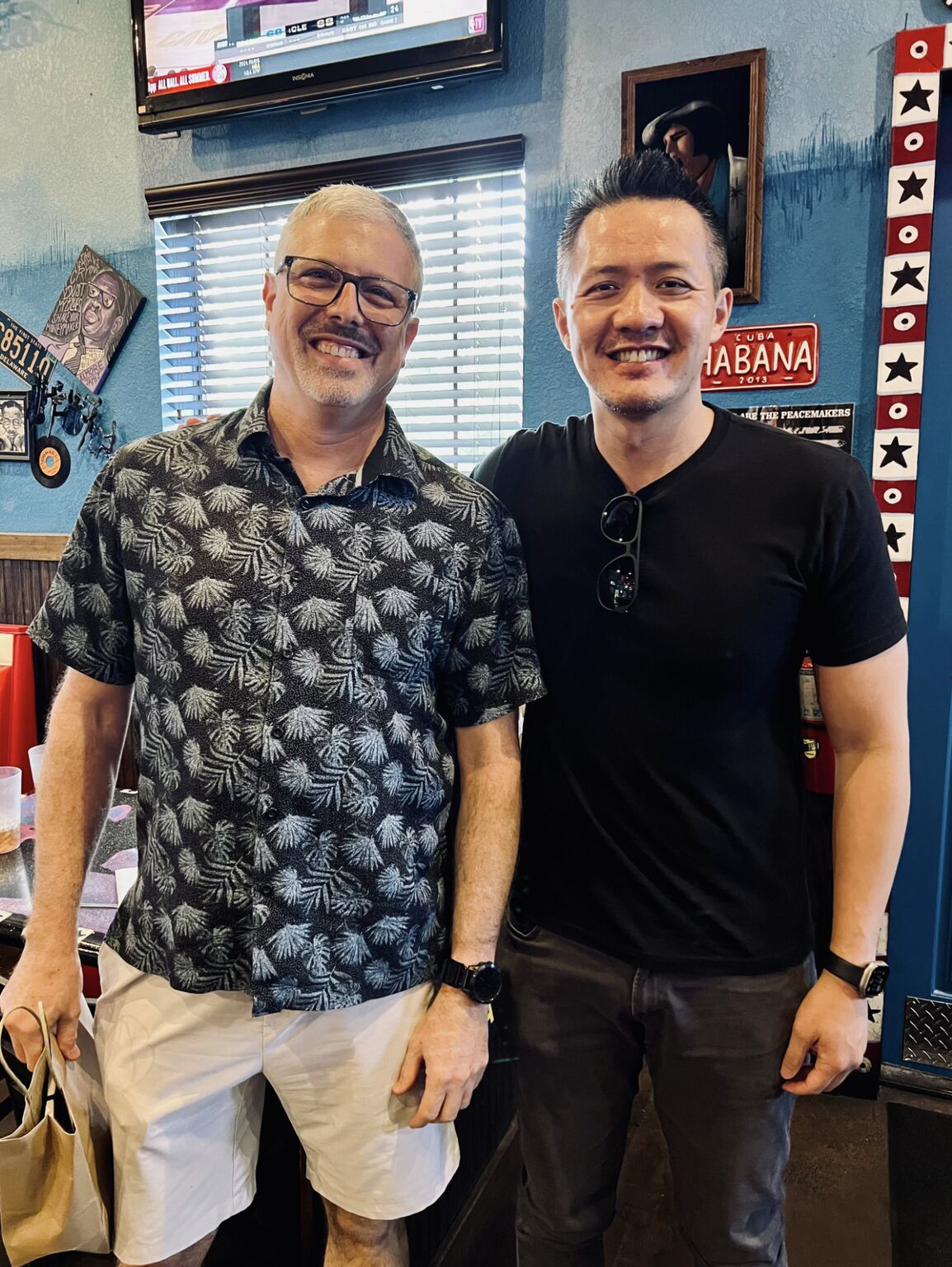
In 2024, Huie shared a visit with Fanatics’ Bob Pascucci, discussing the demands of running a consumer business with local infrastructure across states. The trip included Cuban food in Florida. Learning how customers build was, he said, a favorite part of his job. A photograph of the two together supplies a welcome change from the usual architecture diagram.
His account of a Twingate planning gathering in early 2025 had a similarly social texture: shared meals, engineering demonstrations, new ideas and a birthday celebration for early employee Amy Krikava. He supported working from anywhere while enjoying occasions when the team could be together. Even a company concerned with remote connections has reasons to gather around a table.
A longer guest list
Looking back on 2025, Huie reported that Twingate had reached record annual recurring revenue. He also returned to the difference between the company’s first sales proposition and its wider mission. Replacing VPNs had given customers a familiar place to begin. The access problem was continuing to expand.
AI added another set of demands. Huie’s current description of Twingate encompasses users, machines and AI systems interacting with an organization’s important assets. The company’s product announcements have extended into Kubernetes access and, in April 2026, privileged access for SSH. The cast of participants changes; decisions about permissions remain central.
For Huie, the lesson carried forward from Dropbox still has work to do. More elaborate systems create more opportunities to burden the person expected to operate them. His career has brought him repeatedly to that point of contact between a technical possibility and somebody’s working day. The next access request will arrive soon enough. He wants the route through it to make sense.