Before the cloud, there was a steel mill. Early in his insurance career, Tom Troy went onto the floor of Portland rolling mills with loss-control engineers, examining the businesses he would help insure. At Kemper, he had no computer on his desk. His underwriting recommendations were handwritten. The machinery belonged to the customer; the paperwork belonged to him.
That is a useful place to begin with someone whose recent job titles include chief transformation officer. Transformation can sound rather bloodless, as though a business were a diagram waiting for someone to rearrange the arrows. Troy started with an actual operation, an actual risk and a decision that had to be put on paper. The diagram came later.
Now he leads The Mutual Group in West Des Moines, Iowa. He became chief executive on January 5, 2026, after senior roles at Safeco, Liberty Mutual and Allstate, followed by the top job at CSAA Insurance Group and a transformation role at USAA. His new assignment brings the advantages of large organizations to insurers that want to remain independent.
There is an appealing complication here. Growing bigger is a familiar corporate ambition. Helping other businesses stay themselves while gaining access to bigger-company resources requires a more delicate touch. A local identity can be valuable. So can a modern underwriting system. Troy's job sits where those two desires meet.
A career with more than one kind of customer
Troy did not arrive at the University of Washington with an insurance career already mapped out. Born in Minnesota into a military family, he moved frequently as a child. He has described family photographs taken in different cities and on military bases. Insurance became his profession without having been his original plan.
His education took him through a bachelor's degree at Washington and an MBA at Seattle University. He also earned the Chartered Property Casualty Underwriter designation. The combination is fitting: business education alongside a qualification concerned with the workings of insurance itself. Someone must understand the accounts; someone must understand what the company has promised.
His subsequent responsibilities crossed personal and commercial insurance, operations and distribution. At Allstate, he led a $5 billion portfolio encompassing Allstate Business Insurance, Encompass, Esurance and Ivantage. Those names represented different routes to the customer, rather than a single brand with a single way of doing business.
That breadth helps explain his next move. CSAA appointed him to succeed Paula Downey in 2019, with an April 8 start date. Here was a company selling insurance under the AAA brand, where relationships with auto clubs mattered as much as the mechanics of a policy. He brought experience from several parts of the industry to a business with an established membership identity.
CSAA Insurance Group
USAA
The Mutual Group
The customer gets a vote
At CSAA, Troy described three routes to diversification: products, geography and distribution. The company's concentration in California made geographic balance a practical concern. Its relationship with AAA clubs remained central, but customers also wanted different ways to buy. The task was to broaden access while continuing to work with those partners.
There is a small but consequential distinction in that approach. A company can organize itself around the channel it prefers. A customer can choose the channel that suits Tuesday afternoon. Insurance has to accommodate both. A trusted relationship may bring someone through the door, but convenience determines how willingly they return.
During Troy's tenure, CSAA launched Mobilitas Insurance, a commercial insurer serving the mobility sector. It began working with Lyft in 11 states in 2020, then expanded that coverage to 18 states in 2021. The business was a concrete expression of diversification, taking an insurer known for personal coverage into commercial mobility.
A ride arranged through an app presents an insurer with a different set of relationships from a family car parked in a driveway. Product design has to follow the activity being insured. Mobilitas illustrated a broader question running through Troy's career: when customers and businesses change their habits, how quickly can an established carrier follow?
His answer has included technology, but with close attention to routine service. Adding a newly purchased vehicle to a policy, removing the old one, or making a claim are ordinary transactions. Their ordinariness is precisely the point. A useful improvement should survive contact with a customer who has no interest in the insurer's organizational chart.
The executive who wanted better listeners
Troy's public conversations about leadership often return to employees and culture. At CSAA, he helped introduce a ten-year strategy and culture framework. Accountability, inclusion, service, learning and speed were among its concerns. These are easy words to print. Their value depends on what people feel able to do after reading them.
One of his more personal ambitions was unusually modest in form. Asked in 2020 what legacy he wanted at CSAA, he hoped the organization would become better at listening, until listening felt habitual. He emphasized active attention, rather than simply remaining quiet while another person spoke. The difference matters in a room where the chief executive has the most powerful title.
“This feels like a time to focus more on listening.”
Tom Troy, 2020
Listening is difficult to display on a quarterly slide. It is also difficult to fake for long. People eventually discover whether speaking changes anything. Troy's stated ambition gives his talk about culture a practical test: can an employee's perspective make its way into a decision, or does it stop at the invitation to contribute?
When he announced his departure from CSAA in 2023, he recalled the welcome he received on arriving at the Walnut Creek office. His farewell dwelled on the culture employees had built and his confidence in its continued progress. He described joining something that already existed, then working with colleagues to improve it. That is a revealing way to tell the story of a CEO's tenure.
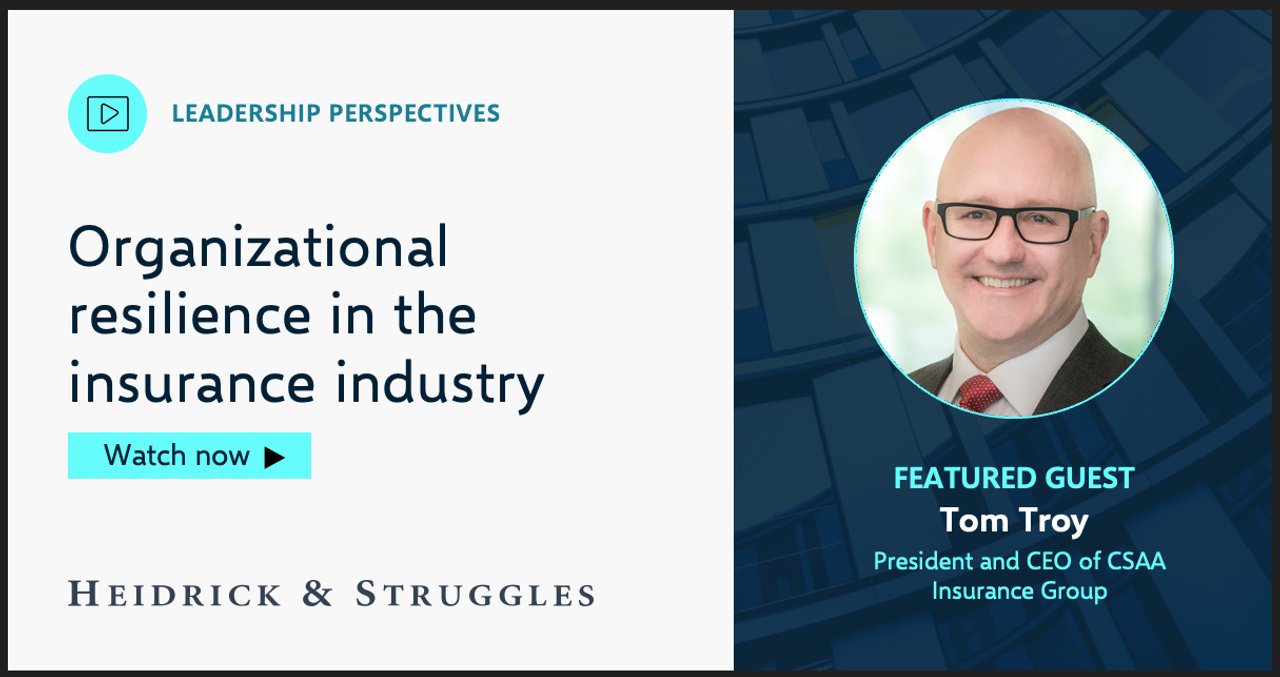
A mission with a family connection
USAA announced Troy's appointment as chief transformation officer in September 2023. He joined on September 25, reporting to chief executive Wayne Peacock. The newly created position covered transformation initiatives and the corporate development team. The brief widened his work from leading a carrier to helping reshape capabilities across a member-focused organization.
There was a personal connection as well. Troy spoke of his father's Army service and his pride in having the opportunity to support military families. The detail puts a human scale on a role whose name could otherwise suggest little beyond systems and processes. Membership represented people whose circumstances were familiar to his family.
His professional affiliations have also extended beyond his employers. He has served on the boards of the American Property Casualty Insurance Association, the Bay Area Council and the California Chamber of Commerce. Those connections place insurance leadership in a wider business conversation, where a carrier's choices affect communities as well as its own balance sheet.
Sharing the machinery, keeping the name
The Mutual Group predates Troy's arrival. Its launch was announced in December 2023, with Bain Capital Insurance investing $200 million into GuideOne Insurance. GuideOne became its inaugural member, while Tim Fleming was named the platform's first chief executive and Chuck Chamness its chairman. Troy inherited a business with a specific purpose and an existing operating foundation.
The company offers capital and shared capabilities across underwriting, claims, corporate services and technology. Its model is built around preserving a member insurer's ownership, brand and board control. That promise explains the appeal: access to resources can increase without requiring each member to disappear into a common identity.
In a 2026 conversation with the Des Moines Business Record, Troy described the pressure smaller mutuals face when competing with large companies able to invest in technology, people and sophisticated pricing. Collaboration offers a way to gain scale while continuing to serve local communities. His argument starts with the cost of competing, rather than a sentimental preference for smallness.
The company identifies expensive technology upgrades, access to capital, reinsurance costs and talent as challenges for prospective members. These are substantial operating questions. A board can value independence and still struggle with an implementation budget. The Mutual Group's proposition gives Troy a place to address both concerns in the same conversation.
Independence, in this setting, asks for some careful definitions. A shared service can be efficient; a member still needs confidence in the decisions that affect its policyholders. The model's attraction rests on how well common capabilities support individual institutions. Its practical test is whether the relationship helps those institutions do their work.
Back to the underwriting desk
On September 24, 2026, The Mutual Group announced a partnership with Nativeorange for an underwriting workbench built with Google Cloud and Gemini Enterprise. The planned workspace brings submission intake, triage, risk analysis, workflow and agent communications together. AI-assisted tools are intended to reduce administrative work and leave underwriters more time for judgment and relationships.
The announcement describes expected improvements, including quicker turnaround and clearer visibility into workloads. These remain aims of the initiative. The distinction matters because a partnership announcement begins the implementation story. An underwriter eventually has to open the system, understand the information and use it to make a defensible decision.
That brings Troy's career back to its beginning. The handwritten recommendation and the digital workbench belong to different eras, but both support a person deciding what risk an insurer should accept. More information and a faster workflow are useful when they make that decision better. The customer still has a business, a building or a vehicle to protect.
Troy's current assignment combines that familiar work with an organizational experiment: give independent mutuals more of the equipment available to larger competitors. The ambition leaves room for something insurance has always depended on, a relationship between an institution and the people it serves. A shared system can carry much of the machinery. The name on the promise still matters.