Retirement was the plan. Then the visitors arrived. Tom Burnside had left CAN Capital when Juan Tavares, Victor Pacheco and his former colleague Franck Fatras came to his wine cellar with a proposal: consumer lending. He later recalled that his wife welcomed the prospect of his returning to work. Domestic encouragement can be a remarkably efficient form of startup finance.
The conversation led to LendingPoint, which he co-founded in 2014. A cellar is an agreeable place to discuss an idea. Making the idea lend money, collect repayments and satisfy investors would require considerably more than agreeable surroundings. The question that brought him back was familiar: could a lender understand people whom existing systems had passed over?
An education in the cost of saying no
Burnside had spent years inside the machinery of financial services. At First Data, he worked on transactions and the information used to assess them. Later came CAN Capital, where he held senior operating roles in small-business finance. His career before LendingPoint supplied a practical apprenticeship in the distance between having data and knowing what it means. A computer can decline someone with impeccable speed. Whether it has reached a useful conclusion is a separate question.
In his 2019 reflections on becoming an entrepreneur, Burnside credited First Data’s executive development path with letting him work across business functions. He learned how the pieces fitted together, then learned to choose the people needed to make them work. His view of the founder’s job was distinctly operational: an idea required tools, colleagues and experience before it could become a business. Inspiration still had to find someone willing to handle the arrangements.
LendingPoint’s early team reflected that preference for experience. Several senior executives, including Fatras, had worked at CAN Capital. By 2017, about 30 of roughly 100 workers, a count that included outsourced positions, were former CAN employees. The connections extended through the organization. Burnside’s second act came with people who already knew something about one another’s first. In a new business, that kind of shared memory is a useful thing to bring through the door.

The borrower between the boxes
The consumer he wanted to understand occupied an awkward position in lending: a credit record that did not win an easy approval, attached to a person who might repay perfectly well. In his 2016 writing about fair-credit borrowers, Burnside described the shortcomings of treating familiar credit measures as simple switches. Above a threshold, welcome in. Below it, the conversation could end before much had been said.
He argued for looking at the interaction between conventional credit information and other evidence, including payment histories for utilities and mobile phones. The purpose of a loan mattered, too. These were questions about what information could reveal willingness and ability to repay. His argument put the work of interpretation at the center: collect meaningful evidence, understand its relationships, and decide what it says about this applicant. Sympathy alone would never balance the books.
A conceptual illustration of Burnside’s published approach to understanding borrowers. No approval promise or scoring formula is implied.
By the time Burnside and Tavares were discussing the business at Money20/20 in 2017, the emphasis remained on credit experience and selecting useful attributes from a much larger supply of data. That sounds less glamorous than a machine that knows everything. It is also a more interesting intellectual problem. A crowded file can still contain the wrong clues; a short one may simply require better questions.
Following the customer to the cash register
The first consumer loan went out in January 2015. The original online lending business gave Burnside a starting point, but customers also needed financing while making purchases. In January 2018, LendingPoint acquired LoanHero, a platform that connected merchants and their customers with financing at the point of sale. The deal brought merchant onboarding tools, reporting and an existing merchant base. Its financial terms were not disclosed.
The strategic attraction was straightforward. A lender could wait for someone to search for a personal loan, or become available where that person was already trying to buy something. Burnside described LoanHero’s merchant platform as complementing LendingPoint’s consumer portfolio. The move toward the cash register made distribution part of the story: better understanding a borrower had to be followed by being present when borrowing became relevant. Even a useful answer needs to arrive at the right address.
By February 2022, Burnside described three connected lines of business: direct consumer lending, point-of-sale financing and small-business e-commerce financing. His longer-term ambition was to serve customers repeatedly as their circumstances changed. The shared information behind those products mattered to him, as did the mobile experience. He was thinking about a continuing relationship, with more occasions to be useful and more opportunities to learn what a customer actually needed.
The arithmetic behind the ambition
The milestones accumulated. LendingPoint crossed $1 billion in funded loans in March 2019. That year it placed No. 17 on the Inc. 5000, and its inaugural securitization comprised $178 million in personal loans. In his year-end account, Burnside put those achievements beside the challenge of understanding people whose credit stories remained difficult to read. He also acknowledged an inconvenient truth: lenders would sometimes refuse someone who would have repaid them.
Financing the lender was its own occupation. In August 2019, a $250 million credit facility arranged by Guggenheim Securities came with an option to expand to $500 million. Those numbers described available financing arrangements, rather than revenue. For Burnside, building a consumer business meant attending to both sides of the transaction: people seeking loans and the capital providers prepared to fund them. The appealing customer experience depended on some rather unromantic plumbing.
- JAN 2015First loanConsumer lending begins
- MAR 2019$1 billionCumulative funded loans
- JAN 2021$125 millionWarburg Pincus equity investment
In January 2021, Warburg Pincus announced a $125 million preferred equity investment. LendingPoint had originated more than $2.5 billion from its first loan through December 2020, and the company said the new money would support financing products and its technology platform. The announcement described a business extending into e-commerce and partner channels. The cellar conversation had acquired a capital structure.
In April 2022, Burnside reported $330 million in net revenue for 2021 and more than 300,000 active borrowers. These are figures from that moment in his tenure. Later that year, Goldman Sachs recognized him at its Builders and Innovators Summit. It was a public marker of the entrepreneurial chapter, though the ordinary work behind such occasions remained less photogenic: pricing risk, funding loans and keeping the operation moving.
A bookshelf with one extra recommendation
For a glimpse of Burnside away from the funding announcements, consider his 2017 list of business books. It introduced five recommendations and proceeded to offer six. Readers received a small bonus before opening a cover. The selection included Malcolm Gladwell’s Blink, Jim Collins and Jerry Porras’s Built to Last, and Stephen Covey’s The 7 Habits of Highly Effective People.
His explanations were practical: identify the important information, understand enduring businesses, stay proactive and organize the day. A recommendation of Joe Girard and Stanley H. Brown’s How to Sell Anything to Anybody came with a recollection of his own earlier work in sales. The list makes a useful companion to the executive biography. Alongside credit models sat the familiar managerial problems of attention, persuasion and getting something finished before another meeting began.
Another glimpse came in 2019, when he shared photographs of an early employee’s retirement celebration. Burnside said the founders had wanted to build a business people would wish to retire from. It is an ambition measured on a different calendar from a funding round. The pictures show colleagues, balloons, food and an ordinary office room. A company’s long-term intentions can occasionally be discussed quite adequately beside a cake.
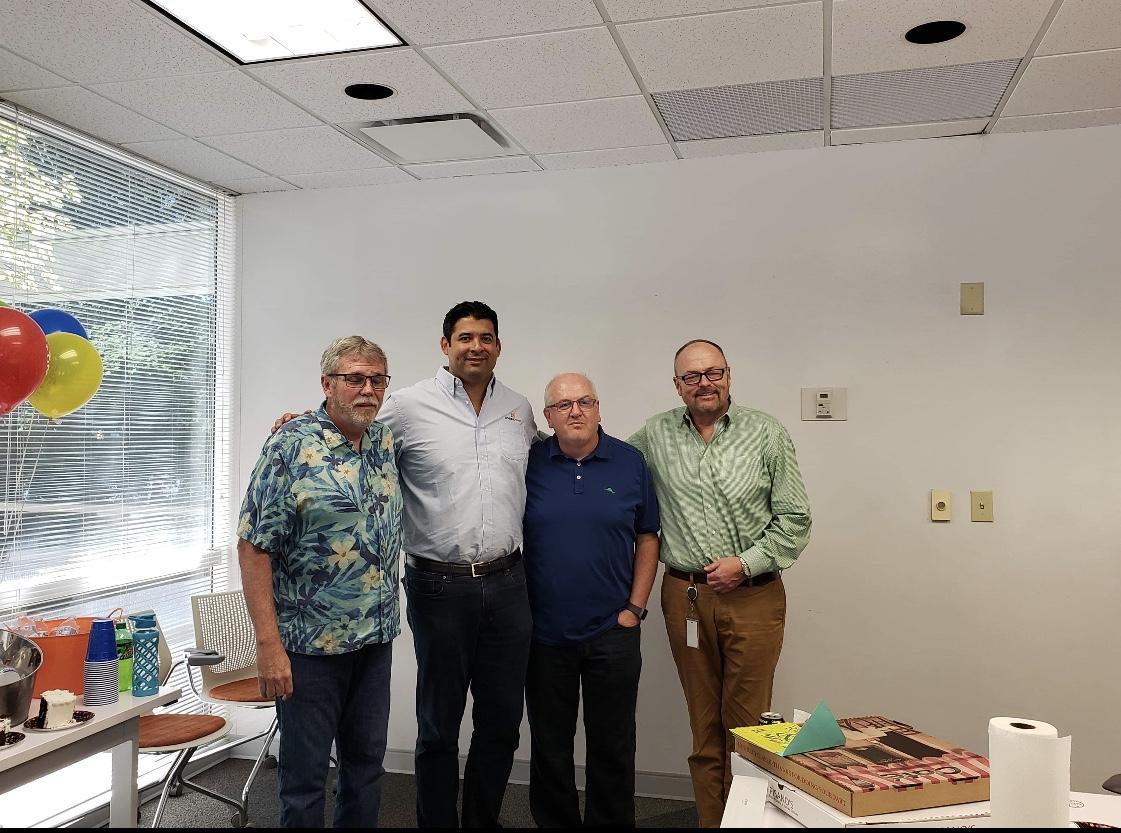
“A company our employees would want to retire from.”
Tom Burnside, describing the founders’ ambition in 2019
The chair changes; the question travels
Burnside left LendingPoint’s CEO role in December 2023. Mark Lorimer served as interim CEO before Shawn Stone’s appointment in August 2024. The chronology matters: the founder’s operating chapter ended, while the company carried on through subsequent leadership changes. A business biography should leave room for that distinction. Founding a company does not make every later chapter a personal possession.
Today, Cambridge Wilkinson lists Burnside as a senior advisor, drawing on his background in financial services and specialty finance. The role places that accumulated experience in a different setting. His career has moved from transaction processing to small-business credit, then consumer finance and now advice. The titles change more readily than the recurring problem: how to make sense of incomplete information before committing capital.
That is what holds this story together. A would-be retiree entertained a proposal in his cellar, returned to work with familiar colleagues, and spent the next chapter trying to give more borrowers a considered hearing. The most durable part of the portrait is the habit of looking again. In credit, as in conversation, a quick answer can be satisfying. A well-considered one takes a little more trouble.
Keep the conversation going
- LendingPointCompany website
- Tom Burnside on LinkedInPublic profile and writing
- Watch: Tom Burnside with Nathan LatkaApril 2022 video interview · YouTube
- Listen: the wine-cellar originJune 2018 interview with Peter Renton
- Listen: the expanding lending businessFebruary 2022 interview with Peter Renton
- Browse Burnside’s business bookshelfDecember 2017 reading list
- Read about the CEO transitionAugust 2024 coverage
- Cambridge Wilkinson professionalsCurrent senior advisor listing