In 2017, Danielle Simpson had a problem that looked too ordinary to become a business. After teaching English online to Chinese children, she spent another two hours writing feedback for their parents. Much of it repeated things she had written before. The teaching earned money. The paperwork consumed the evening.
- A founder education business built from operating experience.
- Free essays and interviews; paid books, a course, and consulting.
- The recurring advice: find the audience, study its problem, protect your time.
Her partner, software engineer Arvid Kahl, built a weekend prototype to help. FeedbackPanda grew from that small intervention into a subscription business, then sold to SureSwift Capital in 2019. The Bootstrapped Founder is the media and education company Kahl built afterward. Its raw material is what happened between the prototype and the exit, including the parts a victory announcement would tend to leave out.
Two hours nobody paid for
The detail to notice is the sequence. Simpson was already doing the work. The problem was visible, repetitive, and close enough for Kahl to understand. They could test a tool against an actual working day. There was no need to invent a customer and then persuade that imaginary person to become real.
That sequence now runs through Kahl’s teaching: audience, problem, solution, product. It gives the business a particular place in founder education. The reader is often a developer or independent maker tempted to start with the thing they can build. Kahl asks them to linger with the person who might eventually buy it.
The original business found customers through the communities where teachers exchanged information. A useful intervention could travel by word of mouth because people shared a job and its frustrations. The lesson is narrower, and more useful, than “post more.” Find the conversation where the problem is already understood.

The founder became the bottleneck
Kahl’s account of FeedbackPanda contains an uncomfortable reversal. More customers made the business more successful and its technical responsibilities more frightening. He describes severe burnout a little over eighteen months into the company’s life. His reluctance to hire helped keep the pressure concentrated on himself.
Simpson encouraged him to get help. He resisted. In retrospect, he connects that resistance to founder pride and neglect of his own mental health. The sale relieved a burden he had struggled to manage. This gives The Bootstrapped Founder’s talk of sustainable businesses a concrete meaning: the person running the company has to remain able to run it.
“Hiring someone to help is not an entrepreneurial failure.”
Arvid Kahl, on founder stress
Readers can take something practical from that admission. A recurring feeling of overload deserves a change in operations. It might mean help, fewer responsibilities, or a better system. Treating every emergency as a test of personal toughness leaves the business dependent on one person’s capacity to keep absorbing trouble.
A small publishing business with a long memory
The Bootstrapped Founder packages that experience at several levels. The essays, newsletter, and podcast offer an accessible entry. Audio and YouTube let people hear the material or watch interviews. Books organize it into something readers can revisit when a particular business decision arrives.
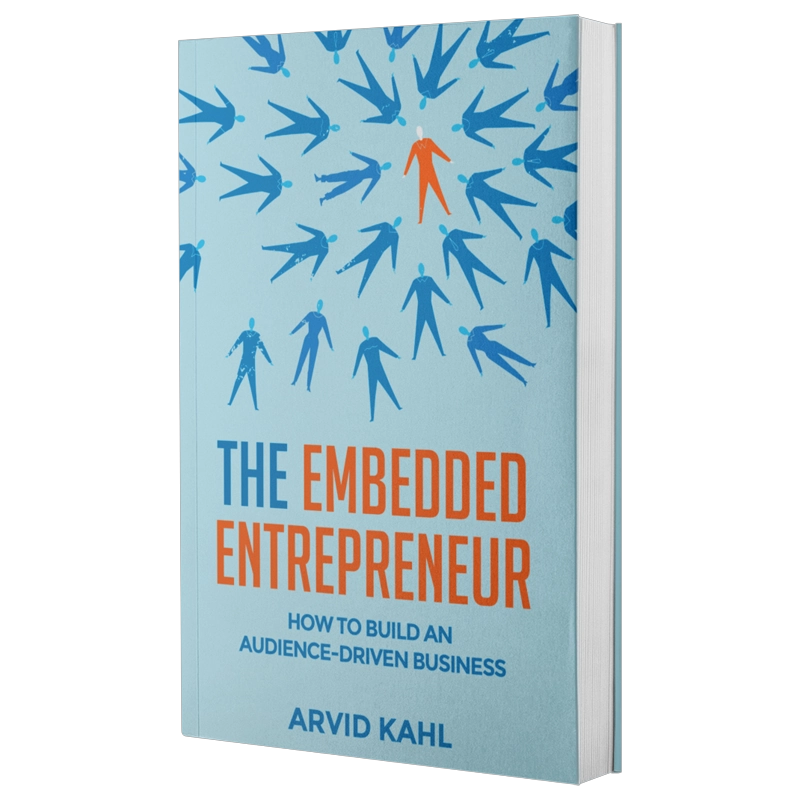
Zero to Sold covers preparation, survival, stability, and growth. The Embedded Entrepreneur concentrates on understanding an audience; its optional Notion toolkit supplies research sheets and checklists. Find your Following applies relationship building to Twitter, with free Essentials lessons and a paid, longer course. The catalogue moves from broad questions to specific work.
There are clear price steps. The official pages list a $20 Zero to Sold ebook, a $50 full course, and a $500 two-hour Clarity Call, plus applicable taxes. Consulting sells focused access to Kahl’s judgment. Sponsorships sell access to the audience. Disclosed affiliate commissions add another income stream.
The publishing economics are unusually tangible. Kahl reports that Zero to Sold, released in June 2020, sold 1,571 copies in its first month, bringing in $12,871 against roughly $4,000 in costs. Editing accounted for about $3,000. These are historical figures for one book. They show that a digital product still requires investment in making it worth reading.
The audience comes before the app
The business belongs alongside independent-founder resources such as Indie Hackers, MicroConf, and Startups for the Rest of Us. Kahl’s particular draw is the continuity between an operator’s experience, an author’s explanations, and an audience-building practice. A reader can sample an idea freely, then buy a more structured way to work through it.
A sensible first exercise is to choose a group whose work you can observe. Record repeated complaints and the workarounds people already use. Ask what a solution must fit around. Only then decide whether the answer is software, a service, or something simpler. A spreadsheet may reveal more than another weekend of coding.
There are conditions attached. You need access to the people you want to serve, a problem important enough to pay for, and enough room to keep learning. An audience of fellow founders may enjoy your updates without buying your product. A business needing substantial capital before its first sale faces a different financing problem. Kahl’s experience offers questions to test, rather than a promised outcome.
Even the advice has to change
In April 2026, Kahl reconsidered one of his own recurring subjects: building in public. Sharing verified revenue had helped draw attention to FeedbackPanda. He now argues that AI coding tools make detailed disclosures easier to turn into competing software. His response is more selective sharing: operational lessons without handing over the architecture or financial blueprint.
That is the interesting test for a business built on advice. Can the advice move when its conditions change? Here, the founder gives readers a revision alongside the original experience. The Bootstrapped Founder remains useful when its audience does the same work: examine the circumstances, keep what applies, and change what no longer earns its place.
Read, listen, go build
Explore the essays, newsletter, and podcast. Browse Zero to Sold, The Embedded Entrepreneur, or Find your Following.
Watch the YouTube channel or Kahl’s FeedbackPanda interview. Follow his work on X, LinkedIn, Instagram, and GitHub.