A recurring piece of management technology in Ted LeNeave's public story is a triangle pointing the wrong way. At Accura HealthCare, the people living in its communities and the employees working directly with them occupy the top of the organizational chart. The farther down you travel, the more your job becomes helping somebody above you. Executives land near the bottom. The central office is not called a headquarters at all. It is the Resource Center, a phrase with the crisp practicality of a supply cupboard.
The arrangement is easy to sketch and difficult to fake. It asks leaders to judge themselves by usefulness rather than altitude. It also gives every employee a wonderfully inconvenient question to ask: if the chart says support flows upward, why does this decision feel as if it is falling down on us?
For LeNeave, founder and chief executive of the West Des Moines company, the diagram is more than internal communications. It is the founding argument. Accura began in 2016 with nine skilled-nursing facilities in Iowa. By 2025, the organization said it served more than 50 communities across Iowa, Minnesota, South Dakota and Nebraska. As the footprint expanded, one small inverted triangle acquired a large job. It had to keep a multi-state operator recognizable to itself.
The upside-down organization
The lower the title sits, the more responsibility it carries to be a resource.
Before the founder title
LeNeave arrived at ownership by taking the long route through the machinery of the field. He studied healthcare management at Norfolk State University from 1993 to 1996, then began as a licensed nursing home administrator in Virginia. The job put him close to the daily arithmetic of post-acute care: schedules, standards, budgets, families, buildings and the endless small decisions by which an institution becomes humane or merely functional.
In 2002, Virginia's governor appointed him to the state licensing board for nursing home administrators. Public meeting records from 2005 show him chairing a task force on licensing assisted-living administrators. He would also chair the Virginia Health Care Association. These were not glamorous detours. They were a second education in how rules are made, how operators respond to them and how a roomful of competing interests eventually has to produce a motion somebody can second.
Recognition arrived early. After his Virginia association chairmanship, LeNeave received a Lifetime Achievement Award at 39. He later received the American Health Care Association's Joe Warner Advocacy Award. The chronology is faintly comic: a lifetime achievement before 40, followed by another couple of decades of work.
“Launching Accura almost 10 years ago on an upside down approach in structure and service has made all the difference.”Ted LeNeave
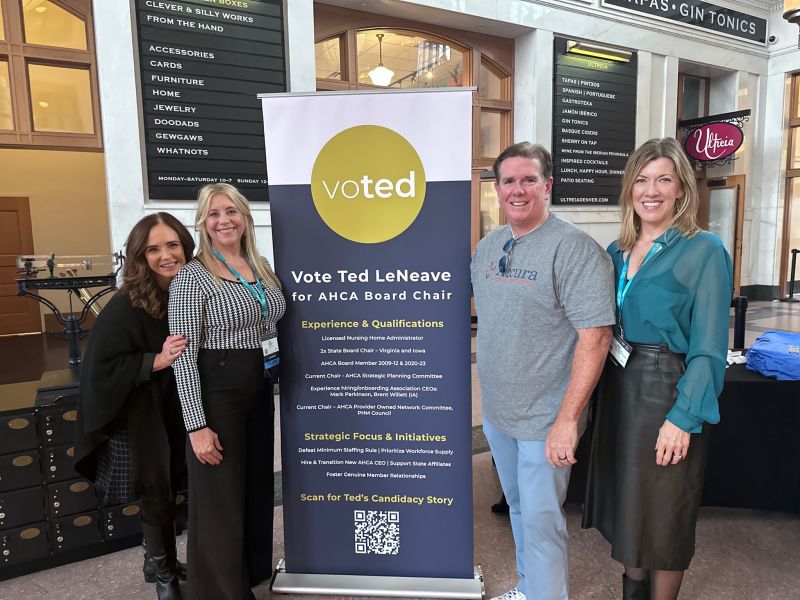
His association career kept growing alongside his operating one. LeNeave spent more than six years on the American Health Care Association's Board of Governors, including a 2021-2022 term representing regional multi-facility operators. In Iowa, he chaired the Iowa Health Care Association and its executive committee. By 2023, an industry reception was promoting his candidacy for AHCA board chair, with a sign that turned a conference photograph into a walking résumé.
The Iowa bet
The company had existed in LeNeave's imagination before it existed on paper. His public biography describes owning a healthcare company as a dream. He moved to Iowa with his wife and three sons to pursue it. There is a revealing lack of founder mythology in that move. No garage, no napkin, no tale of a sudden flash. Just a family relocation and a long apprenticeship finally asking to become an enterprise.
He chose the name Accura from a Latin-rooted word the company defines as “to care for.” The brand's downward-pointing triangle represented people helping people and echoed the inverted chart. Name, logo and organizational structure were made to repeat one another. The benefit of such repetition is clarity. The hazard is that everybody can see when behavior and symbol part company.
Expansion came quickly. In 2019, Accura added 13 skilled-nursing facilities and eight assisted-living communities formerly operated by Tealwood Senior Living. The transaction took the company beyond Iowa into Minnesota, South Dakota and Nebraska. LeNeave's language at the time was about bringing families together, a phrase that treated acquisition as cultural adoption rather than a collection of addresses.
Later additions included Park Place Estates in Le Mars, Iowa, in 2024. With every new community, Accura's original promise became harder to inspect from West Des Moines. A founder can draw the triangle once. Hundreds of managers have to redraw it in daily decisions without the marker.
A decade measured in communities
When the diagram met the balance sheet
Culture makes a handsome poster until cash becomes scarce. In 2023, Accura was operating 34 nursing homes and wrestling with debt while waiting for better state reimbursement. LeNeave agonized over whether the company could hold on. Cost cutting had limits; remove enough support from a support organization and the chart becomes decorative.
His answer was a wager on selective expansion. The right growth, he argued, could generate the cash needed to address the obligations. “We were going to grow our way out of this,” he said. It is the kind of sentence that can precede either a turnaround or a cautionary tale. Accura's 2025 results brought relief, and by early 2026 industry reporting described more than 50 facilities with an ambition to acquire 20 more by 2027.
That rebound does not remove every unsettled bill. In August 2026, Accura faced a second civil lawsuit alleging unpaid professional fees, including a complaint connected to restructuring work. The claims remain allegations, not findings. They belong in the story because growth does not erase its financing, and a tenth anniversary does not make a balance sheet nostalgic.
The useful question is not whether growth is good. It is what growth is being asked to do. For LeNeave, expansion became both operating strategy and financial repair. That adds urgency to his cultural promise. A company trying to grow out of pressure can easily push pressure downward. Accura's chart insists it should flow support upward instead.
“We will never sacrifice that approach within our culture.”Ted LeNeave, on Accura's upside-down structureChapter four
The founder as a network
LeNeave's career also offers a less fashionable founder lesson: committees compound. His years with state associations, licensing bodies and a national board created a web of operators, regulators and advocates before Accura needed one. The photographs are full of lanyards. The work behind them is patient and procedural.
This matters in an industry where a state reimbursement decision can reshape a budget and a licensing change can alter a hiring plan. LeNeave learned to operate not only inside facilities but between institutions. Brent Willett, then president and CEO of the Iowa association, credited him with helping the field navigate unusually difficult conditions and secure tools for the future. Praise from a trade association is expected; the long record of service behind it is more concrete.
Accura's 2025 Bronze Commitment to Quality awards for its Knoxville and Newton communities offered another glimpse of his preferred public posture. LeNeave directed the credit toward the teams. It fits the triangle. The chief executive may speak into the microphone, but the work he describes belongs higher on the chart.
A promise with gravity
In January 2026, Accura turned ten. The company marked the anniversary by returning to the words it had been using all along: purpose, relationships, kindness, responsibility and privilege. Corporate anniversaries tend to polish the past until it shines evenly. Accura's decade was bumpier and more instructive than that. It contained rapid expansion, association honors, financial strain, a rebound, quality awards and unresolved litigation.
Through it all, LeNeave kept returning to the upside-down chart. That persistence offers a personal detail in a public life told mainly through titles and institutions. He has not published a memoir or cultivated the usual stream of founder confessionals. His philosophy is visible instead in repeated nouns: family, partner, resource, care.
The next test is already visible. More communities mean more distance between LeNeave and the moment an employee decides whether a resident's request is a nuisance or the point of the job. More acquisitions mean more inherited habits. More layers mean more chances for the Resource Center to behave like the headquarters it declines to call itself.
A diagram cannot solve those problems. It can keep them from hiding. Accura's triangle gives people a direction in which to point the awkward question: who is serving whom? For a founder who spent years learning the field from facility floors, board meetings and regulatory tables, that question has lasted longer than any individual strategy.
LeNeave's story is therefore less about turning an org chart upside down than about resisting gravity after the novelty wears off. Ten years in, the triangle is no longer a clever launch device. It is a promise attached to every new building, every new balance-sheet decision and every leader whose title places them closer to the bottom.