Ted Cannis likes to run the game. Away from work, he has been a Dungeons & Dragons dungeon master, arranging scenarios and imagining how the pieces might interact. His eventual assignment at Ford involved rather more vans. The appeal, he suggested at a Sonoma County gathering, was similar: get the parts into the same world.
He had arrived there by an unlikely route. There was a philosophy degree, then business school, then a finance job at Ford. There were overseas postings, investors to explain things to, and electric vehicles to help bring into existence. In June 2021 came the founding CEO role at Ford Pro. A company famous for making vehicles was asking him to assemble a business around what happened after customers drove them away.
A philosophy graduate takes the scenic route
Cannis studied philosophy at the University of Michigan and earned his MBA at Indiana University’s Kelley School of Business. He joined Ford in finance in 1989. Philosophy and accounting make an agreeable pair: one asks what things mean, the other insists that they add up. His later career would require both a broad view and an appreciation for the bill.
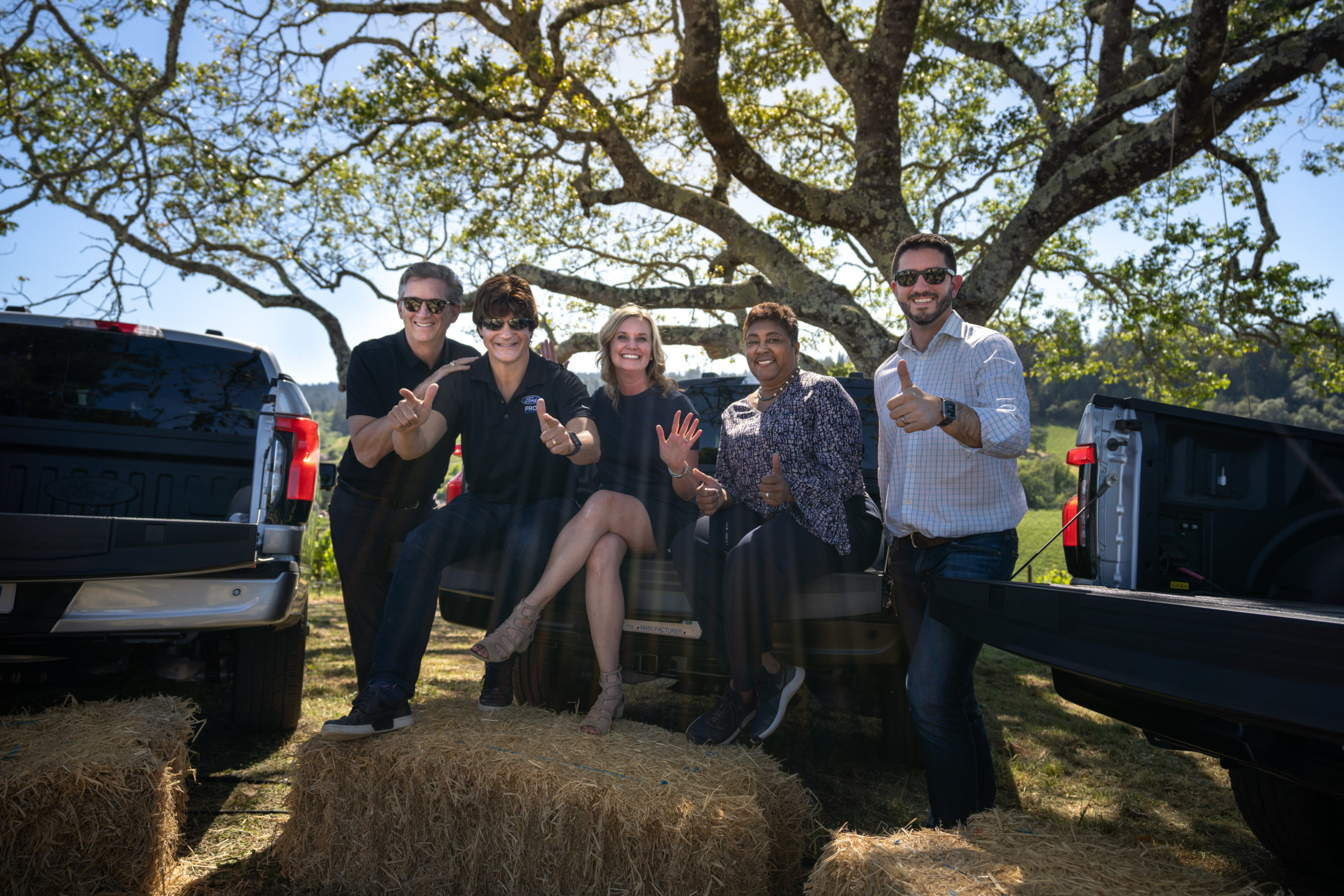
By a January 2023 investor conference, Cannis had developed a clothing policy to go with his commercial responsibilities. He told the audience he had decided never to wear a suit again. “I’m swag only,” he said. He also remembered being able to distinguish investors from company representatives by the investors’ vests, a distinction that had become less reliable. It was a small performance before a financial discussion, but a revealing choice of opening. He could talk to investors without dressing the conversation in ceremony. The Ford Pro clothing in his corporate photograph makes the preference visible.
His international assignments took him to Venezuela, Argentina, Turkey and Russia. He led Ford Argentina and Chile, worked at the Ford Otosan joint venture in Turkey, and became CEO of Ford Sollers in Russia. The neatness of those job titles conceals the variety of the work. A multinational business must accommodate local conditions even when the badge on the vehicle stays the same.
Cannis’s own retrospective placed him in Argentina during the 2002 crisis. Years later, he publicly thanked Rahmi Koç for what he had learned at Ford Otosan, recalling high standards and care for people. His career had acquired a cast of teachers as well as a list of offices. The education continued long after the MBA.
A new room inside an old company
In 2017, Ford put Cannis, then its investor-relations executive, at the head of Team Edison. The group was charged with developing the company’s battery-electric business. Its remit crossed strategy, planning, technology, manufacturing and marketing. Even before a driver could press an accelerator, a collection of departments had to agree on where they were going.
Darren Palmer, an early recruit, later described how Cannis persuaded him to join. The team moved outside Ford’s main buildings, recruited internally and externally, and developed its own working culture. Palmer remembered roughly 70 to 80 handpicked people. Deciding what to build was one challenge; making it happen inside an established company brought another.
The Mustang Mach-E emerged from that effort. Cannis led Team Edison from 2017 to 2020, during a period that also involved work on the F-150 Lightning and E-Transit. These were team undertakings. His place in the story was to help organize a business around an unfamiliar technology, with people who knew different parts of the problem.
First, explain the plug
Some of his work was less about the machinery than the questions people brought to it. In a 2019 essay about electric-vehicle education, Cannis described queries from family, friends and colleagues about performance, winter driving, gasoline and whether an EV could do a job. A technology can be ready for demonstration while its intended customer is still trying to understand the proposition.
His tone was conversational. He acknowledged that earlier industry efforts had concentrated on regulation, and wrote about the gap between capability and public belief. He also slipped in a practical reason to visit a gas station after switching to electricity: beef jerky. The snack survived the transition rather better than the fuel pump.
That habit of explanation matters in his career. Investor relations means translating a business for people allocating capital. An electric-vehicle program means explaining a change in familiar behavior. Ford Pro would bring both tasks into a world where a customer’s interest in the future came attached to obligations in the morning.
Five pieces, one working day
Ford announced Ford Pro in May 2021, with Cannis to lead it as CEO. He had most recently run the North American commercial business. Ford already had commercial customers, vehicles, dealers and service relationships. The new organization brought a particular customer group into focus, with its own business leadership and a wider set of things to sell and support.
The proposition grouped vehicles, software, charging, service and financing. Those categories look tidy on a slide. In practice, they meet at inconvenient moments. A charging installation affects when a van is available. Maintenance affects which jobs it can reach. Financing affects whether the owner can buy it in the first place.
with fewer interruptions
- 01 Vehicles
- 02 Software
- 03 Charging
- 04 Service
- 05 Financing
Five connected responsibilities around the same customer.
By October 2021, Cannis was describing the opportunity created by Ford’s commercial presence in Europe and North America. The existing relationships gave the new services somewhere to begin. The work was to make a large organization feel coherent from the buyer’s side of the counter.
The barber chair in the back
A particularly good illustration arrived with an electric fireplace. In 2023, Cannis shared New Jersey entrepreneur Will Gee’s Chess Moves Mobile barbershop, built into a Ford Transit. Along with the barber chair, the conversion featured an old Ford sign. Cannis praised the business and highlighted Gee’s efforts to help young adults learn barber skills.
The example gives a commercial-vehicle strategy a human scale. A van can be a shop, a workshop, a delivery route, a place where somebody’s working life takes shape. The customer has already supplied the imagination. A vehicle company’s contribution has to hold up under use. It is easy to picture the significance of uptime when an appointment book depends on the vehicle turning up.
When the idea acquired a balance sheet
The business grew. Ford Pro recorded $58.1 billion in revenue and $7.2 billion in EBIT in 2023. In 2024, revenue reached $66.9 billion and EBIT $9 billion. Cannis retired at the end of September that year, so the full-year figures span his tenure and the months that followed it. These are segment results, produced by a business and its people.
USD billions. Full-year 2024 includes the period after Cannis’s September retirement. Values rounded to one decimal.
By the second quarter of 2024, Ford reported 600,000 paid Ford Pro subscriptions. Software introduced a continuing commercial relationship alongside vehicle sales. It also imposed a continuing test: the information and services needed to remain useful after the initial purchase. A subscription renews the question of value as well as the payment.
The customer has a calendar, too
For all his electric-vehicle experience, Cannis’s commercial approach allowed for a gradual transition. In 2024 he described customers replacing only about 10 to 15 percent of their fleets annually. Charging infrastructure took time. Trials took time. One prospective buyer who had discussed thousands of electric vans began with a single vehicle, then increased purchases as the operation learned.
He also described a vehicle-security feature prompted by a Colorado construction customer. The feature could restrict operation during specified hours. It was the kind of request that gave the wider software proposition something precise to do. The customer’s problem came with a place, a schedule and a reason to care.
Speed and patience had to coexist. In later reflections on leadership, Cannis acknowledged that he pushed hard and did not always listen well. He spoke about the tendency of organizations to revert to established behavior after a new initiative. Enthusiasm at the announcement was only the opening condition; ownership had to continue when the plan required adjustment.
“You have to own the pivot. No matter what.”
Ted Cannis / The Automotive Leaders Podcast
Thirty-five years, in snapshots
His retirement photo selection was agreeably untidy: a selfie in Russia, interviewing Coppola, a visit to the New York Stock Exchange, Argentina, the view from Koç headquarters in Istanbul, the 2019 Mustang Mach-E launch in Los Angeles. A corporate career became a series of scenes, with people and places returning to the foreground.
Ford announced his departure on September 12, 2024, effective at month’s end. He had also led the Ford Customer Service Division since 2023. The responsibilities had expanded from commercial vehicles to the parts, service and customization that kept a wider population of customers connected to the company.
Another table to bring together
After Ford, Cannis kept discussing the operational questions. A July 2025 interview covered integrated fleet data, electrification and the practical use of AI. By April 2026 he was chair of the World EV Forum’s Leadership Council, joining an effort spanning vehicles, energy, infrastructure, software and policy. His announcement emphasized solving coordination problems. The ambition was expressed in terms of useful work between sectors.
He also advises PitPro Automation. His career now includes smaller organizations alongside the experience of a multinational.
The through line is a taste for arranging the pieces so that other people can act. Finance supplied one view, overseas operations another, electric vehicles another still. Ford Pro gave him a place to put those perspectives together. Somewhere beyond the meeting, a barber has a customer waiting and a van that needs to start. That remains a fairly exacting test of whether the plan works.